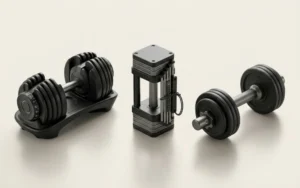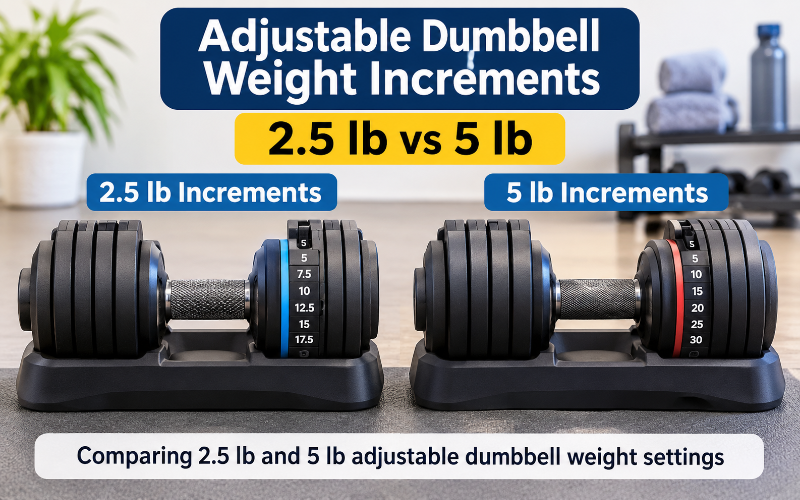
For most home gyms, 2.5 lb adjustable dumbbell increments offer more flexibility than 5 lb increments. Smaller increases give you more weight options, especially for exercises that use lighter loads, such as lateral raises and biceps curls.
However, 5 lb increments can work well when the next available weight is suitable for your current strength and exercises. The best choice depends on the weights you use, not just the number printed on the dumbbell.
What Are Adjustable Dumbbell Weight Increments?
A weight increment is the difference between two consecutive weight settings on an adjustable dumbbell.
For example, a dumbbell with 2.5 lb increments might offer:
| Setting | Weight per dumbbell |
|---|---|
| 1 | 5 lb |
| 2 | 7.5 lb |
| 3 | 10 lb |
| 4 | 12.5 lb |
| 5 | 15 lb |
| 6 | 17.5 lb |
A model with 5 lb increments might offer:
| Setting | Weight per dumbbell |
|---|---|
| 1 | 5 lb |
| 2 | 10 lb |
| 3 | 15 lb |
| 4 | 20 lb |
| 5 | 25 lb |
| 6 | 30 lb |
These are examples, not specifications for particular products.
The 2.5 lb system provides more settings between its minimum and maximum weights. The 5 lb system moves through the range in larger steps.
When comparing models, look at two separate specifications:
- Weight range: The minimum and maximum weight available on each dumbbell.
- Weight increment: The difference between consecutive weight settings.
A dumbbell can have a high maximum weight but still offer large jumps between settings. Check both before buying.
Is 2.5 lb or 5 lb Better for Adjustable Dumbbells?
The main difference is how much resistance you add with each adjustment.
Why choose 2.5 lb increments?
Smaller increments give you more options when selecting a working weight.
Suppose you’re using 10 lb dumbbells. A 2.5 lb system lets you move to 12.5 lb before reaching 15 lb. A 5 lb system skips that intermediate setting.
Smaller increments can be useful for:
- Lateral raises and other shoulder exercises.
- Biceps curls and triceps extensions.
- Exercises where a 5 lb increase feels too large.
- Training plans that use gradual increases in resistance.
The main benefit is flexibility. You have more choices when the next larger setting is not suitable.
However, don’t choose a dumbbell based on increments alone. Maximum capacity, adjustment mechanism, build quality and storage space also matter.
When are 5 lb increments enough?
Five-pound increments can be practical when the increase is manageable compared with your current working weight.
For example, moving from 40 lb to 45 lb is a 12.5% increase. Moving from 10 lb to 15 lb is a 50% increase.
The same 5 lb adjustment creates a very different change depending on your starting weight.
Five-pound increments may suit you if:
- Your usual working weights accommodate the available jumps.
- You prefer fewer weight settings.
- The dumbbell’s weight range meets your training needs.
The main limitation is at lighter weights, where a 5 lb increase can represent a large percentage change.
How do 2.5 lb and 5 lb increments compare?
| Feature | 2.5 lb increments | 5 lb increments |
|---|---|---|
| Size of each step | Smaller | Larger |
| Intermediate settings | More | Fewer |
| Lighter working weights | More flexibility | May leave a large gap |
| Heavier working weights | More adjustment options | Can be practical |
| Main advantage | More precise selection | Simpler, wider steps |
| Main limitation | May cost more or limit model choices | Fewer options between settings |
Buying recommendation: If one pair of dumbbells will cover most of your home workouts, prioritize 2.5 lb increments when possible. They provide more options for lighter exercises without limiting your ability to select heavier settings.
Don’t sacrifice the weight range or overall quality of a suitable dumbbell just to get smaller increments.
Do Adjustable Dumbbells Have Different Increments at Different Weights?
Yes. Some models change their adjustment intervals as you move through the weight range.
The BowFlex SelectTech 552 is a useful example. According to BowFlex, it adjusts from 5 to 52.5 lb per dumbbell.
Its settings use 2.5 lb increments between 5 and 25 lb, then 5 lb increments from 25 to 52.5 lb.
This means you should not assume that every adjustment is 2.5 lb just because the product offers 2.5 lb increments at its lighter settings.
See the official BowFlex SelectTech specifications.
The PowerBlock Elite EXP uses removable micro weights to provide additional 2.5 lb adjustment options. Its weight chart shows how these weights create intermediate settings within the larger weight range.
See the official PowerBlock Elite EXP weight chart.
What to learn from these examples: Always check the complete manufacturer weight chart. The smallest advertised increment may not apply to every setting.
Why Do Weight Increments Matter for Different Exercises?
The right weight increase depends partly on the exercise and your current working weight.
A 5 lb jump may be manageable for one movement but too large for another.
Are smaller increments useful for lighter exercises?
Exercises such as lateral raises, biceps curls, triceps extensions and rear-delt flyes often use lighter weights than larger compound movements.
Imagine using 5 lb dumbbells for lateral raises:
- Moving to 7.5 lb is a 50% increase per dumbbell.
- Moving to 10 lb is a 100% increase per dumbbell.
That is a large change in the selected load. An intermediate setting gives you another option.
This does not mean everyone needs 2.5 lb increments for every isolation exercise. It means smaller steps can be useful when the next available increase is large compared with your current weight.
Are 5 lb increments suitable for compound exercises?
Compound exercises involve multiple joints and muscle groups. Examples include dumbbell presses, one-arm rows, goblet squats and Romanian deadlifts.
Suppose you’re using 25 lb dumbbells for a pressing movement:
- Moving to 27.5 lb is a 10% increase per dumbbell.
- Moving to 30 lb is a 20% increase per dumbbell.
Either increase might be suitable, depending on your performance and training plan.
The exercise category alone does not determine the right increment. Your current working weight matters too.
How Do You Calculate a Dumbbell Weight Increase?
You can compare two weight settings by calculating the percentage increase.
Use this formula:
Percentage increase = (New weight − Current weight) ÷ Current weight × 100
| Current Weight | New Weight | Increase | Percentage Increase |
|---|---|---|---|
| 10 lb | 12.5 lb | 2.5 lb | 25% |
| 10 lb | 15 lb | 5 lb | 50% |
| 25 lb | 27.5 lb | 2.5 lb | 10% |
| 25 lb | 30 lb | 5 lb | 20% |
| 50 lb | 52.5 lb | 2.5 lb | 5% |
| 50 lb | 55 lb | 5 lb | 10% |
A 5 lb increase is half of a 10 lb working weight, but only one-tenth of a 50 lb working weight.
That is why the same adjustment can feel manageable at one weight and too large at another.
What percentage increase should you aim for?
There is no single percentage that applies to every exercise or person.
An American College of Sports Medicine (ACSM) position stand published in 2009 recommended increasing resistance by approximately 2–10% when a person could perform one or two repetitions beyond the desired number at a particular repetition-maximum load.
This was a conditional recommendation, not a rule that every increase must fall within that range.
The 2026 ACSM position stand takes a broader approach to progressive overload. It considers changes in resistance, training volume, frequency and other training variables, with programming adapted to individual goals and circumstances.
For adjustable dumbbell buyers, the practical lesson is to check how much the next setting increases your current load. Don’t assume that a particular increment is suitable just because it falls within a published percentage range.
Sources:
What Should You Do If the Next Dumbbell Setting Is Too Heavy?
Suppose your dumbbells move from 10 lb to 15 lb, but 15 lb is not yet suitable for your planned repetitions.
You don’t necessarily need to replace the set. Consider these options first.
1. Can you increase repetitions first?
One option is double progression. You increase repetitions within a planned range before increasing the weight.
For example, if your program uses 8–12 repetitions, your progression might look like this:
| Progression | Repetitions |
|---|---|
| Starting point | 8 |
| Next session | 9 |
| Later session | 10 |
| Further progression | 12 |
This is an example, not a prescribed program. Once you can consistently complete your planned repetitions with the required technique, reassess whether the next weight setting is suitable.
2. Are your technique and range of motion consistent?
Before increasing the load, consider whether you can complete the planned repetitions with consistent technique and range of motion.
If the heavier setting causes you to shorten the movement or lose control, it may be too soon to increase the weight.
3. Can you adjust your training volume?
Depending on your program, changing the number of working sets is another way to adjust training volume.
However, adding sets is not automatically the answer to a large weight jump. Consider your existing workload, recovery and training goals.
4. Does your dumbbell support fractional weights?
Some adjustable dumbbell systems offer removable micro weights or compatible accessories that allow smaller increases than the standard settings.
Check the manufacturer’s compatibility information before buying. Do not assume an accessory designed for one dumbbell will fit another. Avoid improvised attachments that have not been approved for the equipment.
5. Should you stay at your current weight?
You do not need to increase resistance every workout.
If the next setting is too challenging for your planned repetitions, continue with your current weight while working toward your training targets. Progression should reflect your performance, not simply the availability of another setting.
How Do Different Adjustable Dumbbell Mechanisms Affect Weight Increments?
The adjustment mechanism affects how you select weights, but it does not tell you the full weight-setting sequence.
Selector-pin adjustable dumbbells
A selector pin engages the desired combination of weight plates.
Check:
- The complete list of available settings.
- Whether the increments remain consistent.
- Whether micro weights or additional adjustment options are included.
Dial-adjustable dumbbells
A rotating dial selects the desired resistance.
Check:
- The weight available at each dial setting.
- Whether the increments change across the range.
- Whether the manufacturer provides smaller adjustment options.
Plate-loaded adjustable dumbbells
Plate-loaded designs allow you to add or remove individual plates.
Check:
- The sizes of the included plates.
- Whether compatible fractional plates are available.
- The maximum supported weight.
- Whether additional plates can be purchased separately.
For all three designs, the important specification is the actual weight available at each setting.
What Should You Check Before Buying Adjustable Dumbbells?
Weight increments matter, but they are only one part of the buying decision.
Use this checklist to compare models:
| Buying Factor | What to Check |
|---|---|
| Minimum weight | Is the starting load suitable for your exercises? |
| Maximum weight | Will the capacity meet your expected training needs? |
| Increment size | Are the increases manageable at your working weights? |
| Increment consistency | Do the steps change at different points in the range? |
| Adjustment mechanism | Is the design practical for your workouts? |
| Expansion options | Can you increase the weight range later? |
| Storage footprint | Will the dumbbells and trays fit your available space? |
Is the listed weight per dumbbell or per pair?
Manufacturers and retailers do not always present weight specifications in the same way.
A model described as reaching 50 lb might mean 50 lb per dumbbell or 50 lb for the pair. Confirm this before comparing products.
The distinction also matters when calculating total external load. If each dumbbell increases by 2.5 lb, using two dumbbells increases the combined load by 5 lb.
For percentage comparisons, use the weight of one dumbbell consistently. The percentage increase remains the same when both dumbbells increase by the same proportion.
Will the dumbbells fit your available space?
For an apartment home gym, check more than the weight settings.
The shape of the dumbbells, storage trays, adjustment clearance and space needed to pick them up all affect how practical the set will be.
Rectangular selector-pin designs and dial-adjustable dumbbells have different shapes and storage requirements. Compare the actual dimensions and manufacturer clearance guidance before choosing.
If you’re comparing different weight ranges, adjustment mechanisms and storage options, explore our guide to the best adjustable dumbbells for small spaces (2026).
Frequently Asked Questions
Are 2.5 lb dumbbell increments better than 5 lb?
They offer more intermediate settings, which can be useful when working with lighter weights. Five-pound increments can also be practical when the percentage increase is manageable for your current working weight.
Is increasing dumbbell weight by 5 lb too much?
It depends on the starting weight. Moving from 10 lb to 15 lb is a 50% increase; moving from 50 lb to 55 lb is a 10% increase. Compare the percentage change and consider whether you can complete your planned repetitions with consistent technique.
What dumbbell increments are best for beginners?
Smaller increments give beginners more options when selecting lighter working weights. The right choice also depends on the exercises, starting resistance, maximum weight and budget.
How often should you increase dumbbell weight?
There is no universal schedule. You can increase repetitions within a planned range before reassessing the load. Increase weight when the next setting is appropriate for your training, not simply because another workout has passed.
Can you build muscle with 5 lb dumbbell increments?
Yes. Five-pound increments do not automatically prevent muscle development. The important consideration is whether the available settings allow you to train with suitable resistance and progress your training over time.
The 2026 ACSM position stand discusses resistance-training variables and their relationship to training outcomes, while emphasizing individualized programming.
What if the next adjustable dumbbell setting is too heavy?
Continue with your current weight while working toward your planned repetitions. If your dumbbell supports manufacturer-approved fractional weights, those may provide an intermediate option. Otherwise, wait until the next setting is suitable.
Do adjustable dumbbells have different increments at different weights?
Some do. The BowFlex SelectTech 552, for example, uses 2.5 lb increments at lighter settings and 5 lb increments at higher settings. Check the full manufacturer’s weight chart before buying.
Are smaller increments important for shoulder exercises?
They can be useful for exercises such as lateral raises, where working weights are often relatively light. A small absolute increase can represent a substantial percentage change when the starting weight is low.
Which Adjustable Dumbbell Increments Should You Choose?
For most home gyms, 2.5 lb increments are the more flexible choice, especially if you plan to use one pair for both lighter isolation exercises and heavier compound movements.
Five-pound increments are still worth considering if the available settings suit your working weights and the model offers the capacity, design and storage features you need.
Before buying, check three things:
- The complete weight sequence, not just the advertised minimum increment.
- Whether each listed weight applies to one dumbbell or the pair.
- Whether the next available setting is a practical increase from the weights you currently use.
These details will help you judge whether an adjustable dumbbell will suit your training as your working weights change.