
Best Walking Pads for Apartments: 2026 Buying Guide for Small Spaces

Serah Carter
SmallSpaceStrength Editor
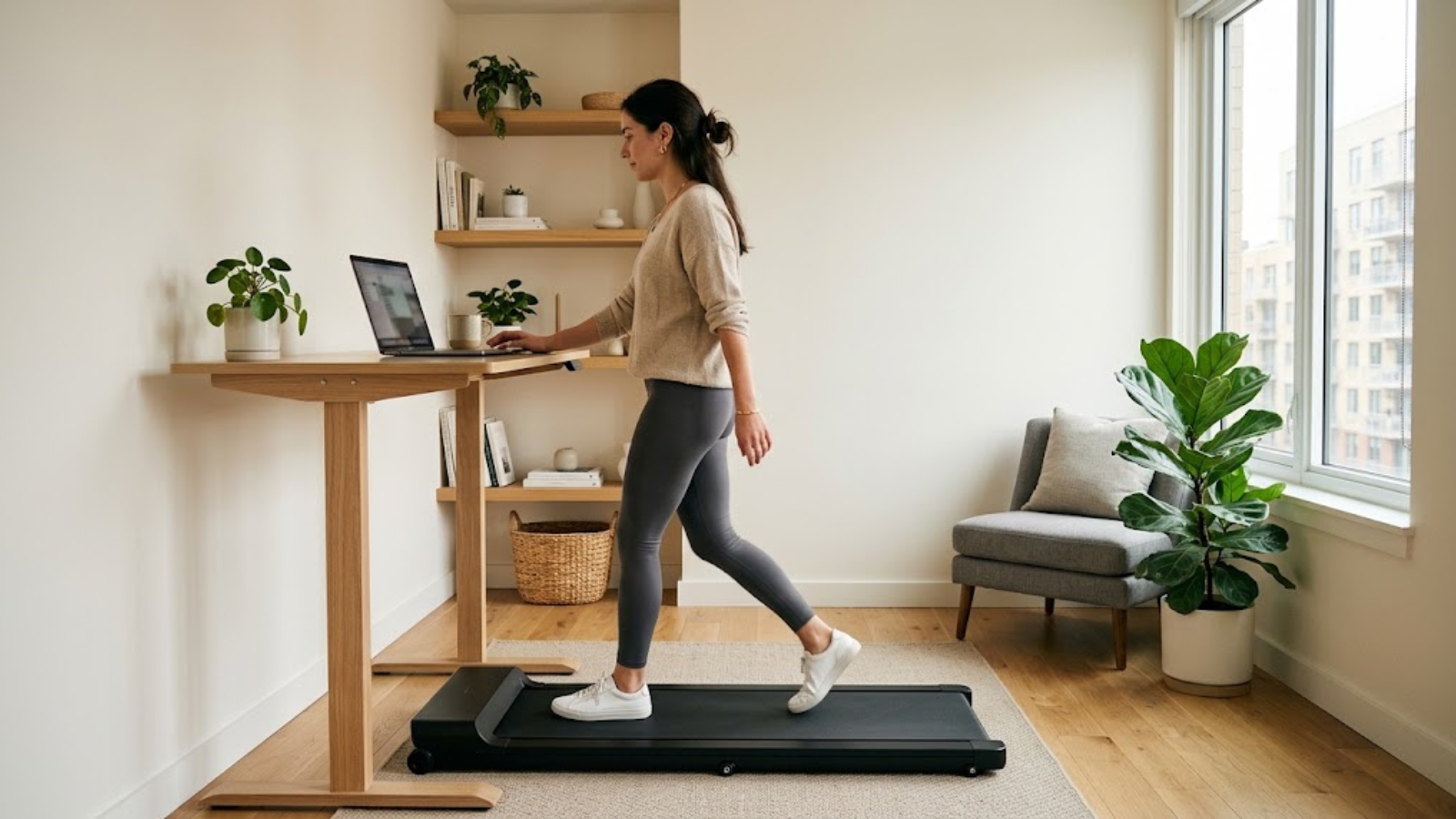
For most apartments, the WalkingPad P1 is the best walking pad to buy. It has a 16.5″ × 47.24″ belt and folds flat to 5 inches, so it slides under most bed frames.
The rest of this guide shows who should pick something else. Three things decide it: where you’ll store the pad, what desk you’ll use, and who lives below you.
Which Walking Pad Should I Buy for My Apartment?
Pick by your biggest constraint:
- You need it to slide under a bed or sofa: WalkingPad P1. Choose the WalkingPad Z1 if you want a higher weight rating.
- You have almost no floor space: WalkingPad X21. It stores upright, about 9 inches deep.
- You’ll walk while you work: DeerRun Q2 Urban.
- You’re on a tight budget: WalkingPad Z1. The DeerRun Q1 Mini is another option (see “Other Walking Pads” below).
- You’re heavier, or two people share one pad: MERACH NovaWalk W50 TrekPad, rated to 400 lb.
- You want incline: DeerRun Z10 (12% automatic). The W50 also has incline, and its specs are better documented.
- Noise is your top concern: No pad here has a noise number we can fully vouch for. The W50’s spec sheet says under 40 dB. But a dB number only measures motor noise, and your downstairs neighbor mostly notices footstep vibration. See the apartment section below, or our picks for walking pads that stay quiet in apartments.
How Do These Walking Pads Compare?
When a brand’s materials conflict, or we couldn’t confirm a number, the table says so.
Disclosure: some links below are affiliate links. If you buy through them, we may earn a commission at no extra cost to you.
Swipe sideways to compare all specs →
| Model | Best for | Walking surface (W × L) | Weight capacity | Storage | Incline | Manufacturer noise rating | Price |
|---|---|---|---|---|---|---|---|
| WalkingPad P1 | Best overall | 16.5" × 47.24" | 220 lb | Flat-fold, 32.5" × 21.5" × 5" | None | Not published | Check price |
| WalkingPad X21 | Tiny apartments | 18.1" × 47.6" | 240 lb | Upright, ~8.8–9" deep | None | Not published | Check price |
| DeerRun Q2 Urban | WFH / under-desk | 35.4" × 15.0" | 300 lb (per listings) | Wheels, ~3.9" tall; stores under desk, bed or sofa (per DeerRun) | Manual, ~7% (per DeerRun) | Under 45 dB | Check price |
| WalkingPad Z1 | Budget | 15.7–15.8" × 47.6" | 243 lb | Flat-fold, ~5.4" | None | Under 40 dB | Check price |
| MERACH NovaWalk W50 | Heavier users | 16.5" × 41.3" | 400 lb | Wheels; no flat-fold | Auto, 1–12% | Under 40 dB (spec sheet) | Check price |
| DeerRun Z10 | Incline | 34.84" × 15.75" | 300 lb (per listing) | Built-in wheels; 5.63" high; non-folding | Auto, 12% | Under 45 dB (manufacturer claim) | Check price |
How Did We Evaluate These Walking Pads?
We have not tested these pads ourselves or measured noise. This guide is based on published specs, not lab results.
Spec figures come from manufacturer spec sheets, manuals, and official brand pages. When a number comes only from a retailer listing, we label it “per listing.” Independent reviews and listings are used only to flag conflicts or fill gaps.
We asked what decides whether a pad works in a small apartment: storage size, floor vibration, belt size, weight capacity, desk fit, and how much of the noise rating you can check. The “How to Choose” sections below explain each one.
WalkingPad, DeerRun, and MERACH are brands we partner with, and we could check their spec sheets. That limits this guide. A pad from another brand may suit you better.
If a brand lists two numbers for one model, we say so instead of picking the nicer one. Lineups change often, with models renamed or revised under the same name. If a listing doesn’t match what we published, tell us and we’ll fix it. For more on noise, see our guide to real-world decibel readings.
How did we choose the overall pick?
A typical renter's pad should pass three tests:
- It stores flat at about 5.5″ or lower, so it fits under most bed frames.
- Its belt is at least 16.5″ wide and about 47″ long, for a full stride.
- It has no handrail.
The P1 is the only pad here that passes all three. The Z1 folds just as flat, but its belt is narrower. The X21 has a handrail and stores upright. The Q2 Urban, W50, and Z10 don't flat-fold, and their belts are 41.3″ or shorter.
The P1 has real trade-offs. It has the lowest weight capacity here (220 lb) and no published noise rating. If a documented noise number or 243-lb capacity matters more than belt width, choose the Z1.
Is the WalkingPad P1 the Best Walking Pad for Most Apartments?
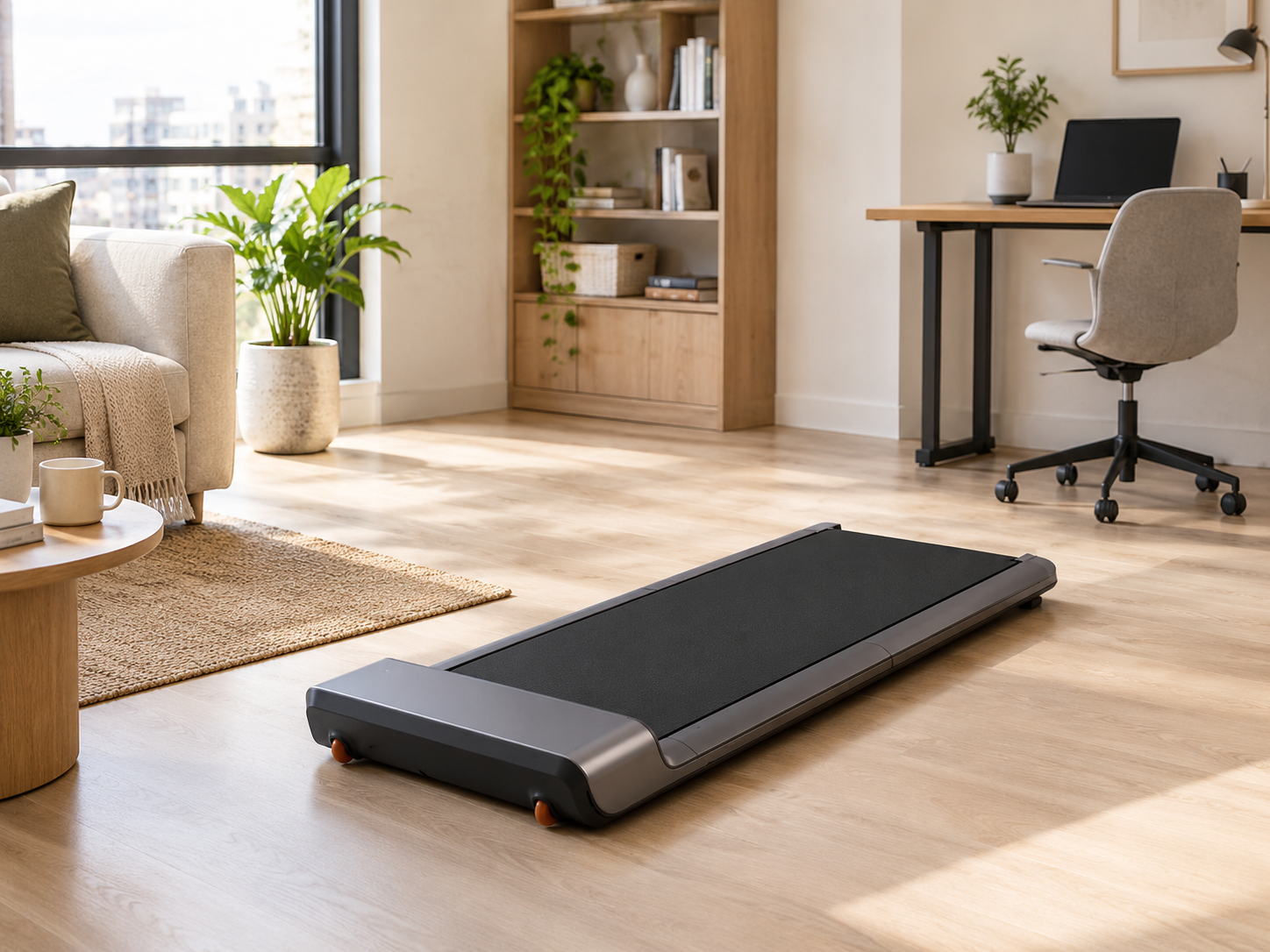
Yes. The P1 is the best fit for most renters because it gives you a full stride and stores flat at about 5 inches. It’s the only flat-folding pad here with a 16.5″ belt and no handrail.
The P1 has no incline, no app, and no published noise rating. What it does have covers what most renters need: room to walk naturally, and a place to put the pad afterward.
Best for
Renters who want one dependable pad for daily walking or desk-walking. It’s not for you if you need incline, an app, or a noise guarantee.
Key specs (manufacturer-reported)
- Walking surface: 16.5″ × 47.24″
- Weight capacity: 220 lb
- Speed range: 0.3–3.75 mph
- Folded size: 32.5″ × 21.5″ × 5″
- Motor: brushed, 746W input. Some retailers list “1HP,” but the manufacturer’s spec table doesn’t print a matching horsepower figure, so treat that label as unconfirmed.
- Noise rating: not published
Should I choose the P1 or the Z1?
Choose the P1 if stride room matters most. Choose the Z1 if capacity, motor type, or a documented noise rating matters more.
What are the P1’s downsides?
The motor is brushed, and there’s no confirmed noise number to compare. That’s a gap in the data, not a sign the pad is loud. But you can’t check it before you buy. At 220 lb, its capacity is the lowest in this lineup.
Skip it if you want incline, you’re close to 220 lb, or you need a documented low-noise figure.
For how a flat deck compares with a handrail-free under-desk design, see walking pad vs under-desk treadmill.
Sources and updates. Specs checked against the manufacturer product page and manual or spec sheet on October 2026. Retailer listings were used only to flag conflicts. Spot a mismatch? Tell us and we’ll correct it.
Which Walking Pad Is Best for Tiny Apartments and Studios?
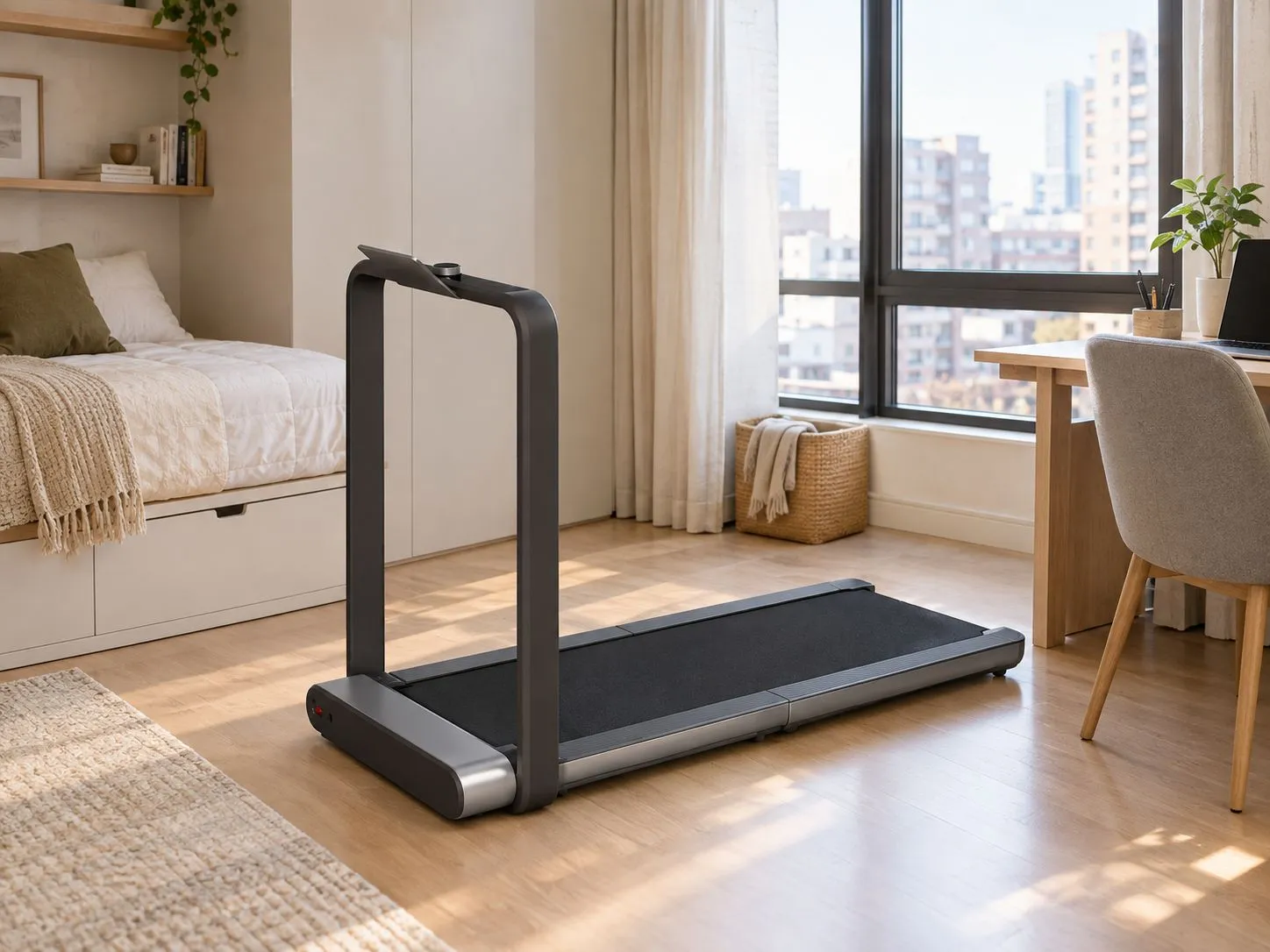
The WalkingPad X21 is best when floor space is your biggest problem. It has the smallest storage depth here. It folds upright to about 8.8–9 inches deep, so it can stand beside a wardrobe or against a wall.
Best for
Studio and one-bedroom renters who need the machine fully out of the way between sessions. It also suits people who want to walk briskly or jog now and then.
Key specs (manufacturer-reported):
- Walking surface: 18.1″ × 47.6″, the widest here (1.6 inches wider than the P1)
- Weight capacity: 240 lb
- Folded size: upright, ~8.8–9″ deep
- Unit weight: ~93 lb, with built-in transport wheels
- Top speed: ~7.45–7.5 mph
- Incline: none
Why does the X21 suit a small home?
The wide belt is forgiving for taller walkers or a longer stride. The speed range means you aren’t stuck at a slow desk pace. At 93 lb you won’t want to carry it, so the wheels matter. A heavy unit also raises questions on upper floors, covered in using a walking pad on an upper floor.
What are the X21’s downsides?
It’s closer to a compact treadmill than a slim walking pad. It has a handrail and console. It’s built to store upright, not slide flat under a desk. If you want a light walking surface for a standing desk, the X21 is more machine than you need.
How loud is the X21?
WalkingPad doesn’t publish a noise rating for the X21. Treadmill Review Guru calls the motor fairly quiet at walking speeds but gives no measured dB. A separate third-party reading of 75 dB was taken at top speed. Treat it as a top-speed number, not typical walking noise.
Skip it if you want a pad that slides under a standing desk or stores flat under a bed.
Before buying, confirm the current dimensions and folded size, since those decide whether it fits your space.
A heavy unit also raises questions on upper floors, covered in using a walking pad on an upper floor.
Sources and updates. Specs checked against the manufacturer product page on October 2026. Retailer listings and the third-party noise reading were used only to flag conflicts or fill gaps. Spot a mismatch? Tell us and we’ll correct it.
Which Walking Pad Is Best for Working From Home?
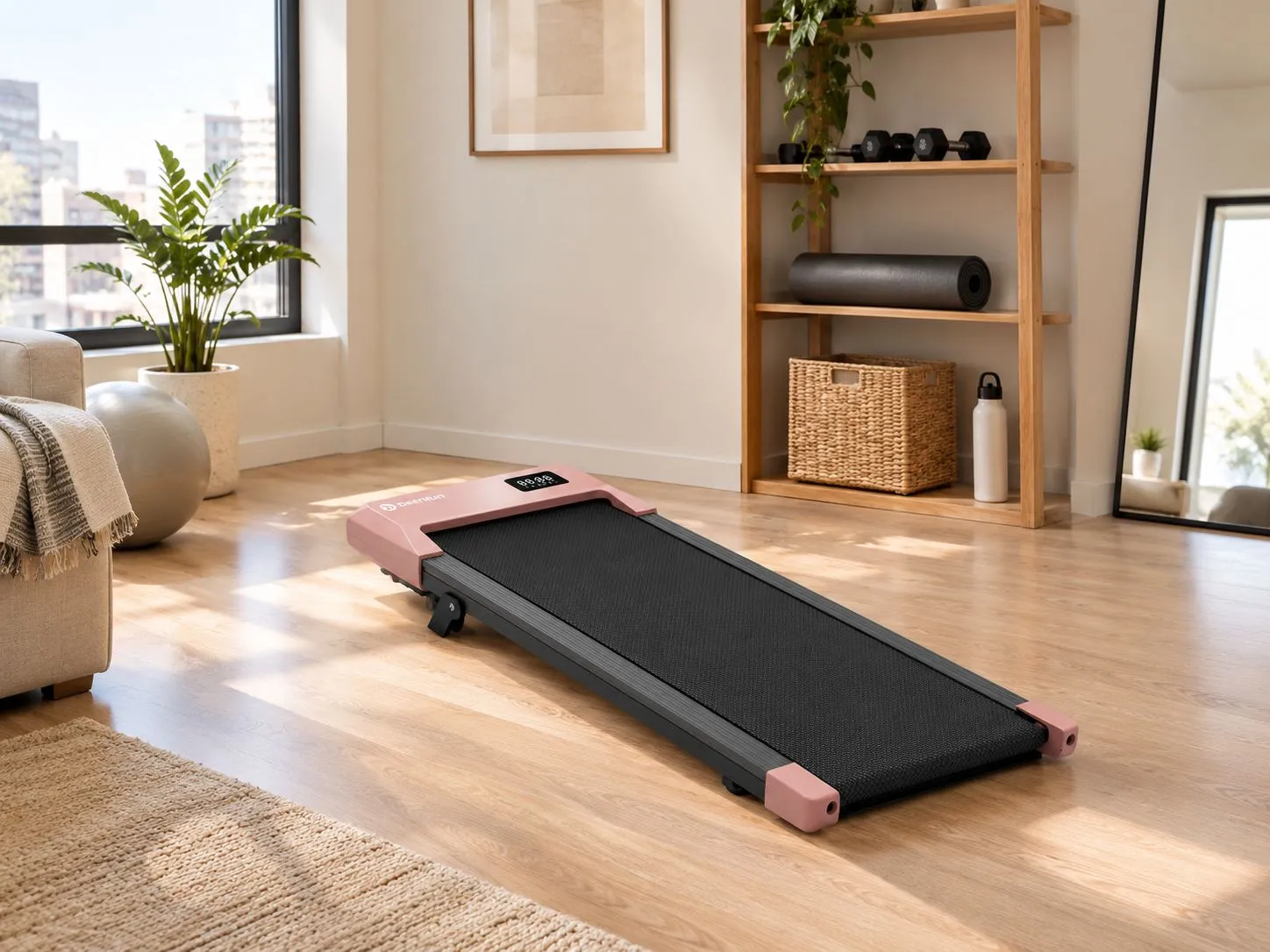
The DeerRun Q2 Urban is the best pick for desk-walking. It’s low, light, and easy to control without looking down.
Best for:
Remote workers who want to walk during calls and emails, and who like having a little incline.
Key specs (per DeerRun and retailer listings):
- Walking surface: 15.0″ × 35.4″
- Overall size: about 42.62″ × 19.69″ × 3.94″
- Unit weight: about 35 lb
- Weight capacity: 300 lb (per listings)
- Incline: manual, about 7% per DeerRun. Some retail listings say 6%, so confirm on the page you’re buying from.
- Storage: built-in wheels. DeerRun says it stores under a desk, bed, or sofa.
- Noise: under 45 dB (manufacturer rating)
- Controls: remote, plus app connectivity through PitPat
Why is the Q2 Urban good for a desk?
At under 4 inches tall, it adds little height under your feet. At about 35 lb, it’s the lightest pad in this guide. It’s also the only pad here with incline that DeerRun positions for under-bed storage. That makes it the compromise pick if you want incline and can’t give up floor space.
What are the Q2 Urban’s downsides?
It doesn’t fold, so under-bed storage depends on your frame’s clearance. Measure first. The incline is manual, so you change it while stopped.
The belt is short at 35.4″, so it suits a natural desk-walking stride better than a long one. The under-45 dB figure is DeerRun’s own rating, not an independent test.
DeerRun also sells several Q2 variants, including the Q2 Urban Plus with a longer belt. Some listings show a handlebar version. Confirm which model you’re looking at, because belt length and capacity can differ.
Skip it if you need motorized incline, a longer belt, or an independently tested noise figure.
For setup specifics, see how to use a walking pad while working.
Sources and updates. Specs checked against the DeerRun product page and manual or spec sheet on October 2026. The 300-lb capacity comes from retailer listings and is labeled that way. Spot a mismatch? Tell us and we’ll correct it.
Which Walking Pad Is the Best Budget Option?
The WalkingPad Z1 is the best budget pick. It pairs flat-fold storage with a confirmed 243-lb capacity, which is more than the P1 offers.
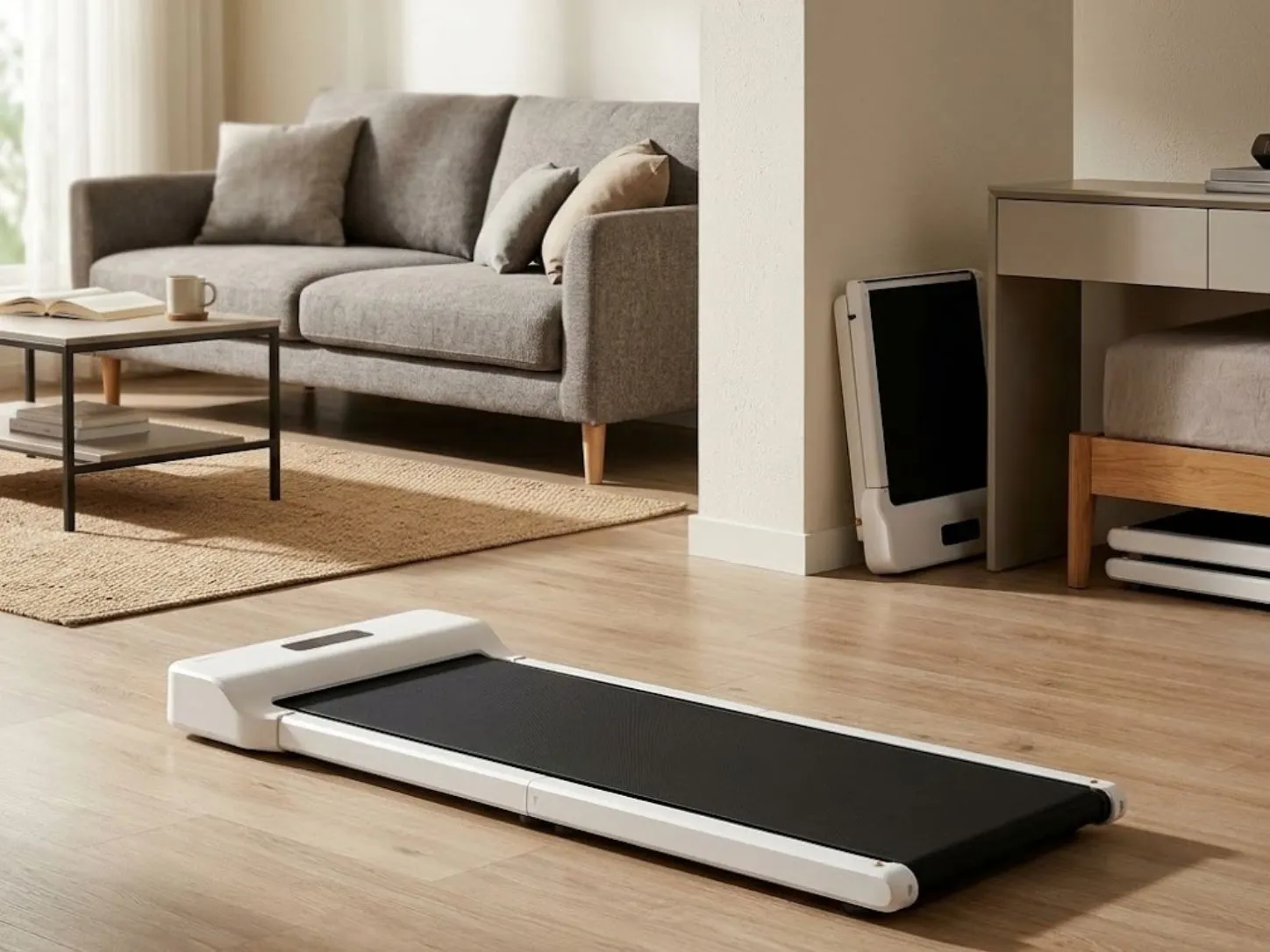
The Z1 pairs flat-fold storage with a confirmed 243-lb capacity, more than the P1 offers. For a first pad, that’s a capable combination at the entry end of the lineup.
Best for:
First-time buyers who want steady, moderate-pace walking without paying for incline or app features.
Key specs (manufacturer-reported):
- Walking surface: 15.7–15.8″ × 47.6″
- Weight capacity: 243 lb
- Folded size: ~5.4″, flat-fold
- Motor: 0.75 HP, brushless
- Noise: under 40 dB (manufacturer rating)
- Incline: none
Why is the Z1 a good first pad?
It folds flat, has no interface to learn, and holds more than the P1. For slow, centered walking or an after-dinner session, the narrower belt works fine.
Skip it if you have a wide stride, or you want incline or app tracking.
If price is your main filter, our roundup of budget-friendly picks under $300 compares more options.
Sources and updates. Specs checked against the manufacturer product page and manual or spec sheet on [date]. Retailer listings were used only to flag conflicts. Spot a mismatch? Tell us and we’ll correct it.
Which Walking Pad Is Best for Heavier Users?
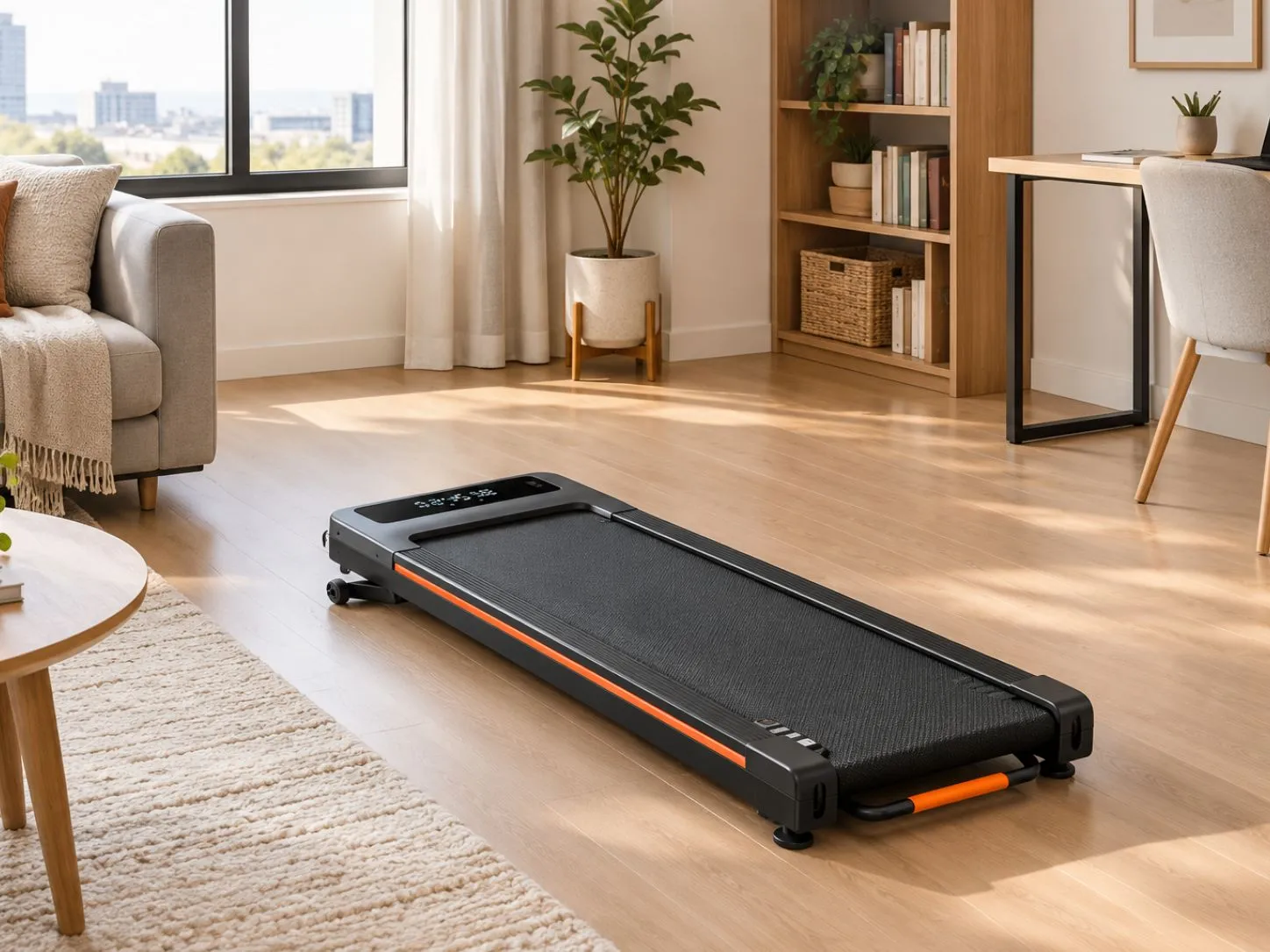
The MERACH NovaWalk W50 TrekPad is the best pick for heavier users. At 400 lb, it has more rated capacity than anything else here. Check it first if body weight is the deciding factor or two people share one machine. For more choices, see our guide to high weight-capacity options.
Best for:
Larger users, shared households, and anyone who wants motorized incline without a slim desk-style deck.
Key specs (manufacturer-reported):
- Walking surface: 16.5″ × 41.3″
- Weight capacity: 400 lb
- Incline: automatic, 1–12%
- Motor: brushless, 3.5 HP peak / 1.25 HP continuous
- Unit weight: ~69.2 lb
- Warranty: 2 years
What makes the W50 stand out?
MERACH lists a continuous horsepower figure next to the peak figure. Peak is a brief maximum. Continuous is closer to what the motor holds in a real session. That makes the listing more useful than most.
What are the W50’s downsides?
It doesn’t flat-fold. It rolls on wheels, so plan a semi-permanent spot.
MERACH also lists two noise figures. The official spec sheet says under 40 dB, and some retail copy claims 25 dB. We’re flagging the gap, not resolving it. Treat the lower number with caution until the current listing confirms it.
Skip it if you need under-bed storage, or you want the lightest possible desk pad.
Which Walking Pad Is Best for Incline Walking?
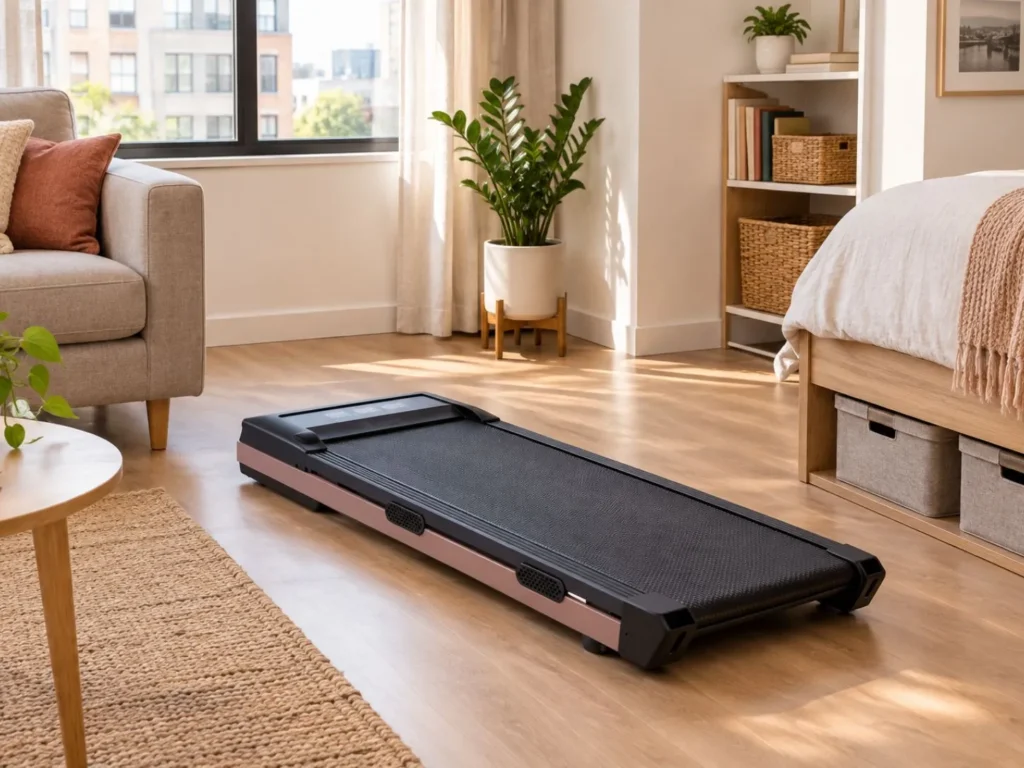
The DeerRun Z10 is the best incline pick here. It’s DeerRun’s automatic-incline walking pad, listed at up to 12%.
In an apartment, incline is the better way to make a session harder. Speed adds noise and floor impact. Grade adds effort at a pace that stays gentle on the floor. For other models, see walking pads with adjustable incline.
Best for:
Anyone who wants a harder workout at an apartment-friendly speed, and would rather change grade from the remote than step off to adjust it.
Key specs (per DeerRun and retailer listings):
- Incline: automatic, up to 12%
- Walking surface: 34.84″ × 15.75″
- Weight capacity: 300 lb (per listing)
- Height: 5.63″
- Storage: built-in wheels; does not fold
- Noise: under 45 dB (manufacturer claim)
- Controls: remote and smart app
What are the Z10’s downsides?
Incline raises the deck, so check your desk clearance at the grade you’ll use. The Z10 doesn’t fold, so plan a semi-permanent spot or enough under-bed room for a 5.63″ deck.
The belt is short at 34.84″, and the noise figure is a manufacturer claim. We couldn’t confirm the motor from the sources we rely on.
Should I choose the Z10 or the W50?
Choose the W50 for more capacity and belt length. Choose the Z10 if a 300-lb rating and a compact deck are enough.
Both have 12% automatic incline. The W50 offers a higher rating (400 lb vs. 300 lb), a longer belt (41.3″ vs. 34.84″), a listed brushless motor, and a 2-year warranty.
Skip it if you need under-bed storage, a long belt, or an independently tested noise figure.
Sources and updates. Specs checked against the DeerRun product page on October 2026. The 300-lb capacity comes from retailer listings and is labeled that way. Spot a mismatch? Tell us and we’ll correct it.
What Other Walking Pads Are Worth Considering?
DeerRun Q1 Mini
This is DeerRun's smallest under-desk treadmill. Tom's Guide names it the best walking pad for most people. It cites a $149 RRP and a 3.8 mph top speed, and reports noise under 50 dB. That is independent reporting, not a manufacturer spec.
It's the natural alternative to the Z1 if you want a low price and a steady pace over incline or capacity. Confirm current price and specs on DeerRun's site. If you'd rather spend more, see our guide to mid-range models up to $500.
WalkingPad R3 (flat-pad version)
We left the R3 out of the ranked picks. One naming issue comes first: the maker also sells an "R3 Hybrid+" with a handrail, front rollers, and a 2.0 HP motor. That's a different unit, so confirm which R3 a listing shows.
For the flat-pad R3, the manufacturer's spec page confirms:
- A 17.3-inch belt
- A 265-lb capacity
- A 1.0 HP brushless motor
- A folded size of about 33.5″ × 26.5″ × 7.5″
Noise is the one figure not published, so ask about it.
DeerRun A1 Pro Move+
It's listed at 350 lb, 10 mph, and 6% incline. This foldable treadmill is beyond walking-pad territory. It's for people who want to run indoors, and it's more machine than most small apartments need.
How Do I Know Which Walking Pad Will Fit My Apartment?
Measure five things before you buy. These narrow your options faster than any spec sheet. If you also want to read spec sheets yourself, see what to check on a spec sheet.
- Under-bed clearance. Measure the gap between the floor and the bed frame. The P1 and Z1 fold to about 5 and 5.4 inches. The Q2 Urban is about 3.9 inches tall. Compare each to your gap.
- Wall space for upright storage. If you’re considering the X21, measure the spot, including a folded depth of about 9 inches.
- Desk fit. The pad must fit between your desk legs. The Q2 Urban is about 19.7 inches wide. You’ll also stand on a deck about 4 inches high, so confirm your desk still reaches a comfortable typing height. Incline adds more. Pads with handrails, like the X21, don’t go under a desk.
- Floor type. Most manufacturers expect hard, flat flooring. Thick carpet can affect belt stability.
- What’s below you. Know who lives there, and whether your lease posts quiet hours.
Is there a quick tool to check the fit?
Yes. Use our free Walking Pad Fit Calculator. Enter your open floor length and width, your height, how you’ll use the pad, and how you’ll store it. It estimates the biggest footprint you can fit
Free Walking Pad Fit Calculator
Not sure what size walking pad will fit your apartment? Enter your available floor space and get a practical maximum footprint to use when comparing models.
Your Walking Pad Space
- Estimated maximum machine footprint
- Estimated maximum deck (walking surface)
- Planning operating area (footprint plus clearance)
- Planning clearance (Small Space Strength allowance)
Clearances are Small Space Strength planning allowances, not industry standards or manufacturer requirements.
Your fit checks
Always compare the calculator result with the manufacturer's published dimensions and required clearance before purchasing.
How this calculation works
This is a screening tool. It uses planning clearances, not manufacturer requirements, so always follow the installation instructions for any model you buy.
Ready to compare walking pads?
See the Best Walking Pads for ApartmentsWhy do walking pad dimensions matter so much?
The belt is smaller than the machine. The frame, motor housing, and end caps add length and width. Compare overall dimensions, not just belt size.
You need operating room. You need space to step on and off, plus open floor behind the belt. Brisk walking and jogging need more of it than a slow pace. Check each manual for its stated clearance.
Stored size can differ from running size. Whether the pad slides under a sofa, stands upright, or rests in a closet, the stored height and depth decide if it really disappears.
Width is often the tighter measurement. A narrower model is easier to place. But compare the belt width to what feels comfortable for your stride.
Under a desk, check the details. Look at desk legs, cables, and open floor behind you. With a standing desk, check the pad’s height at the desk’s lowest setting.
Always confirm the exact numbers on the manufacturer’s page before you buy. Sizes and stored dimensions can change between versions.
What Happens When Two Needs Collide?
This lineup makes you choose in a few places:
- Incline vs. flat-fold storage. The two flat-fold pads (P1, Z1) have no incline. The incline pads (W50, Z10) don’t flat-fold. The Q2 Urban’s low profile is the closest compromise.
- High capacity vs. under-bed storage. The W50’s 400 lb comes with a semi-permanent footprint. If you weigh 220–300 lb and want to store the pad out of sight, check the Q2 Urban’s 300-lb listing rating first.
- Desk-walking vs. jogging. The X21 is the only pad here built for real jogging speeds, and it can’t go under a desk.
What Belt Size Do I Need?
For most adults, a belt about 47 inches long and 16.5 inches wide is comfortable. That’s the P1’s size. The X21 and Z1 are about 47 inches long too.
A narrower belt, like the Z1’s 15.7–15.8 inches, works for slow, centered walking. A wider one, like the P1’s 16.5 inches or the X21’s 18.1, gives taller or longer-striding walkers more room.
A shorter belt, like the W50’s 41.3 inches, may feel tight if you have a long stride.
What Weight Capacity Should I Look For?
Pick a pad rated well above your weight. A pad running below its limit gives the motor and belt more margin over years of use.
Here are the ratings: P1 220 lb, X21 240 lb, Z1 243 lb, Q2 Urban and Z10 300 lb (per listings), W50 400 lb. Check your model’s own guidance for details.
What Should I Know About Motors, Speed, and Incline?
Brushed vs. brushless. A brushless motor is usually quieter and longer-lived, though it varies by build. We list a motor type only when the manufacturer’s own spec shows it.
Peak vs. continuous horsepower. Peak is a brief maximum. Continuous is closer to what the motor holds during a session. A listing with both, like the W50’s, tells you more than one with only peak.
Speed. Most walking pads suit about 0.5 to 4 mph. Only some, like the X21, go well past that. For desk-walking, a low top speed isn’t a drawback. A slow, steady pace is easier during calls and typing.
Incline. Most buyers don’t need it. If you do, choose between automatic (change grade mid-walk) and manual (adjust while stopped). Then check how it affects your desk clearance.
Are Manufacturer Noise Ratings Reliable?
Use them as a starting point, not proof. For any noise number, ask three questions: Who published it? At what speed was it measured? Does the same brand list a different number elsewhere?
Even a trustworthy dB rating misses footstep vibration. The next section explains why that matters.
What About Apps, Warranty, and Unit Weight?
App connectivity, like DeerRun’s PitPat, helps if you want step and session tracking. It isn’t a dealbreaker either way.
Check the warranty length (the W50 lists two years) and the return policy. Unit weight runs from about 35 lb (Q2 Urban) to about 93 lb (X21). If you’ll move the pad between rooms, look for built-in transport wheels. The W50 and X21 both have them.
Will a Walking Pad Bother My Downstairs Neighbor?
They’ll likely feel the footsteps more than they’ll hear the motor. In an apartment, that matters more than any single dB number.
Three things are at work:
- Motor noise is airborne sound from the belt and motor. It’s what a dB rating measures.
- Footstep impact is your foot landing on the deck.
- Floor transmission is how that impact travels through your floor and joists to the ceiling below.
Your neighbor notices a mix of all three, and no spec sheet measures the mix. A pad with an excellent dB rating can still send footfall vibration through a hard floor if nothing sits under it. For more, see how loud walking pads really are.
Do I Need a Mat Under My Walking Pad?
Not always, but a mat can help. Most manufacturers don’t require one. A mat can cut vibration and protect hardwood or laminate from scuffs.
How much it helps depends on the mat’s material and thickness, your floor’s construction, and how heavily you walk. It isn’t a guarantee.
If carpet is your only option, a thin, dense mat gives a steadier surface than carpet alone. Check your manual first, since tolerance varies.
Can I use a walking pad in an upstairs apartment?
Yes, but keep a slow pace in the evening. Motor noise and footfall impact both rise with speed.
Check your lease for quiet hours before you build a late-night habit. The full picture is in our guide to using a walking pad above neighbors.
Walking Pad FAQs for Apartment Living
Are walking pads good for apartments?
Yes, for most people. They’re smaller and lighter than traditional treadmills. Many store flat under a bed or upright against a wall. Just check your storage clearance and how much vibration your floor passes along.
Not sure a walking pad is the right category? See walking pad or exercise bike for apartments.
Will my downstairs neighbor hear or feel a walking pad?
Possibly. A dB rating covers motor noise only, not footstep vibration. A mat and a slower speed both help, though neither guarantees silence.
Can I trust the manufacturer's noise rating?
Treat it as a starting point. Ratings are measured under controlled conditions, and brands sometimes list different figures for the same model, as MERACH does for the W50. Where independent figures exist, like the 75 dB reported for the X21 at maximum speed, they’re flagged in the write-ups. See how loud walking pads really are.
Can I use a walking pad on carpet, and do I need a mat?
Most manufacturers design for hard, flat flooring and caution against thick carpet. A thin, dense mat helps if hard flooring isn’t an option, and it can cut vibration and floor scuffing on any surface. Check your manual.
Will a walking pad fit under my bed?
Measure your bed-frame clearance against the pad’s folded or overall height, not its walking-surface dimensions. The P1 and Z1 fold to roughly 5 inches, and the Q2 Urban is about 3.9 inches tall. The X21 stores upright, so it doesn’t go under a bed.
Will a walking pad fit under my standing desk?
Check that the pad fits between your desk legs, and that the desk still reaches a comfortable typing height when you stand on a deck about 4 inches high. Incline adds height. Handrail models like the X21 don’t work under a desk.
What weight capacity should I look for?
Choose a pad comfortably below its rated maximum, not at it. Capacities here range from 220 lb (P1) to 400 lb (W50).
Can I run on a walking pad?
Only on some. The X21 tops out around 7.5 mph, and the DeerRun A1 Pro Move+ is listed at 10 mph. Most walking pads, including the DeerRun Q1 Mini at 3.8 mph, are built for walking speeds.
What's the difference between a walking pad and a treadmill?
A walking pad is built for slow, steady walking on a low deck that stores away. A treadmill supports a wider speed range, including running, with a taller deck and usually a fixed handrail. Some pads, like the X21, sit between the two. See walking pad vs under-desk treadmill differences.
Before You Buy
Confirm three things before you click. The specs above are only as current as the listing you’re viewing.
- Which exact model the listing shows. This matters most for the Q2 Urban, the R3, and CyberPad-style variant families.
- Any spec we flagged as conflicting or unverified.
- Your own bed, desk, and floor measurements.
Specs in this guide come from manufacturer spec sheets, product manuals, and official brand pages, cross-checked where more than one official source exists. Where sources conflict or no verified figure exists, we say so instead of guessing. This guide reflects published specifications, not independent lab testing.