
Quick Answer
Auto-incline walking pads change angle from a remote or app while you keep walking. Manual-incline pads make you stop the belt and adjust a leg or panel by hand.
Get auto-incline if you desk-walk daily. Get manual if you’ll use incline once in a while and want to spend less. The type matters more than the incline number on the box.
Two walking pads can both say “12% incline” and feel nothing alike. On one, you raise the grade from a remote mid-step. On the other, you stop, bend down and flip a leg by hand. Same spec sheet, very different Tuesday afternoon.If steep grades are your real goal, see when a full treadmill makes sense for incline.
What Does Incline Mean on a Walking Pad?
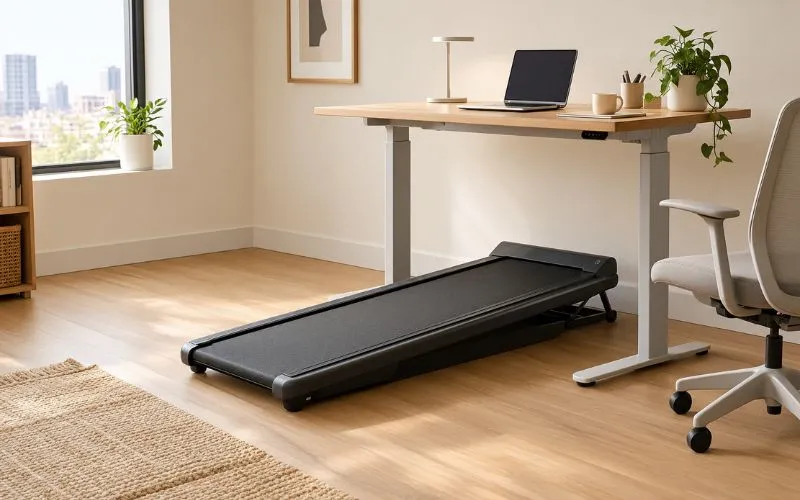
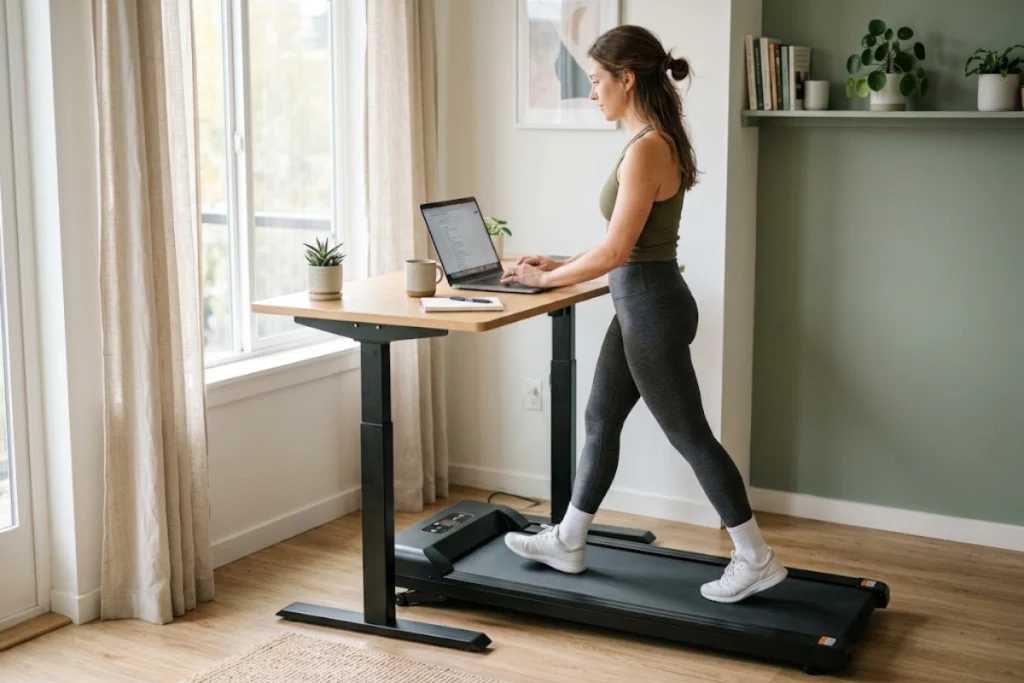
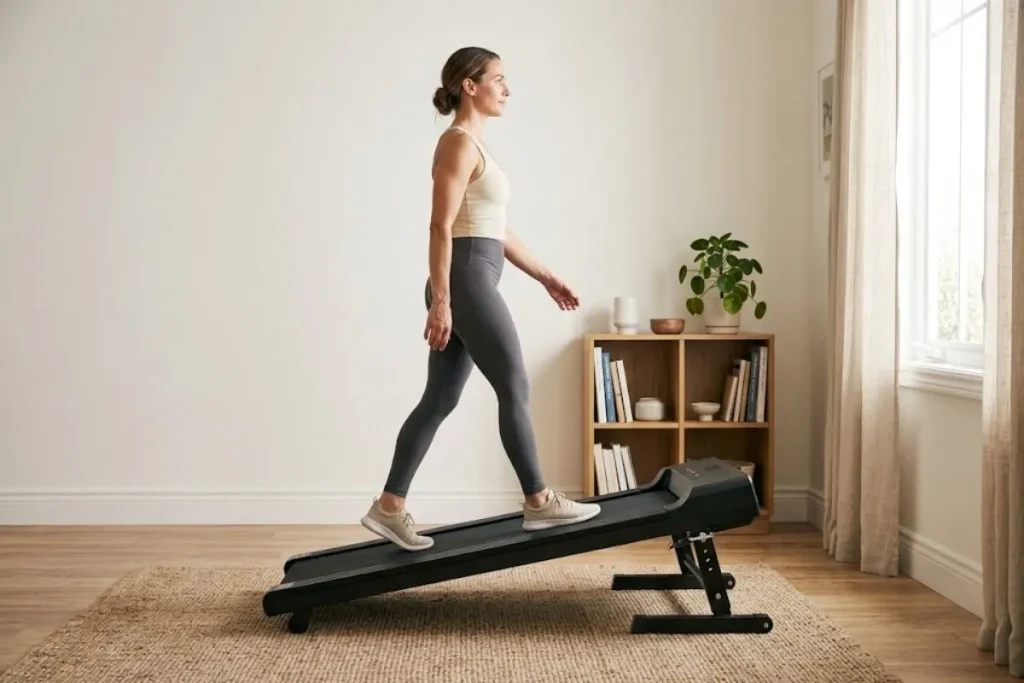
Incline is the angle of the deck. Raise the back of the belt and you walk uphill instead of on flat ground. It works like the incline button on a full-size treadmill, built into a machine that fits under a desk.
Standard walking pads stay flat. Once incline is added, the machine falls into one of two types, based on how the angle changes.
What’s the Difference Between Manual and Auto Incline?
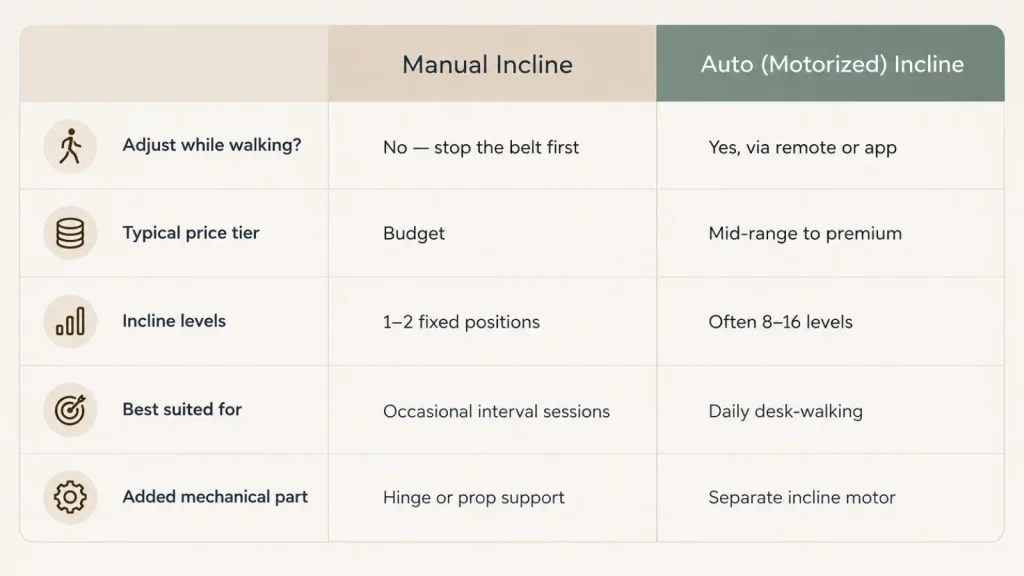
The key question is simple. Can you change the incline without stopping your walk?
Auto (motorized) incline has its own motor, separate from the belt motor. You change the grade from a remote or app while you keep moving.
Manual incline is set by hand, usually by folding down a support leg or panel. You must stop the belt first. Most manual models give you one or two fixed positions.
That one question predicts daily use better than the percentage does. If you walk during calls, stopping to kneel and reposition a panel defeats the point. This is true even when the manual model has a higher incline than an auto one.
How do you tell which type a listing sells?
Read the description, not the headline. “Auto incline,” “motorized incline” and “remote-adjustable” mean auto. “Manual incline” and “adjustable leg support” mean manual.
If a listing says only “10% incline,” keep reading. That’s how buyers end up with a pad they can’t adjust mid-walk
Ready for incline you can adjust without stopping?
See the WalkingPad H1 Plus →What Incline Percentage Is Best for a Walking Pad?
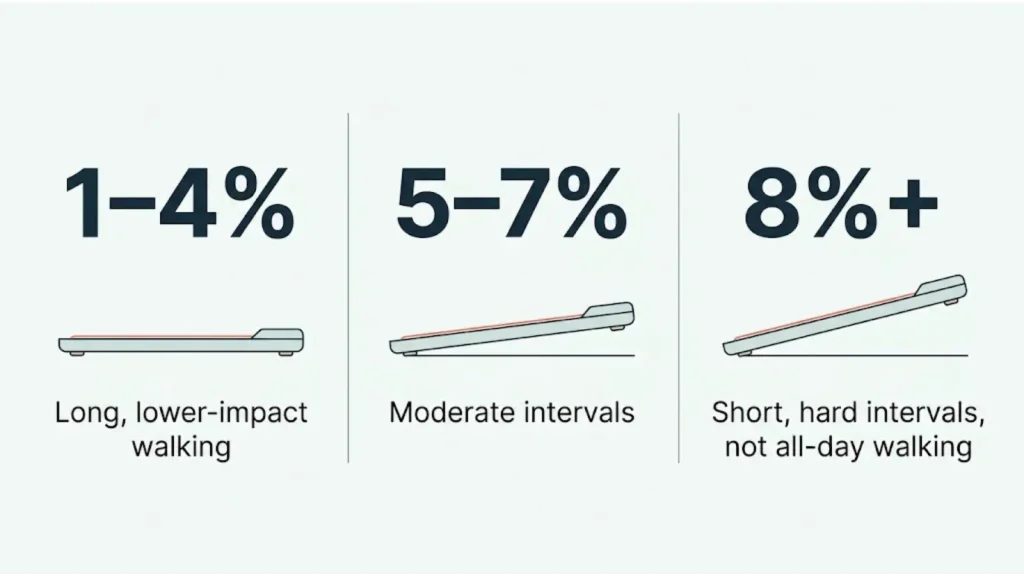
For all-day walking, most experts point to a gentle incline of about 1–4%. Higher grades suit short, hard intervals. Listings lead with the biggest number, like 10% or 12%, because steeper feels harder at the same speed. That sells well. It’s not the grade you want running in the background for hours.
Hospital for Special Surgery quotes sports medicine physician Dr. Jordan Metzl on knee problems. He suggests starting at 1.5–2%. Most people then settle around 3–4%.
That’s one source, not a rule. Comfort varies by person.
This isn’t medical advice. If you have a knee or joint issue, ask a physical therapist or doctor what range fits you.
What Are the Downsides of an Incline Walking Pad?
Incline adds cost and bulk, and it adds a part that can wear out. Here are the four trade-offs the spec sheet skips.
Does it fit under your bed or couch?
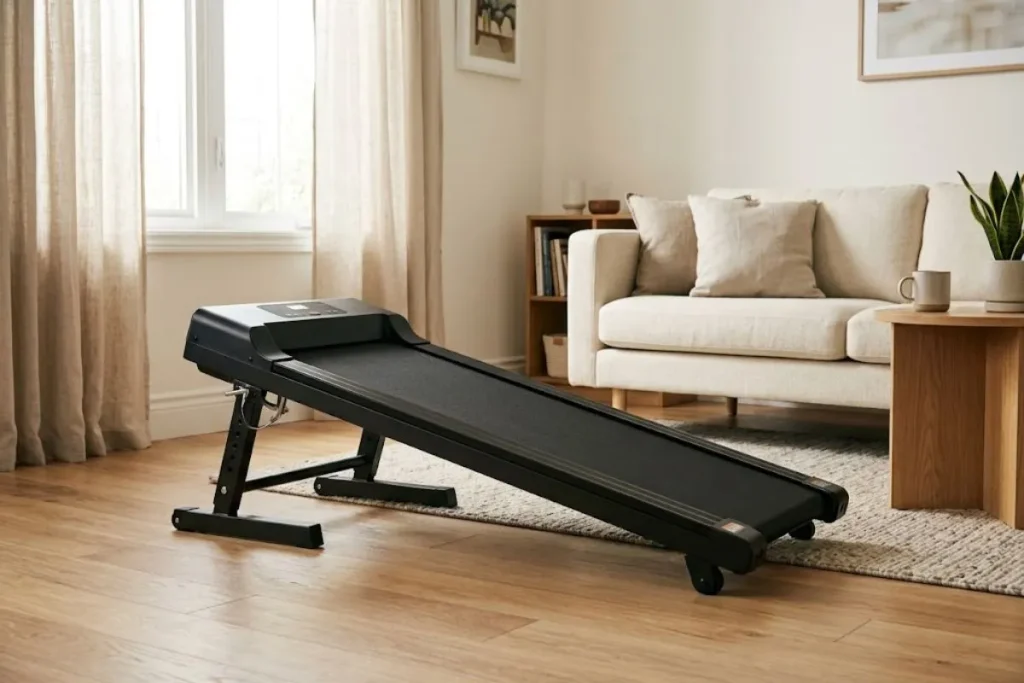
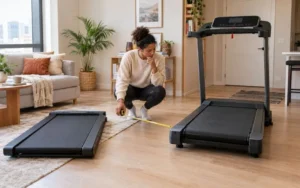
The hardware that lifts the deck adds thickness. If your last pad slid under a bed, measure the folded size of the incline model against that gap. Don’t assume it fits the same way.
Is an incline pad louder?
Probably, a bit. Brands rarely say whether their dB rating was measured flat or inclined. Expect more noise once an auto-incline motor runs, especially at steep settings.
I haven’t tested this on the models below. If you take calls while walking, ask the retailer or try the unit in person.
Does incline add another thing to break?
Yes. A flat pad has one motor. An auto-incline pad has a second one that raises and lowers the deck, and it can wear out on its own. A manual pad has no second motor, but its hinge or prop wears too.
This is mechanical reasoning, not failure-rate data. Check that the warranty covers the incline part, not just the belt.
Does belt size matter more on an incline?
Yes. Your stride shifts on an angled deck. A belt that feels fine flat can feel tight when raised. If you’ll use incline often, a longer or wider deck gives you room.
Should You Get Manual or Auto Incline?
Get auto if you desk-walk daily and incline is part of your routine. Staying in motion is worth the price gap.
Get manual if budget decides it, you’ll use incline now and then, and stopping to adjust won’t bother you.
Here’s how that plays out:
- Video calls most of the day: Choose auto. You can’t stop the belt mid-call.
- One incline session a week, tight budget: Manual is fine. A weekly adjustment barely registers.
- Single-room apartment, one machine for flat walks and the odd hard session: Look at a mid-tier auto model that folds compactly.
What Are the Best Walking Pads With Incline?
I sorted these by use, not by one overall winner. The right pad depends on how you’ll use the incline, so each pick names its type first.
Prices and stock change often. Several figures below come from one retailer, so check the live listing before you buy.
Best for Most People: WalkingPad H1 Plus (Auto)
You adjust incline from the remote or HitGo app without bending down. It has nine incline levels, a 2 HP brushless motor and a 15.4″ x 40″ walking area (per the maker). Weight capacity is 243 lbs. It arrives fully assembled with built-in wheels. Brand-site price: $249.
At least one retailer showed it as sold out or pre-order at the time of writing. Check stock first.
Check H1 Plus Price & Availability
Best for Daily Desk-Walking: MERACH W50 Lite (Auto, 10%)
This one is built for hours of use across a workday. MERACH rates the brushless motor under 40 dB. It has 10 incline levels, a 350 lb capacity, a 3.0 HP peak motor and Bluetooth speaker and app sync.
Best Buy lists it at $299.99. Treat that as one data point. MERACH’s site and other retailers have shown different prices during promotions.
Check W50 Lite Price on MERACH
Best for Small Apartments: MERACH T19 (Manual, 6%)
The incline is fixed, so you can’t adjust it on the fly. That’s a real limit. In return, it folds for under-bed or closet storage and has a raisable handlebar for balance.
It switches between walking and a running mode up to about 7.6 mph. Capacity is 300 lbs, with a 16″ x 37.4″ belt. Starting price: $159.99. It appears to sell mainly on Amazon, so check the current listing.
If adjustable incline matters more than folding storage, skip this one. Pick the H1 Plus or W50 Lite.
Check T19 Price & Folding Dimensions
Best Budget Manual Pick: WalkingPad Massage Step (Manual, 5%)
The incline is fixed at 5%, and the frame doesn’t fold. That solid frame is why the incline feels steady underfoot. The reverse side flips to a massage surface.
It measures 43.5″ x 21.5″, holds 265 lbs and tops out at 4 mph. It’s listed at $89.70, down from $299, though sale prices shift without notice.
The trade-off is real: fixed incline and no folding. Renters should compare it to the T19 before choosing on price alone.
Check Today’s Price on WalkingPad Massage Step
Best for Interval Training: MERACH NovaWalk W50 (Auto, 1%–12%)
It has a 3.5 HP peak motor, a 400 lb capacity, a reinforced steel frame and a 16.5″ x 41.3″ deck. Pricing ran $389.99 to $399.99 across the brand site and Amazon at the time of writing.
You may also see this model sold as “TrekPad.” Check the exact product name before you buy.
The higher capacity and wider deck make it the pick for real incline intervals, not steady all-day walking.
These are organized by use case, not ranked as a single “best overall,” because the right pad depends on how you’ll actually use the incline. Each pick states its mechanism type up front — that matters more than the price.
Prices and stock in this category change often, and several figures below are single-retailer snapshots, so check the current listing before you buy.
Check NovaWalk W50 Price & Incline Specs
Which pick should you choose at a glance?
| Use | Pick | Incline Type | Starting Price |
|---|---|---|---|
| Most people | WalkingPad H1 Plus | Auto | $249 |
| Daily desk-walking | MERACH W50 Lite | Auto | $299 |
| Small apartments | MERACH T19 | Manual (fixed) | $159.99 |
| Budget | WalkingPad Massage Step | Manual (fixed) | $89.70 |
| Intervals | MERACH NovaWalk W50 | Auto | $389.99–$399.99 |
FAQ
Is manual or auto incline better on a walking pad?
It depends on use, not quality. Auto suits daily desk-walking because you adjust without stopping. Manual costs less and works for occasional sessions. You just stop the belt each time you change it.
What incline percentage is best for a walking pad?
For long walks, sources often point to about 1–4%. Higher grades suit short, hard sessions. This is general guidance, and comfort varies.
Can you adjust incline while walking?
Only on auto-incline models, using a remote or app. Manual models need you to stop the belt and move the mechanism by hand.
Do incline walking pads fold flat like regular ones?
Not always. Incline hardware adds thickness, and some models fold less compactly. Check the folded size before you buy.
Are incline walking pads louder than flat ones?
Possibly. Noise ratings rarely say flat or inclined, so expect a bit more once the incline motor runs. It varies by model, and I haven’t tested these.
What’s the best incline walking pad for a small apartment?
Pick a model with clearly listed folded dimensions, since incline adds bulk. The MERACH T19 is built for apartment storage.
Do incline walking pads break down faster?
An auto-incline pad has one more motor that can eventually fail. A manual pad has a hinge or prop with its own wear. That’s mechanical reasoning, not failure-rate data.
Is an incline walking pad worth the extra cost?
If you’ll use incline daily while working from home, auto-incline usually pays off. For occasional use, it’s harder to justify.
Bottom Line
Ask “auto or manual?” before you look at the incline percentage. That answer decides whether incline fits your day or sits unused after a week.
Desk-walk daily? Pay for auto. Use incline now and then on a budget? Manual is a fair trade. Still unsure incline is worth it? Browse our walking pads for apartments and small spaces.
Pingback: Best Walking Pads Under $500: Premium Features, No Overpay
Pingback: Walking Pad vs Treadmill: Best for Small Apartments