Adjustable dumbbells let one handle connect to different amounts of weight. You pick a setting, and a selector or lock attaches the weight you chose. That means you don’t need a separate fixed dumbbell for every weight.
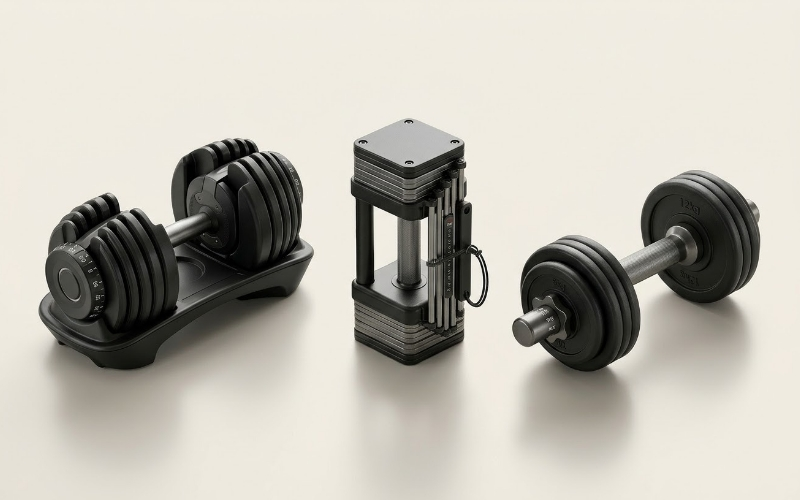
There are four common designs. Dial models use a rotating dial. Selector-pin models use a pin. Twist-handle models change weight when you turn the handle. Spin-lock models use removable plates held by threaded collars.
Each design works differently. Knowing how helps you pick one that fits your workouts, your space and your budget.
How Do Adjustable Dumbbells Work?
They connect the handle to the weight you select. Every adjustable dumbbell has a handle, weight plates or sections, and a mechanism that decides how much weight attaches to the handle.
When you pick a weight, the mechanism locks onto the right sections. You lift the handle, and those sections come with it. The rest stays in its storage spot or is stored separately, depending on the design.
For example, say a dial model is set to 25 lb. The selector links the sections needed for 25 lb to the handle. The unselected plates stay in the cradle when you lift.
A selector-pin dumbbell works in a similar way. You insert a pin into the right spot on the weight stack to choose the weight.
Not all adjustable dumbbells pick and secure weight the same way.
What Are the Main Parts of an Adjustable Dumbbell?
Knowing the parts makes each system easier to follow.
| Component | What it does |
|---|---|
| Handle | The part you grip when lifting |
| Weight plates or sections | Provide the resistance |
| Selector | Chooses which weight sections are used |
| Locking components | Help hold the selected weight in place |
| Base or cradle | Holds the dumbbell and stores unused plates on some designs |
| Adjustment mechanism | Changes the selected weight |
Not every model arranges these parts the same way. A spin-lock dumbbell, for example, uses threaded collars instead of a dial or selector pin.
What Happens When You Change the Weight?
On a selector-based dumbbell, changing weight takes three steps:
- Select a weight: Turn the dial, insert the pin or rotate the handle, depending on the model.
- Connect the weight: The internal mechanism attaches the right weight sections to the handle.
- Lift the dumbbell: The selected sections move with the handle. Unused sections stay in storage.
The process varies by brand. Some designs must sit in their cradle before you change the setting. Certain selector-pin designs let you adjust on a flat surface.
How Do Dial Adjustable Dumbbells Work?
Dial dumbbells use a rotating dial to select the weight. The dial is usually near one or both ends. Turning it changes which weight sections connect to the handle.
The BowFlex SelectTech 552 is one example of this design.
How Does the Dial Mechanism Work?
Here is the basic process:
- Place the dumbbell correctly in its storage cradle.
- Turn the dial to the weight you want.
- The selector changes which sections connect to the handle.
- Lift the handle with the selected sections attached.
- The remaining plates stay in the cradle.
The dial doesn’t add weight by itself. It changes which sections are mechanically connected to the handle.
Parts vary by product. The manufacturer’s documentation is the best source for a specific model.
What Are the Advantages of Dial Adjustable Dumbbells?
- Easy weight selection: You can change settings without removing plates by hand.
- Clear markings: The dial typically shows the available settings.
- Good for changing exercises: You can pick a different weight during a workout.
What Are the Trade-Offs of Dial Adjustable Dumbbells?
- Cradle dependency: Many designs need their own base to change weight.
- More parts: Internal selector and locking parts add complexity compared with a basic plate-loaded dumbbell.
- Correct seating: The dumbbell must sit properly when the manufacturer’s steps require it.
Example: The BowFlex SelectTech 552 shows how selected plates travel with the handle while unused plates stay in the base.
How Do Selector Pin Dumbbells Work?
Selector-pin dumbbells use a removable pin to choose how much weight attaches to the handle. You insert the pin into a set position on the weight stack. That position decides which sections connect to the handle.
The PowerBlock Elite EXP is one example of this mechanism.
How Does the Selector Pin Mechanism Work?
PowerBlock-style dumbbells use a nested, rectangular weight stack. The adjustment process generally follows these steps:
- Find the weight setting you want.
- Line up the selector pin with that position.
- Insert the pin into the opening.
- The pin connects the selected sections to the handle.
- Lift the dumbbell with those sections attached.
The unselected sections stay in the stack.
This differs from a round dumbbell with removable plates. The pin picks which sections of the assembled stack connect to the handle.
What Are the Advantages of Selector Pin Dumbbells?
- Direct weight selection: The pin is a physical way to choose the weight.
- Nested design: Nested sections form a block-shaped dumbbell.
- Possible expansion: Certain models support expansion kits that add weight range.
- Cradle-free adjustment on some designs: This depends on the manufacturer.
What Are the Trade-Offs of Selector Pin Dumbbells?
- Different feel: The rectangular shape can feel different from a round dumbbell.
- Pin placement matters: You must insert the pin correctly.
- Model-specific increments: Available settings depend on the dumbbell and its setup.
Example: The PowerBlock Elite EXP uses a selector pin and a nested stack. It is built very differently from dial designs like the BowFlex SelectTech 552.
How Do Twist-Handle Adjustable Dumbbells Work?
Twist-handle dumbbells use the handle as the weight control. You turn the handle to pick a weight. There is no separate dial or pin.
The SMRTFT NÜOBELL is one example of a twist-handle dumbbell.
How Does the Twist-Handle Mechanism Work?
The basic process looks like this:
- Seat the dumbbell in its storage cradle or base.
- Turn the handle to the weight you want.
- An internal selector changes which sections connect to the handle.
- Lift the handle with those sections attached.
The exact inner design depends on the maker. On designs with a cradle, the unused sections stay in the base when you lift.
What Are the Advantages of Twist-Handle Dumbbells?
- Built-in adjustment: The handle also works as the weight selector.
- Simple operation: You don’t need to insert a separate pin.
- Traditional-style handle on some models: The NÜOBELL, for example, uses a knurled steel handle.
What Are the Trade-Offs of Twist-Handle Dumbbells?
- Internal parts: A handle-operated selector adds mechanical parts.
- Seating requirement: The NÜOBELL is designed to be adjusted while seated in its cradle. Other designs may differ.
- Model-specific rules: Steps and limits differ by manufacturer.
Example: The SMRTFT NÜOBELL shows how turning the handle can replace a dial or pin.
How Do Spin-Lock Adjustable Dumbbells Work?
Spin-lock dumbbells work differently from the other three. You load removable plates onto a handle by hand. Then you secure them with threaded collars.
This is one of the simpler adjustable designs.
How Does the Spin-Lock Mechanism Work?
Changing weight takes four steps:
- Slide the plates you need onto the handle.
- Arrange them as the manufacturer’s loading instructions say.
- Screw the threaded collars onto the ends of the handle.
- Check that the plates and collars are secure.
The collars hold the plates against the handle and help keep them from moving during use.
Spin-lock models don’t usually come with a cradle for unused plates. You store the extra plates separately.
What Are the Advantages of Spin-Lock Dumbbells?
- Simple construction: The design is a handle, removable plates and threaded collars.
- Flexible loading: You can combine compatible plates to make different weights.
- Cost: Basic plate-loaded sets have generally been priced below selector-based dumbbells. Prices change, so compare current prices before buying.
- Separate storage: You don’t need a selector-specific cradle.
What Are the Trade-Offs of Spin-Lock Dumbbells?
- Slower changes: You must remove collars and handle individual plates.
- More manual work: You load and unload plates each time you change weight.
- Storage needs: Extra plates need their own space.
Example: Yes4All spin-lock dumbbells show this traditional plate-loaded approach.
How Do the Four Adjustable Dumbbell Mechanisms Compare?
All four let you change the weight of one dumbbell. The process and construction differ.
| Feature | Dial | Selector pin | Twist handle | Spin-lock |
|---|---|---|---|---|
| Weight selection | Rotate dial | Insert pin | Rotate handle | Add or remove plates |
| Weight engagement | Internal selector | Pin and weight stack | Internal selector | Threaded collars |
| Unused weight | Usually in base | Remains in stack | Usually in base | Stored separately |
| Adjustment process | Faster than loading plates by hand | Faster than loading plates by hand | Faster than loading plates by hand | Manual |
| Dedicated base | Usually | Model-dependent | Usually | Not required |
| Mechanical design | Selector-based | Pin-based | Handle-operated selector | Plate-loaded |
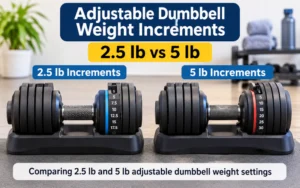
| Weight increments | Model-dependent | Model-dependent | Model-dependent | Depends on available plates |
Which Adjustable Dumbbell Mechanism Is Most Convenient?
It depends on how often you change weights and how you like to handle equipment. No single mechanism is best for everyone.
If you change weights a lot, dial and twist-handle systems cut down on plate handling. Selector-pin systems also let you change weight without loading plates by hand.
Spin-lock dumbbells take more effort to adjust. Some people prefer their simple, traditional design.
Your routine, space, handling preference and budget should decide.
Which Adjustable Dumbbell Mechanism Is Best for You?
Don’t choose on the mechanism alone. Think about how you’ll use and store the dumbbells.
What If You Change Weights Often?
Consider a dial or twist-handle design. You can pick a new weight without removing plates each time.
That helps when your workout uses several exercises at different weights.
What If You Prefer a Nested, Block-Style Weight Stack?
Consider a selector-pin design such as the PowerBlock Elite EXP. Its rectangular, nested build has a different storage and handling profile from round adjustable dumbbells.
Compare the full storage footprint, including any accessories or expansion parts.
What If You Prefer a Traditional-Style Handle?
Consider a twist-handle model such as the NÜOBELL, which uses a knurled steel handle. Check the handle size and grip design before you choose.
What If You Want a Simple Plate-Loaded Design?
Consider spin-lock dumbbells. They suit you if you don’t mind changing plates by hand.
Plan storage for the extra plates and collars.
For apartment home gyms: The mechanism is only part of the storage question. Compare the dumbbell’s real dimensions, its base or cradle, the space you need to reach it and where unused plates will go.
For a comparison of designs and their trade-offs, see our guide to the best adjustable dumbbells for small spaces.
Are Adjustable Dumbbells Safe to Use?
They can be, if you follow the manufacturer’s instructions. Adjustable dumbbells rely on mechanical parts to keep the selected weight attached to the handle. Safety steps differ by design.
Keep these points in mind:
- Check selector engagement: Make sure the pin or dial is fully engaged before you lift.
- Follow positioning instructions: Return the dumbbell to its base before changing weight if the manufacturer requires it.
- Don’t force the mechanism: If a dial, pin or handle resists, check the positioning and the troubleshooting steps in the manual.
- Inspect the parts: Look for damaged plates, loose collars or worn locking parts.
- Follow drop restrictions: Don’t assume an adjustable dumbbell can handle being dropped. Some manufacturers warn against it.
- Use compatible parts: Expansion kits and replacement parts should match your dumbbell model.
As a general rule, a selector that isn’t fully engaged or a collar that isn’t fully tightened may not hold the weight securely. Check your manual to see how to confirm the weight is locked in before you lift.
BowFlex’s SelectTech documentation, for example, gives specific steps for seating, adjusting and handling. Don’t apply those steps to PowerBlock or other brands.
The best approach is to follow the manual for your dumbbell.
Frequently Asked Questions
How Do Adjustable Dumbbells Lock the Weights in Place?
It depends on the design. Dial and twist-handle models use internal selector and locking parts. Selector-pin models use a pin to connect the chosen sections to the handle.
Spin-lock dumbbells use threaded collars to secure removable plates.
What Happens to the Unused Weight Plates?
On many selector-based models, unused plates stay in the cradle or weight stack when you lift. The exact setup depends on the design.
Spin-lock dumbbells are different. You remove the extra plates and store them separately.
Are Dial Adjustable Dumbbells Better Than Selector-Pin Dumbbells?
Neither is automatically better. Dials give you a convenient rotating control. Pins give you a physical way to select the weight.
The right choice depends on weight range, increments, handling, size and storage needs.
Do Adjustable Dumbbells Need a Base?
Not all of them do. Many dial and twist-handle models use a cradle to store unused plates and help change weight.
Some selector-pin designs can be adjusted on a flat surface, depending on the maker. Spin-lock dumbbells generally don’t need a selector cradle.
Can Adjustable Dumbbell Plates Fall Off?
They can if the locking parts aren’t properly engaged or are damaged. The risk and the locking design depend on the product.
Assemble the dumbbell correctly, engage the selector fully and follow the manufacturer’s instructions.
Are Twist-Handle Dumbbells Reliable?
Reliability depends on build quality, maintenance and how you handle the equipment. A twist-handle system isn’t automatically more or less reliable than a dial or pin system.
Check the warranty, replacement-part availability and product documentation before you buy.
How Do Spin-Lock Dumbbells Differ From Selector Dumbbells?
Spin-lock dumbbells make you add or remove plates by hand and secure them with threaded collars. Selector dumbbells use a built-in mechanism to connect the weight you want to the handle.
You don’t load each plate yourself.
Can You Change Adjustable Dumbbell Weight Between Exercises?
Yes. Adjustable dumbbells are made to let you pick different weights. Follow the manufacturer’s instructions when you change weight, including any rule to return the dumbbell to its base first.
What Is the Main Takeaway?
Adjustable dumbbells all solve one problem. You can use different weights without storing a fixed dumbbell for every one.
The mechanism still matters. Dial systems use a rotating selector, and pin systems connect the handle to selected sections. Twist-handle designs use handle rotation, and spin-lock models use hand-loaded plates and collars.
Look beyond the advertised maximum weight. For an apartment or compact home gym, weigh the mechanism alongside the full storage footprint, weight range, increments, handle size and warranty.
For a closer look at specific models, read our guide to the best adjustable dumbbells for small spaces.