Walk for about five minutes every hour, and aim for roughly 7,000 steps a day. Those are reasonable starting points for many adults, based on a 2026 study and a large Lancet review. This guide shows you how to get there without a gym.
Quick answer: Start with a five-minute walk about once an hour and gradually work toward a daily step goal that suits your current activity level. Around 7,000 steps can be a practical target for some adults, but there is no single step count everyone needs to reach. Try walking during calls, between meetings, or before and after work. Consider a walking pad only if it fits your routine, available space, and budget.
Why Can Working From Home Mean Less Movement?
An office day builds in small, automatic movement. At home, a whole workday can pass between a chair and a kitchen. That is a common-sense explanation, not a measured result.
What did an office day do for you?
None of it was exercise, but each cue below has a free replacement in Level 1.
- The commute: a walk before or after work
- The walk to a meeting room: a lap after each call
- Lunch out: eating away from your desk
- Coffee, printer, stairs: a refill-and-lap
Why does sitting get worse at home?
Video calls don’t make you go anywhere. Back-to-back meetings can mean hours with no reason to stand.
The authors of a 2026 study say adults in high-income countries are sedentary for 11 to 12 hours of the day on average. They link that much inactivity to higher risks of many long-term conditions and death. bmjgroupbmjgroup
In our view, the problem is rarely motivation. The cues are gone, and this guide helps you rebuild them.
How Often Should You Get Up From Your Desk?
About once an hour, for about five minutes. The researchers behind a large 2026 study judged that schedule the best balance of results and practicality. Treat it as a starting point, not a prescription.
What did the 2026 study find?
A 2026 study in the British Journal of Sports Medicine, led by Keith Diaz at Columbia University, drew on 19,342 adults in an online challenge run by NPR in the US. Nearly 60% of them (11,484) took 5-minute walks every 30, 60 or 120 minutes for 14 days, after a week of their usual routine. People choose their own schedule.
The researchers concluded that hourly breaks gave the best balance between ease and results. However, treat this as a starting point, not a prescription.
What are the study’s limits?
Keep these in mind before you rely on it:
- Every result came from people’s own survey answers.
- Participants were mostly White, female and highly educated, so the findings may not apply to everyone.
- The study was short, so long-term results are unknown.
- The press release calls it observational, which means it can show patterns but can’t prove cause.
- Because people picked their own schedule, the three groups may differ in other ways. That point is our reading, not the authors’.
How do 30, 60 and 120 minutes compare?
| Break schedule | Fatigue and mood benefit | Ease of maintaining | Suggested use |
|---|---|---|---|
| 5 min every 30 min | Strongest improvements | Lowest feasibility and compliance | Short-term boosts on flexible days |
| 5 min every 60 min | Met the study’s threshold for a meaningful improvement in fatigue and good mood | Easier than every 30 minutes; the most popular choice |
A default starting point
Practical option |
| 5 min every 120 min | Least effective of the three schedules | Easiest to maintain | Meeting-heavy days |
The pattern in the study: the 30-minute group improved the most but scored low on feasibility and compliance. The 120-minute group was the easiest to keep up but the least effective.
Will walking breaks hurt your work?
The researchers saw no sign that breaks hurt work performance, as people rated it themselves. Engagement and performance improved slightly on average (4% to 7% and 1% to 3%), but none passed the study’s line for a meaningful change. Everything was self-rated.
What if you don’t have five minutes?
A Finnish laboratory study (SitFit, press release May 2024) compared several ways of breaking up sitting and recommended a two-minute easy walk every 30 minutes. Volunteers picked a two-minute treadmill walk as their favorite break.
On a meeting-heavy day, a two-minute lap is a reasonable fallback, in our view.
How Many Steps Should a Desk Worker Take?
Around 7,000 steps a day is a reasonable general target for adults. A large Lancet Public Health review found benefits at that level, and it may be easier to reach than 10,000.
Why 7,000 instead of 10,000?
The review looked at device-counted steps. It found turning points at around 5,000 to 7,000 steps a day for several outcomes. The authors said 7,000 might be a more realistic and achievable target for some people. Two results stand out: nih
- 7,000 steps versus 2,000 was linked to a 47% lower risk of death from any cause. urbanhealthtoday
- 4,000 steps versus 2,000 was linked to a 36% lower risk. theleader
This is observational research, so it shows a link, not proof that steps cause the benefit. The authors add that 10,000 steps can still be a good target for people who are more active.
How Do You Build a WFH Movement Budget?
Subtract your baseline from your target. Then fill the gap with small walks instead of one big workout.
Step 1: What is your baseline?
Open your phone or watch and look at a typical workday, not your best one. Average a few if you can. Step counts vary widely by person and job, so use your own number.
Step 2: What is your gap?
Target minus baseline. With a baseline of 4,200 and a target of 7,000, the gap is 2,800 steps.
Step 3: How do you fill the gap?
Walk comfortably for five minutes and check your count. Use that number to size each tactic.
| Tactic | Effort | Time cost | How to size it |
|---|---|---|---|
| Hourly 5-minute walk | Low | About 40 minutes across an 8-hour day | Your 5-minute count × number of breaks |
| Walking during calls | Low | No extra time | Call minutes × your steps per minute |
| “Commute loop” before and after work | Medium | 10–20 minutes | Your steps per minute × loop length |
| Post-meeting lap | Very low | 1–2 minutes each | Steps per lap × meetings a day |
A hypothetical example, not a benchmark: your test shows 500 steps in five minutes. Four hourly walks add 2,000. A 10-minute commute loop adds about 1,000 more, which covers the 2,800 gap. Your numbers will differ.
Will walking breaks help you lose weight?
This guide doesn’t promise weight loss. A 2011 lab study of 20 adults aged 18–39 estimated that walking 1, 2 or 5 minutes every hour could theoretically burn an extra 24, 59 or 132 calories over an 8-hour day, compared with sitting. nih
Those figures are theoretical, come from a small study, and depend on pace and body size. The authors suggested such breaks could help with weight control, but that is still a hypothesis. We recommend walking breaks for energy, mood and breaking up long sitting, and the mood and fatigue results in the 2026 study were self-reported.
Level 1: What Free Ways Can You Stay Active?
Start with free habits tied to things you already do. The tips in Levels 1–3 and the tables are editorial guidance, not study findings.
Which habits can you tie to your day?
| When this happens | Do this | Takes |
|---|---|---|
| A call starts | Walk or stand | Length of the call |
| A meeting ends | Walk a short loop | 1–2 min |
| You refill your drink | Add a lap or a stretch | 1 min |
| Lunch ends | Walk a few minutes | A few minutes |
| A short errand comes up | Go on foot | Varies |
| Work ends | Take a “commute” walk | 10–20 min |
Can you take calls on your feet?
Listen-only calls are the easiest, such as a status update with your camera off. Calls where you share your screen or take notes are harder.
Use a headset or earbuds so your hands are free. Keep to rooms and routes you can walk safely. [REVIEW 10]
Can you recreate your commute?
A walk before and after work adds steps. For some people it also gives the day a clear start and finish when the desk is in the living room.
To walk while you work, see How to Use an Under-Desk Treadmill While Working: Setup, Speed & Tips.
Level 2: What Small, Low-Cost Gear Is Worth Trying?
Our suggestion: give Level 1 a couple of weeks before you buy anything.
Are resistance bands a good fit for a small apartment?
Bands are compact and quiet. Use them for a few minutes between tasks.
Check bands for nicks or wear before each use, and follow the maker’s instructions.
Can pedals or a mini stepper help?
Both can add light movement while you sit. How much depends on the product and how hard you work.
In our view, they add to walking breaks but don’t replace them. They may also disrupt focus-heavy days less.
What should you skip for now?
These are our suggestions:
- Anything you can’t store out of the way
- Gear bought to make a plan feel complete, not to fix a problem you’ve had (for example, skipping walks because of weather)
- A second piece of equipment before you’ve used the first
Level 3: Should You Walk While You Work?
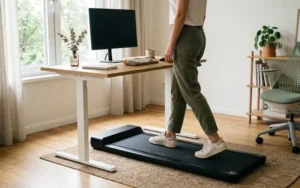
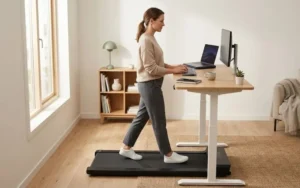
A walking pad or under-desk treadmill lets you add steps without leaving your desk. It is the biggest commitment in this guide, and it isn’t for everyone.
Who is a walking pad a good fit for?
In our view, it suits call-heavy days, flexible schedules, and people with a home office or a clear corner of one. Here is a quick test, also ours. If you can say yes to all three, it’s worth a closer look.
- Do I have call-heavy or flexible days?
- Do I have space to unfold it and a place to store it?
- Can I live with the noise, on my calls and for the people downstairs?
Who should skip it?
People who do fine mouse work or long stretches of typing may find walking while working harder. Noise can also be a problem in buildings where it carries.
Experience varies, and we haven’t tested this ourselves. Our how-to guide covers speeds and setup.
What should renters check first?
- Noise: read the maker’s noise information, and think about the floor below you.
- Floor protection: a mat may help protect floors and reduce vibration, but results vary.
- Storage: measure where it will live, such as under a bed or against a wall.
- Safety: read the manual for weight limits, start at the slowest speed, and slow down or step off if typing or mousing gets sloppy.
Does equipment alone cut your sitting time?
A 2013 study from Curtin University in Australia (published in PLOS One, as summarized by the trade magazine ISHN) suggests not by itself.
- Each of three strategies cut sitting by only about eight minutes a day, a 1–2% drop.
- One strategy gave workers treadmill or cycling desks, with a suggestion to use them 10 to 30 minutes several times a day.
- The lead researcher said organizations found regular use of active workstations hard to put in place.
- One office with more scheduling flexibility saw the biggest drop, and the authors suggested these methods might work best for people with flexible hours and self-managed breaks.
The study is more than a decade old, and this summary comes from a secondary source. Our view: a walking pad is a tool, and the habit does the work.
Where can you learn more?
- How it works day to day: How to Use an Under-Desk Treadmill While Working: Setup, Speed & Tips
- Our under-desk options: best under-desk treadmills
- Before you buy: Under-Desk Treadmill Buying Guide: What to Know Before You Buy (2026)
Which Option Fits Your Workday?
These pairings are our suggestions, not study findings.
| Your workday | Best starting tactic | Why |
|---|---|---|
| Back-to-back meetings | Post-meeting laps and 2-minute breaks | There’s no time for longer ones |
| Deep-focus work | Hourly 5-minute walk | Protects your focus blocks |
| Call-heavy | Walk during calls | The steps are free |
| Flexible or creative | Commute loop plus hourly walk | Most room to experiment |
Thinking about equipment? Our guide to the best walking pads for apartments covers small-space picks.
What Doesn’t Work for Staying Active at Home?
Is a standing desk enough?
Not on its own, in our view. Standing changes your posture, but it isn’t walking.
The evidence summaries we reviewed were mixed on whether a standing desk alone reduces sitting time. We treat one as an add-on to walking breaks.
Is one morning workout enough?
One workout doesn’t create movement cues for the other eight hours. That’s reasoning, not a proven harm, so keep your workout. Add breaks on top of it.
Why do vague reminders fail?
In our view, “move more” doesn’t say when or for how long. “Walk for five minutes at the top of the hour” does.
How Do You Make It Stick?
These are editorial suggestions.
- Make the first step easy. Keep shoes by the door and equipment where you can see it.
- Use the triggers above instead of relying on memory.
- Keep a two-minute fallback for bad days. In our view, a tiny version is usually better than skipping.
- Track one number: steps or breaks, not both.
What Does a 7-Day Starter Plan Look Like?
- Day 1: Note your step count at the end of a normal workday. That’s your baseline.
- Day 2: Set an hourly reminder for a five-minute walk (two minutes if five isn’t realistic today).
- Day 3: Walk during one listen-only call.
- Day 4: Add a lap after each meeting.
- Day 5: Try a commute loop before or after work.
- Day 6: Keep what you did at least twice, and drop what you skipped.
- Day 7: Decide whether to stay at Level 1 or look at Level 2 or 3, using the workday table above.
FAQs
How often should I get up from my desk when working from home?
About once an hour for roughly five minutes is a reasonable starting point. A large 2026 study’s authors judged it the best balance of results and practicality. A 2024 Finnish lab study recommended two minutes every 30 minutes. Both are general guidance.
How many steps should a desk worker take a day?
Around 7,000 is a reasonable general target for adults. A Lancet Public Health review linked it to meaningful health improvements, but that is a link from observational research. Your health, age and starting point matter, so use it as a guide, not a rule, and check your baseline first.
Is a 5-minute walk every hour really enough?
In the 2026 study, hourly 5-minute walks were linked to less fatigue and better mood, based on self-reports. The study measured mood, fatigue and work outcomes. It did not test whether breaks meet overall physical-activity guidelines, so treat them as a way to break up sitting, alongside other activity.
Is a standing desk enough to stay active?
Not on its own, in our view. Standing isn’t walking, and the evidence summaries we reviewed were mixed on whether a standing desk alone reduces sitting time. Pair one with regular walking breaks.
How can I stay active in a small apartment?
Use the space between rooms. Walk during calls, add a lap after meetings, and keep a band in a drawer. A compact walking pad works only if you have somewhere to store it.
Is a walking pad worth it for working from home?
It depends on your work and habits. In our view, it suits call-heavy or flexible days and may be less useful in noise-sensitive buildings. Try Level 1 first, then see our buying guide and our honest take on whether walking pads are worth it.
Can I stay active without leaving my desk?
Partly. Under-desk pedals or a mini stepper can add light movement while you sit. In our view, they add to walking breaks but don’t replace them.
Will taking walking breaks hurt my productivity?
The 2026 study found no sign that hourly breaks hurt self-rated work performance. Changes in performance and engagement were small and didn’t pass the study’s meaningful-change line. Everything was self-rated.
If you have pain or a health condition, or you’re new to exercise, check with a clinician before changing your activity.
Where Should You Start Tomorrow?
Pick one trigger from the Level 1 table and use it for a week. If it sticks, add a second.
If a couple of weeks pass and it hasn’t stuck, that’s the time to look at gear. If walking while you work appeals to you, start with our best under-desk treadmills.