Disclosure: some links on this page are affiliate links. If you buy through them, we may earn a commission. This guide recommends no specific walking pad models.
Check five specs before you buy a walking pad: deck size, continuous motor power, noise, weight capacity, and folded size. For most walkers, top speed and app features matter less.
A pad can look great on paper and still fail in an apartment. For example, the neighbor below may hear every step, or the folded unit may not fit under your sofa. The belt may also be too short for your stride.
How to read this guide: Figures with a source are that source’s numbers, not our measurements. When a line says “we’d” or “in our view,” it is our opinion.
What should I look for in a walking pad?
Start with these five specs. This is our editorial view, not a tested standard.
- Deck size: a belt long and wide enough for your natural stride.
- Motor: the continuous power rating, if the maker lists one.
- Noise: four sources (motor, belt, footsteps, floor vibration), not one decibel number.
- Weight capacity: a limit well above your body weight.
- Fold and storage: the folded size, plus the clearance it needs.
We’d rank top speed, app features, and extra programs lower for most walkers, because they rarely change daily use.
How this guide was built: It draws on published buying guides, retailer content, and community talk. However, we haven’t tested walking pads for this article, so no figure here is our own measurement.
Which walking pad specs matter most for me?
It depends on how you walk and where you live. Use the table below as editorial guidance, not a tested standard.
| If you mostly… | Prioritize first | Then look at | Safe to skip |
|---|---|---|---|
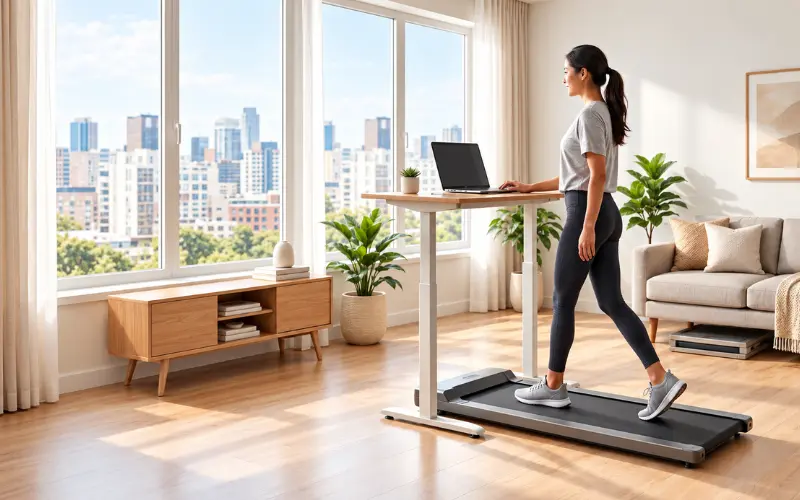
| Walk slowly at a desk | Noise, deck size | Low profile, simple controls | Top speed, incline |
| Walk briskly for longer sessions | Deck length, continuous motor rating | Incline, cushioning | App features |
| Live in a shared home or rental | Noise, fold and storage size | Weight capacity | Top speed, app features |
What is a walking pad, and how is it different from a treadmill?
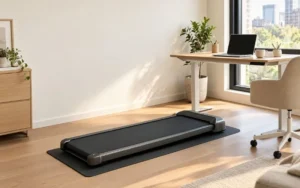
A walking pad is a small treadmill built for walking. Because it is shorter and lower than a full treadmill, it often folds or stores flat. Its top speed is also usually lower.
| Walking pad | Full-size treadmill | |
|---|---|---|
| Intended use | Walking | Walking and running |
| Footprint | Small; often fits under furniture | Large; often needs its own spot |
| Handrails | Often none; some models add one | Usually built in |
| Best for | Desk walking, small spaces | Running, heavier training |
If you plan to run, a walking pad is probably the wrong category. Before you buy, check the maker’s top speed and intended use.
How big should a walking pad belt be?
The belt should fit your stride, not just your floor space. Your body and pace set the size you need, while your room sets the upper limit.
Two published sources show how much the advice varies. However, both are single-source rules of thumb, not standards.
| Source | Suggested belt | Context |
|---|---|---|
| One regional retailer’s buying guide | At least about 40 cm wide × 110 cm long (roughly 16 × 43 in) | For most adults; taller walkers may want longer |
| A full-size treadmill guide | 18 in wide for walkers; about 55 in long for a walking stride | Written for full treadmills, not walking pads |
The treadmill guide wants a longer belt than the retailer’s minimum. It also links belt length to how fast you move. So if a pad’s belt is near the short end, the fit test below matters more.
A short belt can make you shorten your stride, which can make walking feel less natural.
How can I test belt size for free?
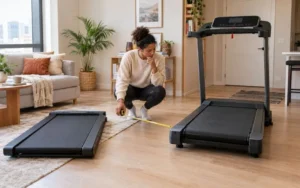
All you need is masking tape and your floor. This is our recommendation, not a tested standard.
- First, find the listed belt length and width. If the listing shows only overall size, ask the seller for the belt size.
- Next, mark that rectangle on your floor with masking tape.
- Then walk along it at your normal pace, and again a little faster.
- Finally, look at where your feet land. If they keep landing near the edges or the back, the size is probably too tight.
Belt length is not overall length. The frame, motor housing, and rear cover add length. So use the belt size to judge your stride, and use the overall size to judge your floor.
How much motor power does a walking pad need?
Look for the continuous rating, because peak horsepower is only a short-burst number. For slow walking, we’d pick a smooth motor with a good warranty over a big horsepower figure.
Guides disagree on how much power you need. One reason may be that they mix two measurements.
- Continuous horsepower (CHP) is what the motor can keep up during normal use.
- Peak horsepower is what it can produce for a short time.
A listing that says “3.0 HP” may not say which kind it means. As a result, it is hard to compare with a listing that states continuous power.
How do I compare motors?
- First, check if the figure is continuous or peak. If it isn’t stated, treat it as a weak signal and ask the seller.
- Next, note the motor type. Brushless motors are often called quieter, but check the maker’s wording.
- Finally, read the motor warranty separately from the frame warranty.
Are walking pads quiet enough for an apartment?
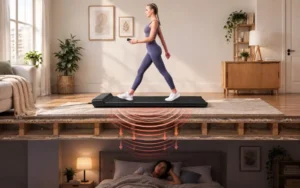
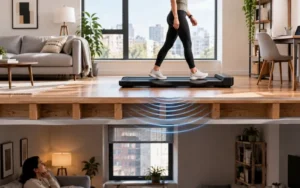
It depends on the machine and your building. A walking pad makes four kinds of noise, but one decibel number rarely says which ones it covers. In apartments, footsteps and floor vibration often matter most.
This is our own framework, not an industry standard.
| Noise | Where it comes from | Who hears it | What to look for |
|---|---|---|---|
| Motor hum | Motor and drive system | You, and anyone on your call | Brushless motor; noise at slow speeds |
| Belt noise | Belt and deck | You, nearby rooms | Owner reviews that mention belt sound |
| Footfall thud | Your steps landing on the deck | The unit below yours | Cushioning; a mat underneath |
| Floor vibration | The frame passing vibration to the floor | Neighbors, and you | Anti-vibration mat; flooring type |
Why do decibel claims disagree?
Guides and listings give very different numbers for what counts as quiet. Makers may also test under different conditions, and they don’t always share them. In fact, at least one review site says these figures are maker claims unless it measured them itself.
So treat a single dB number as a rough hint at best. For more detail, here’s a closer look at what decibel ratings mean.
Why do apartments change the noise priority?
One buying guide says footfall and vibration can matter as much as motor noise, especially in a flat. If you share a wall or floor, the last two rows of the table may matter more to your neighbors than the first two.
What can renters do to cut noise?
These are our recommendations, and we haven’t tested how well they work.
- Put the pad on an anti-vibration mat.
- If you can, keep it away from shared walls.
- When you take calls, use slower speeds.
How much weight capacity do I need?
Pick a limit well above your body weight, not one that barely clears it. One published guide suggests a gap of 15 to 20 kg (about 33 to 44 lb), but that is a single-source rule of thumb, not a standard.
The guide’s reasoning is that running near the limit strains the deck and motor.
Example (illustrative numbers, not a product): At 180 lb, adding a 33 to 44 lb gap points to a stated capacity of about 213 to 224 lb or more.
In a shared home, use the heaviest regular user’s weight. Some compact machines also have lower limits than full-size treadmills, so check the listing. If you need extra headroom, browse high-capacity models built for heavier users.
Will a folding walking pad fit where I want to store it?
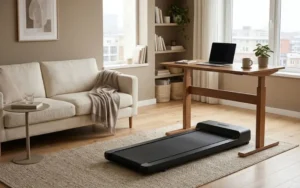
Maybe. Folded size and the clearance the machine needs are two different things. Because motor housings, wheels, and handles can stand taller than the deck, a slim fold may still not slide under a low sofa.
| Fold type | How it stores | Trade-off |
|---|---|---|
| Folding deck | Deck folds back on itself | Folded size varies; compare listed dimensions |
| Non-folding slim | Stays flat | Needs a stable spot, like under a bed |
Fold terms (single fold, double fold, 180°-fold) may differ by brand, so compare the listed folded size, not the label. A lock keeps the folded unit from swinging open. Meanwhile, the listed weight tells you what you’ll lift or tilt alone.
What should I measure for each storage spot?
- Under a sofa or bed: measure floor-to-frame clearance at the lowest point of the frame, not the middle.
- Closet: measure the inside width, depth, and door swing.
- Behind a door: check the space with the door fully open, and how far the folded unit sticks out.
Do I need a high top speed or incline?
Most walkers don’t need a high top speed. In our view, it is one of the least useful numbers on the listing. At a desk, you’ll likely stay at a slow pace, so deck size, stability, and noise will matter more.
Is incline worth it?
- Brisk walkers: incline can help because it raises effort without raising speed.
- Desk walkers: incline is usually optional.
- Manual vs. automatic: manual is simpler, while automatic adjusts from the remote or console. The listing should say which.
Can I jog on a walking pad?
Check the maker’s speed range and intended use first. Many walking pads are built for walking only, and using one outside its range may be unsafe or affect the warranty.
What controls and safety features should I look for?
A simple remote is often enough, in our opinion. It lets you change speed at your desk without looking down. An app is only worth paying for if you’ll open it.
Controls come as a handheld remote, buttons on the unit, or an app. Also look for these safety features:
- An emergency stop, such as a clip-style shutoff or a stop button.
- A stable fold lock.
- A handrail, if balance is a concern. Not every walking pad has one.
What should I check about warranty and cost of ownership?
The price tag is only part of the cost. Check these three things.
- Warranty coverage: length often differs by part, so read the motor, frame, and other parts separately.
- Maintenance: some belts need regular lubrication, so follow the maker’s instructions.
- Returns: you may not be able to test a pad in a store, so read the return terms, including who pays return shipping on a heavy item.
Which listing claims should I double-check?
Check any claim about motor power, noise, capacity, folding, or speed. The table below shows patterns to watch for, but they are not claims about any specific product. Always verify every figure on the maker’s own spec sheet.
| Spec | What the listing says | What it may really mean | What to do |
|---|---|---|---|
| Motor | “3.0 HP” | Possibly peak, not continuous | Find the continuous rating |
| Noise | “Ultra-quiet” | May reflect motor noise only | Check reviews for footfall and vibration |
| Capacity | “300 lb” | The maximum, not a comfortable range | Add headroom over your weight |
| Foldable | “Space-saving” | It folds, but may need clearance | Get folded height, including wheels |
| Speed | “Up to 6 mph” | A top speed you may never use | Judge the deck against your stride |
What should I ask the seller before I buy?
If the listing doesn’t answer them, ask these questions.
- Is the horsepower figure continuous or peak?
- At what speed and load was the noise figure measured?
- What are the belt dimensions, apart from the overall dimensions?
- What are the folded dimensions, including wheels and handle?
- How long is the warranty for the motor, the frame, and other parts?
- What is the return window, and who pays return shipping?
What should I measure before I buy a walking pad?
Measure seven things at home before you order. Use this checklist.
- ☐ Floor space where you’ll walk (deck length and width, plus room around it)
- ☐ Folded footprint of the model you’re considering
- ☐ Clearance height where you plan to store it
- ☐ The path from the delivery point to storage (doors, hallways, stairs)
- ☐ Your floor type (hard floor, carpet, or shared with a downstairs neighbor)
- ☐ The machine’s weight, and whether you can lift or tilt it
- ☐ The nearest outlet and the cord length
Should I buy a walking pad, a treadmill, or an under-desk bike?
Choose the pad if you want to walk in a small space. If running matters, choose the treadmill. Or pick the bike if you’d rather stay seated.
| Walking pad | Full treadmill | Under-desk bike | |
|---|---|---|---|
| Footprint | Small, storable | Large | Very small |
| Best for | Walking at a desk or during other activity | Walking or running | Pedaling while seated |
| Noise sources | Motor, belt, footfall, vibration | Similar sources; levels vary by model | Pedal and resistance mechanism |
| Trade-off | Limited speed range | Often needs its own spot | No walking motion |
Walking pad buying guide FAQs
How big should a walking pad deck be?
Big enough that your feet don’t land near the edges at your natural stride. One retailer guide suggests at least about 40 cm × 110 cm for most adults, and longer for taller walkers. That is a single-source rule of thumb, not a standard, so try the tape test above before you buy.
Are walking pads quiet enough for an apartment?
It depends on the machine and the building. Because footsteps and floor vibration can matter as much as motor noise, a mat and a slower pace may help. Still, treat maker decibel figures as claims, not measurements.
How much weight capacity should a walking pad have?
Well above your body weight. One published guide suggests a gap of 15 to 20 kg (about 33 to 44 lb), but that is a single-source rule of thumb. If you share your home, use the heaviest regular user’s weight.
Is a folding walking pad worth it?
In our view, usually yes if you’ll store it between uses. Compare folded size and clearance, not just the fold type. However, if it stays out all day, a non-folding slim pad may be enough.
Do I need incline on a walking pad?
Not necessarily. Brisk walkers may like the extra effort without more speed, while desk walkers can usually skip it.
Can you run on a walking pad?
Many are built for walking only, so check the maker’s speed range and intended use. If you want to run, research full-size treadmills built for running.
Is a walking pad better than a treadmill for small spaces?
For storage, often yes, since many walking pads are lower and fold. However, the trade-offs are often a shorter belt and a lower top speed.
Are walking pad horsepower claims reliable?
Not always comparable. Some listings show peak power, some show continuous, and some don’t say. So look for the continuous rating and the motor warranty.
Can I use a walking pad on carpet or hardwood?
Check the manual for the maker’s floor guidance, because some machines need a firm, level surface. Thick carpet could affect stability or warranty coverage. On hardwood, a mat may protect the floor and reduce vibration.
Where can I see walking pads that fit these specs?
Once you’ve worked through the specs above, see our picks for walking pads that meet these specs.