
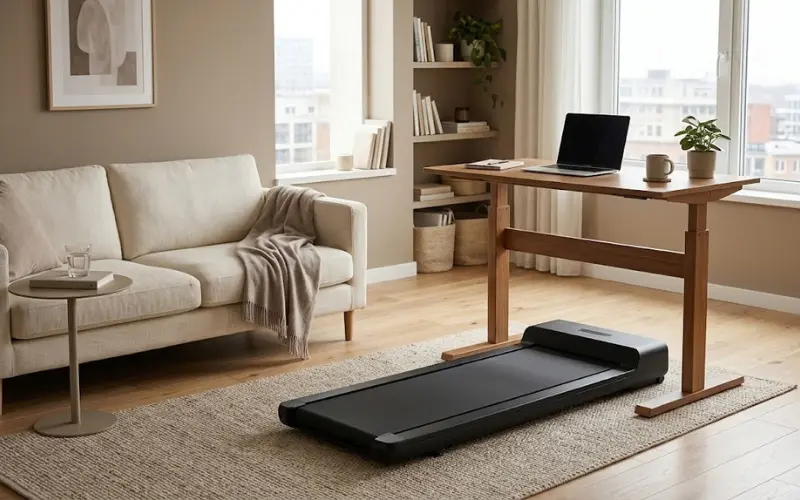
Are walking pads worth it? For most apartment dwellers, yes, if you’ll use one, your floor can take it, and your neighbors won’t hear it. Most of the decision comes down to those three things, not motor size or app features.
This guide gives you a two-minute test, the cost math worked out, and a plain list of who should skip one.
The Quick Answer
Are walking pads worth it? Yes, if you live in a small space, will walk 20+ minutes on most days, and can keep the noise under control. It’s not worth it if you want to run, can’t reduce noise for the neighbors below you, or rarely stick with home equipment. Take the test below to check.
Are Walking Pads Worth It for You? The 2-Minute Apartment Test
Score one point for each “yes.” Four or more suggests a good fit; two or fewer suggests trying something else first. This is my own rule of thumb, not a validated tool, and the 20-minute figure in question 5 is an editorial benchmark, not a medical standard.
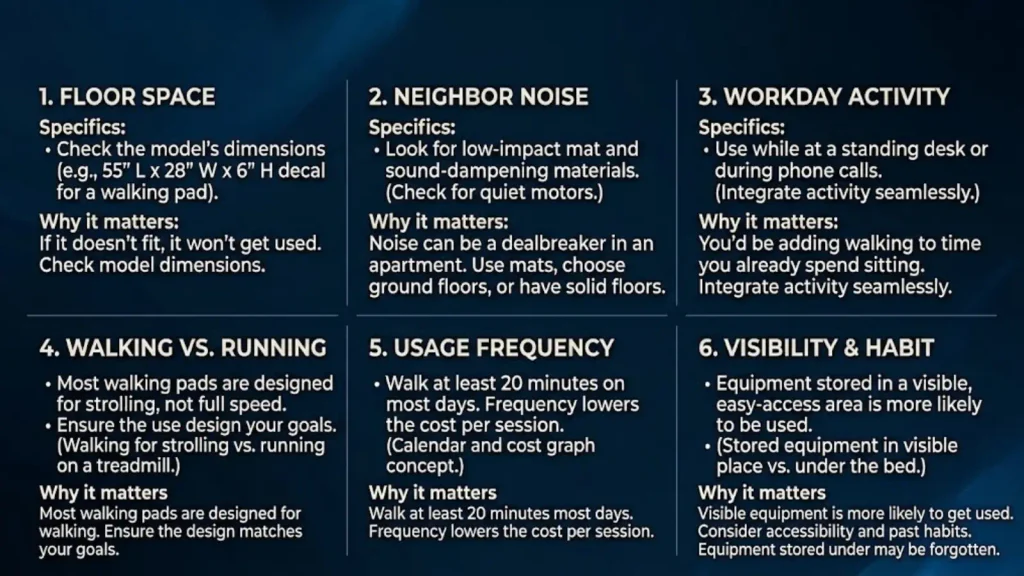
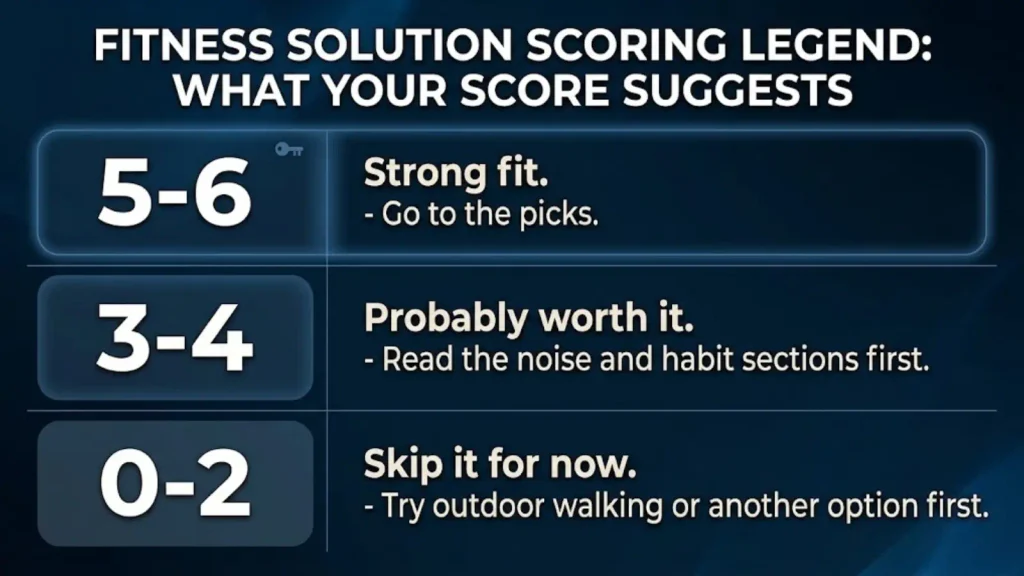
If you’ve bought home equipment before and it went unused, count question 6 as a no. It may mean placement and routine matter more for you than specs do.
Two hypothetical readers
These are invented for illustration, not real customers.
| Reader A | Reader B | |
|---|---|---|
| Situation | Ground-floor one-bedroom, calls most afternoons, open corner in the bedroom | Third-floor unit above a neighbor who works nights, wants to jog, closet storage only |
| Q1 space | Yes | Yes |
| Q2 noise | Yes | No |
| Q3 sits a lot | Yes | Yes |
| Q4 walking only | Yes | No |
| Q5 20+ minutes | Yes | Unsure |
| Q6 visible or a track record | Yes | No |
| Score | 6: strong fit | 2: skip, or look at other options |
Reader B loses points on noise, purpose, and placement. Those are problems a different walking pad wouldn’t fix.
What You Actually Get From a Walking Pad
A walking pad makes gentle daily movement easy to do at home. It won’t replace strength training or running.
More walking on days you’d otherwise skip it
For example, rain, heat, dark winter evenings, unsafe streets, and back-to-back calls are situations where a pad can help. Meanwhile, step counts vary by person, speed, and stride, so use your own tracker rather than a generic number.
Walking, not running
Walking pads are designed mainly for walking. Compared with running, walking is commonly described as a lower-impact option; however, if you have joint, injury, or balance concerns, ask a clinician before starting.
You may see the term NEAT (non-exercise activity thermogenesis): the energy you use for everyday movement other than sleeping, eating, or deliberate exercise. A pad is one way to add more of it.
What health guidelines say
he CDC recommends at least 150 minutes of moderate-intensity physical activity a week for adults and lists brisk walking as an example. In addition, it recommends muscle-strengthening activity on at least 2 days a week, which a walking pad doesn’t cover. Whether your pace counts as moderate-intensity depends on your effort, so check the CDC’s description of intensity. (Source: CDC, “Adult Activity: An Overview,” cdc.gov/physical-activity-basics/guidelines/adults.html.)
Beyond those weekly targets, the CDC also advises adults to move more and sit less, and says some activity is better than none.
Calories and weight
Calories burned depend on your weight, speed, and time. One commonly used estimate:
kcal per minute = MET × 3.5 × body weight (kg) ÷ 200
MET measures how hard an activity is. Look up the value for your speed in the Compendium of Physical Activities, and check the formula against a reputable source before relying on it.
Hypothetical example: at 68 kg (about 150 lb) and an assumed MET of 3.5, the formula gives roughly 4 kcal per minute, or about 250 kcal an hour. The 3.5 is a placeholder for illustration, and your numbers will differ.
Whether a pad affects your weight depends on your whole routine, including food, sleep, and other activity. For realistic weight-loss expectations, see our walking pad weight-loss guide. This article can’t promise weight-loss results; a clinician or dietitian can advise you personally.
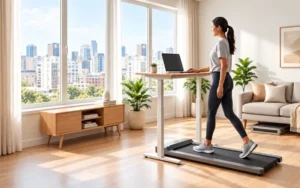
Walking while working
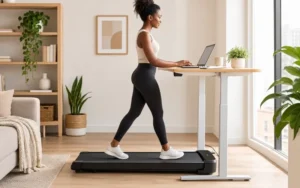
Many people find calls, reading, email, and videos work well while walking. Precision tasks like detailed design or fast typing may feel harder, though experiences vary. [INSERT your own experience, or leave it out.]
Walking Pads: Pros, Cons, and Where They’re Worth It
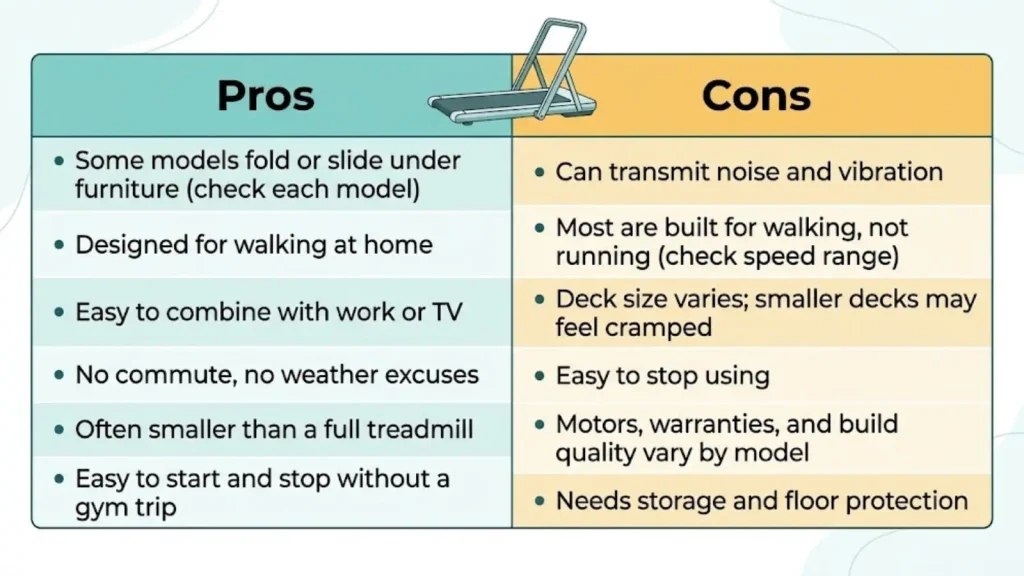
The rows that matter most for apartments are noise (cons) and storage (cons). If those two are solved, the rest of the table mostly works in your favor.
Are Walking Pads Worth It? The Cost-Per-Use Math
Price ÷ realistic sessions per year = cost per session. Prices change often, so the table below uses hypothetical figures to show the math, not a price quote.
| Option | Hypothetical cost | Sessions per year | Cost per session |
|---|---|---|---|
| Walking pad (example price) | $300 one-time | 200 | $1.50 |
| Same pad, used less | $300 one-time | 50 | $6.00 |
| Gym membership (example) | $30/month = $360/year | 100 | $3.60 |
| Outdoor walking | $0 | Weather-dependent | $0 |
Break-even
To find your break-even, divide the pad’s price by the per-session cost of the alternative. For example, against the example gym at $3.60 a session, a $300 pad breaks even at about 83 sessions, (300 ÷ 3.60), a little under two a week. These figures cover year one only. Keep in mind that this compares cost, not equivalence, since a gym offers equipment, a pad doesn’t. If the upfront cost is your main hesitation, there are good options at a lower price.
The better question: what does it replace?
In my view, cost per session matters less than what the pad replaces. If it replaces walks you’d take anyway, you’ve paid for convenience. On the other hand, if it creates walking that otherwise wouldn’t happen, like evenings after dark, call-heavy days, or bad weather, it’s doing real work.
Costs beyond the sticker price
- Anti-vibration or protective floor mat
- Lubricant, if your model requires it (check the manual)
- Replacement remote or accessories
- A standing desk or riser, if you want to work while walking
Apartment Reality Check: Noise, Floors, and Storage
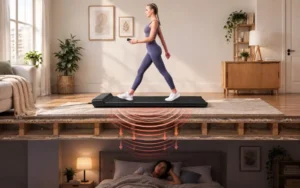
In an apartment, noise, floors, and storage matter more than motor specs.
More importantly, vibration can be what neighbors notice, sometimes more than motor sound.. Vibration can be what neighbors notice, sometimes more than motor sound.
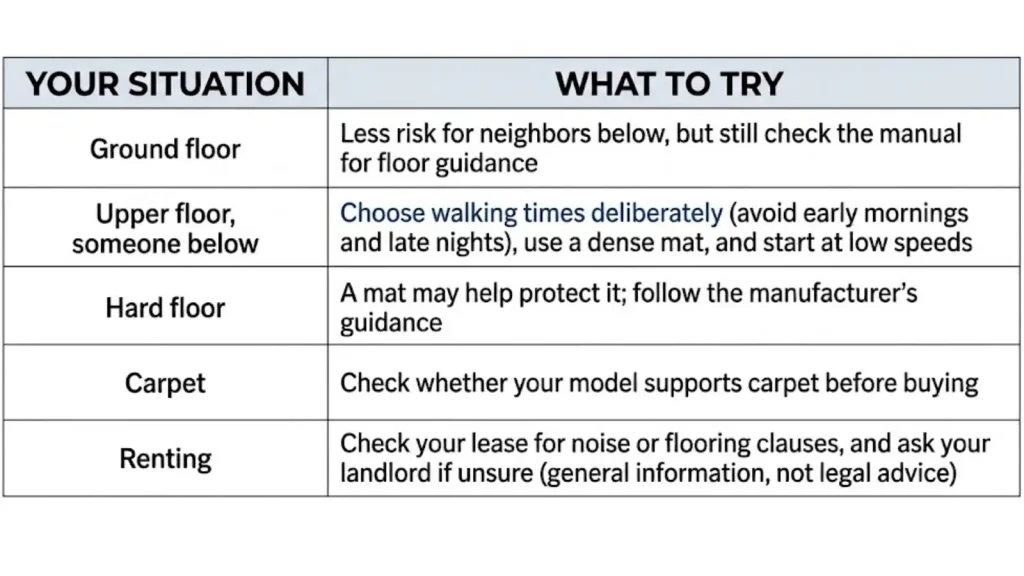
What to do in your situation
These are suggestions, not guarantees.
Test it in your own unit
Noise depends on your building, so check the retailer’s return policy before you buy. If noise is your biggest worry, start with quieter walking pad models. Then, during the first few days, walk at your slowest and your usual speed, and if a housemate or a neighbor who agrees can listen from below, ask what they hear.
Where it lives
| Storage spot | Works if… |
|---|---|
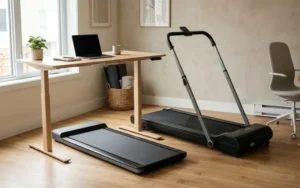
| Under the bed | The pad’s folded height clears the frame |
| Behind the couch | You have a narrow, uncluttered gap |
| Closet | The pad is foldable and light enough for you to move easily |
| Leaned vertically | Your model allows upright storage (check the manual) |
Measure your space against the folded dimensions before ordering.
No desk? You don’t need a standing desk. Many people use a pad during TV, phone calls, or audiobooks.
Walking Pad vs. Treadmill vs. Other Options
Choose a walking pad for walking in tight spaces, a full treadmill to run, and outdoor walking if you have safe routes you’ll actually use.
| Walking pad | Full treadmill | Stationary bike | Outdoor walking | |
|---|---|---|---|---|
| Best for | Walking in small spaces | Running, incline work | Seated cardio | Free, fresh air |
| Space needed | Small | Large | Medium | None |
| Weather-proof | Yes | Yes | Yes | No |
In practice, choose a walking pad for walking in tight spaces, a full treadmill to run, and outdoor walking if you have safe routes you’ll actually use. Our full guide lets you compare a walking pad with a full treadmill in detail.
When Walking Pads Aren’t Worth It: Who Should Skip One
Another option may serve you better if any of these fit:
- You want to run or do intervals. Get a full treadmill, or run outside.
- You can’t reduce noise and live above someone. Try outdoor or gym walking.
- You need a high weight capacity or a larger deck. Check each model’s limits before buying.
- You know you won’t keep it visible. Try two weeks of outdoor walking first. As a rule of thumb, if that doesn’t stick, a pad may not either, but that’s opinion, not a guarantee.
- You have a health condition, injury, or balance concern. Talk to a clinician before starting.
Keeping It in Use
In my opinion (not research), home equipment tends to go unused when it’s hidden, inconvenient, or tied to a large goal.
- Keep it where you’ll see it. A closet may require more effort each time.
- Attach it to something you already do. Pick one recurring call, show, or podcast as your walking time.
- Start small. Ten to fifteen minutes is a reasonable starting point for many people. Adjust to your fitness and any clinician advice.
- Track weekly, not daily. A weekly total may feel more forgiving than a daily streak.
Safety: follow the instructions in your model’s manual. As general good practice, start at a low speed while you get used to walking and doing something else, and keep kids and pets away from the moving belt.
Which Walking Pads Are Worth It? Picks by Profile
Check these on the spec sheet:
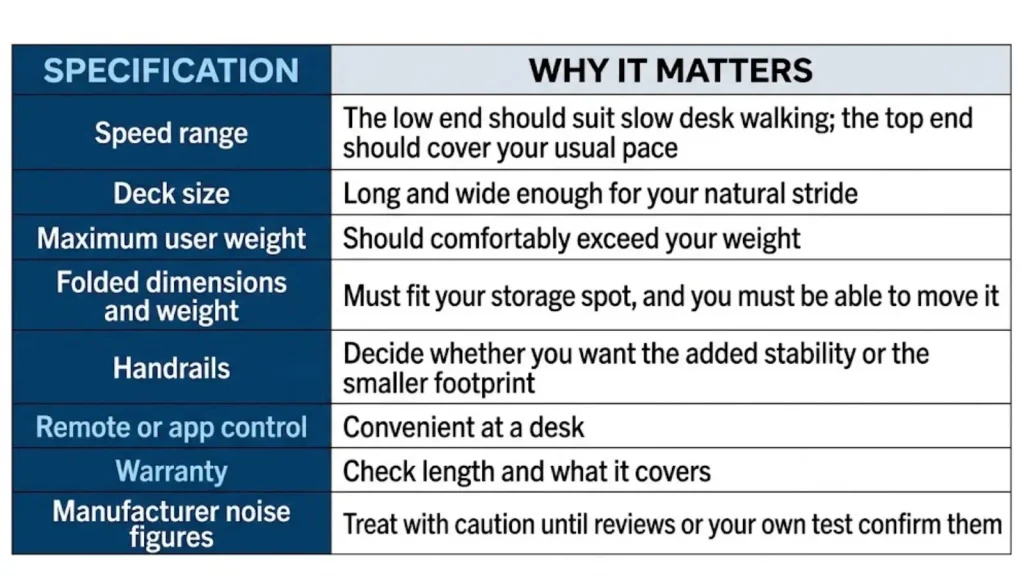
For apartment use, I’d generally prioritize folded size and noise over top speed, since these pads are for walking. That’s my opinion. Our walking pad buying guide covers which features to check in more detail.
My three picks
I earn a commission if you buy through the links below. I haven’t tested these three; the specs come from each brand’s own page and published reviews, and they can change, so confirm on the brand’s page before you buy.
WalkingPad A1 Pro: best for small-space renters
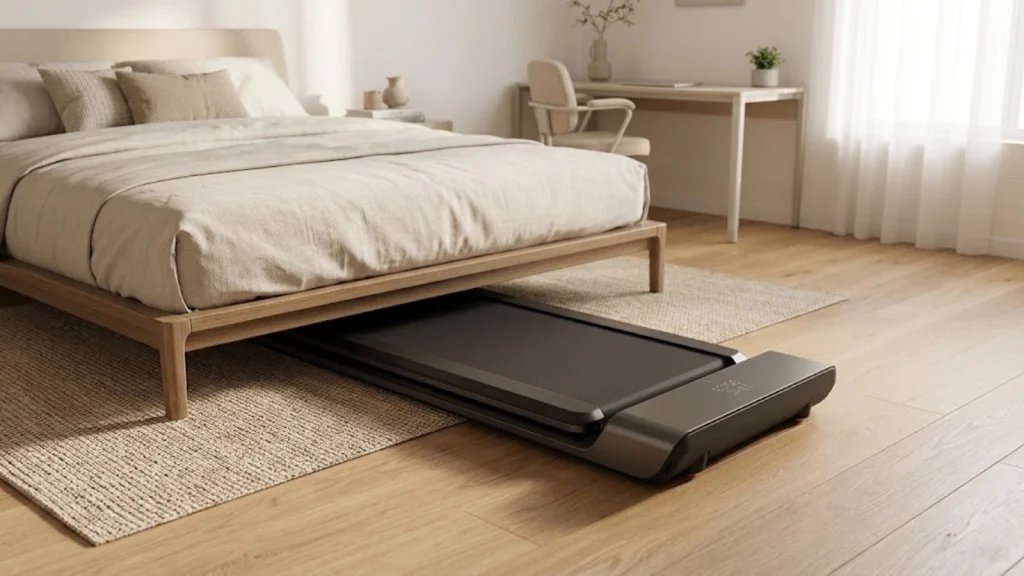
Why it fits: A walking-only pad that folds in half to about 32.5 inches long and 5 inches high, so it can slide under a bed, couch, or desk if you have the clearance. Top speed is about 3.75 mph, with remote, app, and foot-sensing control, and the brand states 65 dB or less.
Honest con: No incline, and at roughly 63 lb it’s easier to roll on its wheels than to lift.
Check first: Weight capacity (the brand lists up to 300 lb, while one review lists 220 lb), the current price, and your under-furniture clearance.
WalkingPad C2: best for under-desk walking
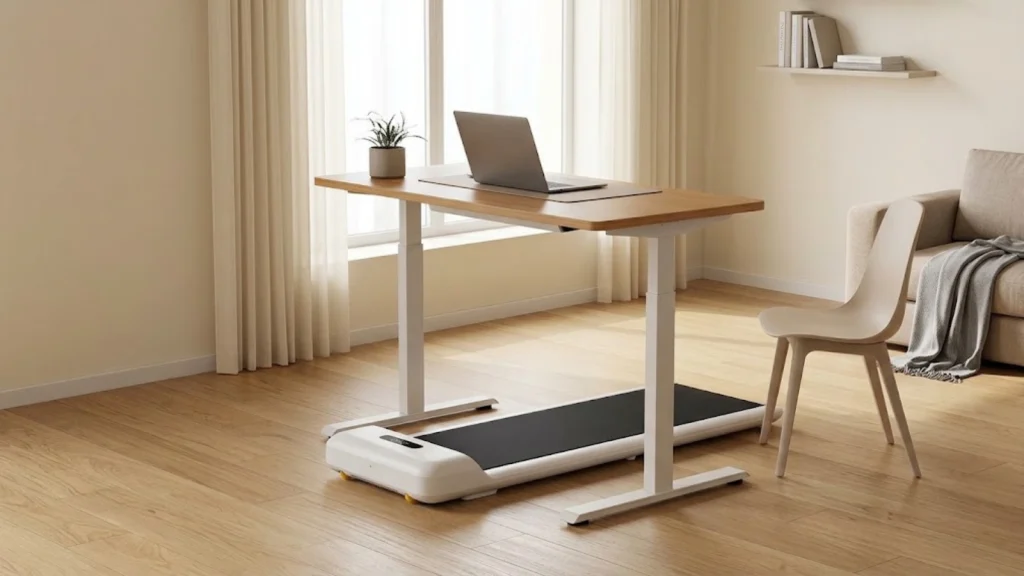
Why it fits: The brand lists a maximum speed of 4 mph and a folded thickness of 5.4 inches. An independent review listed a 47 × 16.5 inch deck, a 220 lb capacity, no incline, and a remote. It’s a walking-only design that folds flat and slides under a standing desk or bed.
Honest con: One review reports owner complaints about the belt drifting off-center and motor noise rising after months of heavy use, though it says these aren’t universal. The same review also preferred the newer Z1 on value.
Check first: Weight and belt width differ between sources (the review lists about 62 lb and a 16.5-inch belt, a retailer lists 55 lb and 16 inches), so use the brand page. Also confirm the current price and warranty.
WalkingPad Z1: best on a budget
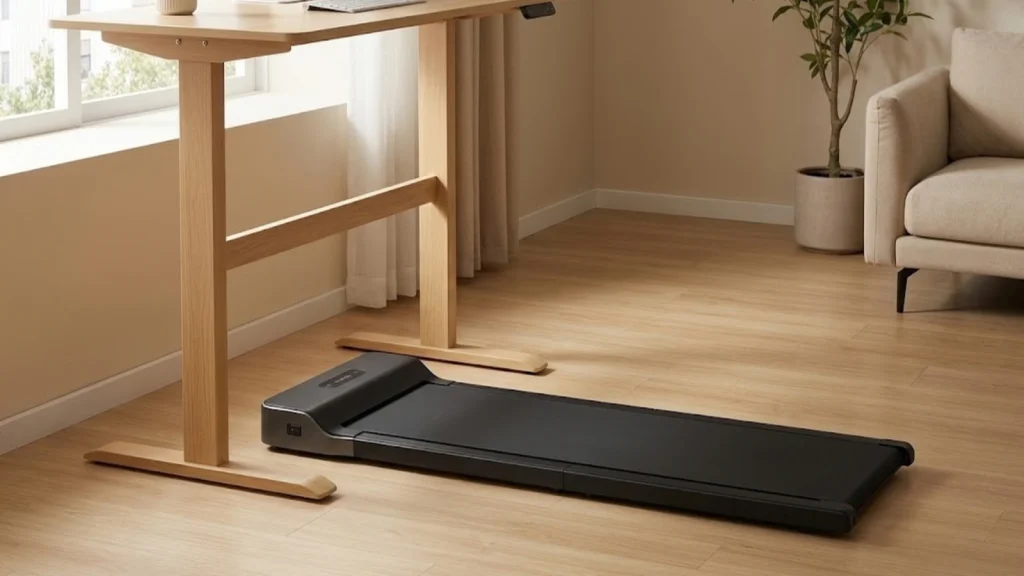
Why it fits: The brand’s site listed the Z1 at a $299 sale price (regular $329) at the time I checked, described as its lightest and most compact model. Its listing gives a 4.1-inch height, 50 lb weight, up to 242 lb capacity, and a 1-4 mph speed range. The brand states a 2.25 HP brushless motor and a flat fold that slides under a bed or sofa.
The trade-off: It’s capped at 4 mph and its capacity is lower than the A1 Pro’s. As a newer model, it has less long-term owner feedback, so read recent reviews before buying.
Before buying: Current price, since sale prices change, and whether the 242 lb capacity covers you with margin.
FAQ: Are Walking Pads Worth It?
Are walking pads worth it for small apartments?
Often yes, if you’ll use one regularly and can manage noise. Take the test above to check your space, floors, and habits.
Is a walking pad worth the money?
It depends on how often you use it and what it replaces. Divide the price by your realistic sessions per year.
What are the pros and cons of a walking pad?
Pros are compact size, walking at home, and easy multitasking. Cons are possible noise, limited speed, and the risk of not using it. See the table above.
Do walking pads help with weight loss?
Results depend on your overall routine, and this article can’t promise weight loss. A clinician or dietitian can give personal guidance.
Are walking pads loud?
It varies by model, floor, and footsteps. Vibration through the floor can be what neighbors notice. A mat and sensible timing may help.
Who shouldn’t buy a walking pad?
People who want to run, can’t reduce noise, lack storage, or won’t keep it accessible. Anyone with a health or balance concern should check with a clinician first.
How many steps can you get on a walking pad?
It depends on speed, stride, and time. Use your own tracker.
Is a walking pad better than a treadmill?
In my view, for walking in small spaces, often yes. For running or incline training, a full treadmill is the better tool.
How long do walking pads last?
It varies by model, build quality, and use. Check the manufacturer’s warranty and read long-term reviews.
Can you use a walking pad on carpet?
It depends on the model. Check your manual, and contact the manufacturer if it doesn’t say.
What to Do Next
- Score yourself with the test above.
- Measure your storage spot and compare it to folded dimensions.
- Check the return policy before ordering, so you can test noise in your own unit.
- Shortlist by profile from our top-ranked walking pads, and read what each pick’s drawback is before you buy.
If you scored two or lower, try two weeks of outdoor walking first. It costs nothing and tells you a lot about whether the habit is there.
Pingback: Walking Pad Weight Loss: Real Calories Burned Per Hour - Small Space Strength
Pingback: Best Walking Pad Under $300 (2026): 3 Picks - Small Space Strength