
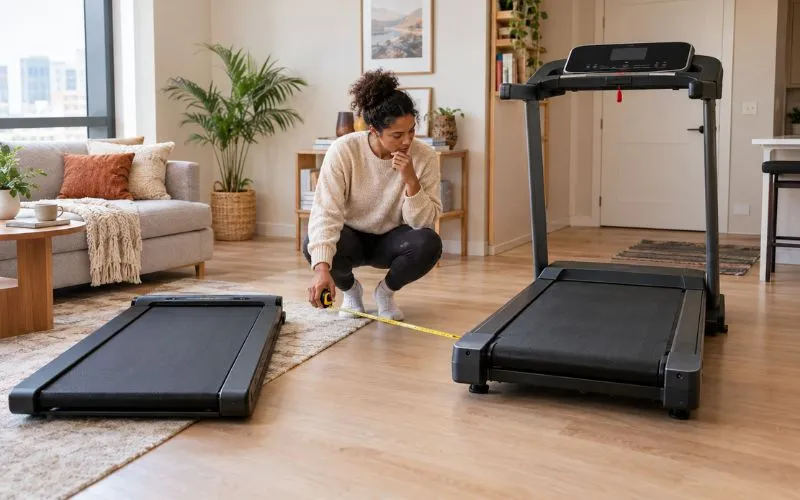
You’re standing in your living room with a tape measure, trying to figure out if either machine will fit — but for most renters, “will it fit” isn’t actually the question that decides a walking pad vs treadmill purchase. The real question is quieter and harder to Google: will this wake up the apartment below you, and will your landlord notice the dent it leaves in the flooring.
Most comparisons stop at specs — speed, incline, price — as if that settles it. Those numbers matter, but if you share a wall or a floor with a neighbor, two other things decide this purchase: how much sound and vibration each machine sends through your building, and what your lease says about the consequences if you get it wrong. The specs are below. So is the part most guides skip.
Quick Answer
For most apartments, the walking pad vs treadmill decision comes down to two factors, not specs: a walking pad is typically quieter, lighter, and easier to store, which matters most if you share a floor or wall with a neighbor. A treadmill makes more sense if you’re training seriously, have a ground-floor unit or a dedicated room, and your lease doesn’t restrict heavy equipment. Check how noise and vibration travel through your specific building, and what your lease says about floor load and damage, before you check anything else. If a walking pad wins for you, start with the best walking pads for apartments.
Walking Pad vs Treadmill: The Basics
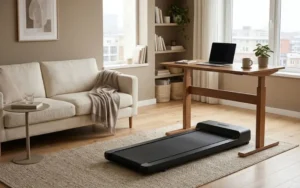
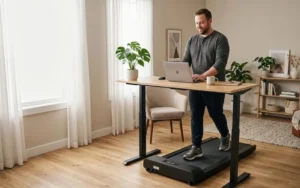
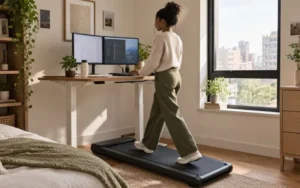
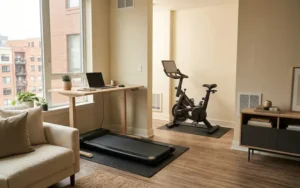
A walking pad is a slimmed-down treadmill — a motorized belt without the tall frame, console, or handrails. It does one job: steady walking, usually while you’re doing something else, like working at a standing desk. You may also see them called under-desk treadmills, so here’s whether under-desk treadmills are the same thing.
A treadmill is the fuller machine, with a sturdier frame, a stronger motor, and incline options. Its speed range covers running as well as walking. It takes up more room and costs more, but it does more.
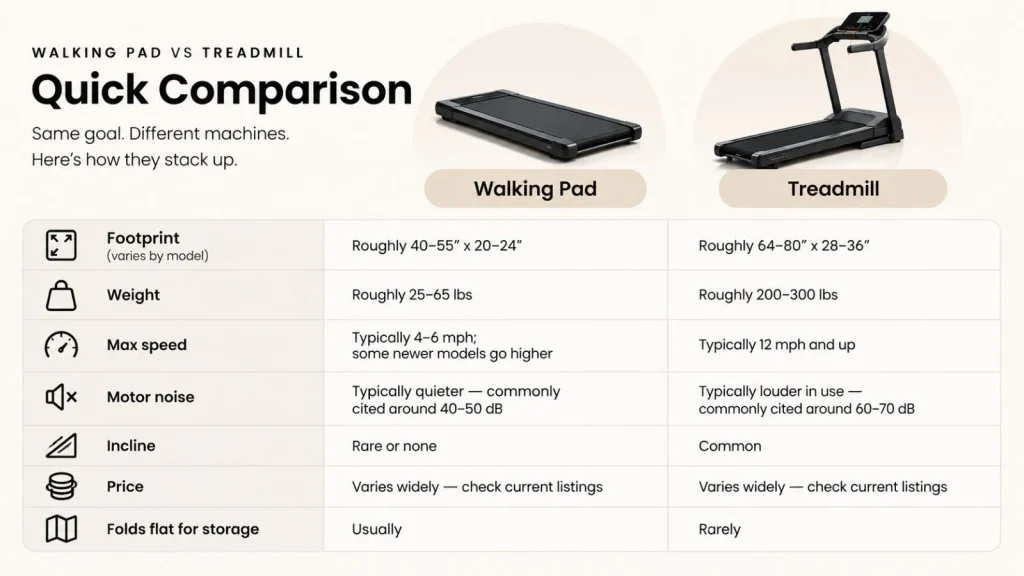
Noise figures are commonly cited approximations from manufacturer and retailer materials, not independently lab-tested for this article — treat them as directional, not exact.
If your goal is more daily movement without a dedicated workout block, that table already points to a walking pad. If you’re training for something specific — a race, structured intervals, incline work — a treadmill’s range makes it the more capable tool. But for renters, footprint and price aren’t the whole decision. That’s where most comparisons stop, and where this one keeps going.
The Real Apartment Problem: Two Kinds of Noise
“Noise level” isn’t one number. It’s two separate problems, and a machine can solve one while doing nothing about the other.
Airborne noise: what you hear in the room
This is what decibel ratings measure — motor hum, belt sound, the whoosh of the machine running. Sources commonly put walking pads around 40–50 dB at walking speed, roughly comparable to a quiet conversation. The same sources often put treadmills at jogging pace in the 60–70 dB range, closer to a vacuum cleaner. The direction is clear: walking pads run quieter, even if the exact figures are approximate. For a closer look, see how noisy walking pads really are.
Structural noise: what your neighbor feels
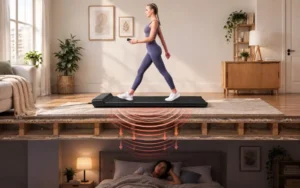
This is the part the spec sheet never mentions. Every footfall on the belt sends a small shock through the machine’s frame and into the floor. From there it reaches the building’s structure. In a concrete-slab building, that impact can travel down to the ceiling below you as a dull, rhythmic thud. It happens no matter how quiet the motor sounds from where you’re standing.
Airborne and structural noise have different causes and different fixes. Airborne noise comes down to the motor and your speed. Structural noise comes down to the floor construction and the machine’s contact points. It also depends on whether anything absorbs the impact before it reaches the floor.
Why a “quiet” walking pad can still get you a complaint
A walking pad advertises its dB rating, you check the box, and you assume you’re safe. But that number only accounts for airborne noise. Say you’re on an upper floor with a hard subfloor, or directly above someone’s bedroom. Footfall impact can still transmit downward, no matter how quiet the motor is. Renters bring this up often enough in discussions of home workout equipment to take it seriously. There’s no formal data on how often it happens, so treat it as a real possibility, not a documented statistic.
Editor’s take: If you’re above ground level, don’t stop at the decibel rating. Where you place the machine matters: over a living room is likely lower-risk than over a bedroom. Buy a mat before you start using the machine, not after the first complaint.
Deposit Risk: What Your Lease Doesn’t Tell You
Noise complaints happen in real time. Floor damage shows up later — usually on your move-out inspection, when there’s nothing left to do about it.
Floor damage by flooring type
(General guidance, not tested claims — actual risk depends on your specific flooring and subfloor.)
- Laminate and vinyl — softer surfaces, more prone to indentation from concentrated weight under the machine’s feet over time.
- Carpet — more forgiving, but sustained pressure can flatten and mat the pile in one spot.
- Hardwood — durable against weight, but scuffing and scratching are a real risk if the machine shifts.
- Tile and concrete — least likely to dent, but sound and vibration travel through these surfaces more readily.
What to check in your lease before you buy
- Weight restrictions or prohibited-equipment clauses
- “Damage beyond normal wear and tear” language that could apply to floor indentation
- Posted quiet hours that might conflict with your workout schedule
- Whether your landlord requires notification or approval
We’re not trying to talk you out of either machine. We just want to save you a conversation with your landlord in month eleven of a twelve-month lease.
Mats and floor protection that actually help
A dense rubber or interlocking foam mat does two things. It spreads the machine’s weight over a larger area, which reduces pressure points on your floor. It also absorbs some footfall impact before it reaches the floor itself. A mat costs little next to a possible deposit deduction. Buy it before you start using the machine, not after.
Which One Fits Your Goals
A walking pad fits if: you work from home and want to walk during calls or emails. It also fits if your goal is daily movement, not a training block, and a moderate pace is enough.
A treadmill fits if: you want structured cardio sessions, incline training, or the ability to run. A basic walking pad supports none of those. Some models do offer incline, so see how walking pads with incline work before you rule one out.
A walking pad suits someone hitting a daily step count at a standing desk. That’s exactly its job. Someone training for a half marathon or running intervals with incline needs a treadmill’s speed range. A walking pad’s lower ceiling won’t get them there. Beyond noise and space, one factor decides the walking pad vs treadmill question: what you want your workout to do.
Space and Storage in a Small Apartment
Before you buy either, measure three things — not just the machine’s operating footprint:
- Storage clearance — under the bed, sofa, or in a closet, wherever it’ll actually live when not in use.
- Folded dimensions — not the same as the operating footprint; check the manufacturer’s folded measurements specifically.
- Doorway and hallway width — including any turns between your front door and where it’ll be used or stored, and elevator dimensions if you’re above ground floor.
Walking pads generally have the edge — most fold flat and slide under furniture. Treadmills fold too in most cases, but the folded footprint stays substantial, and moving a couple hundred pounds through a narrow hallway is easier with two people than one.
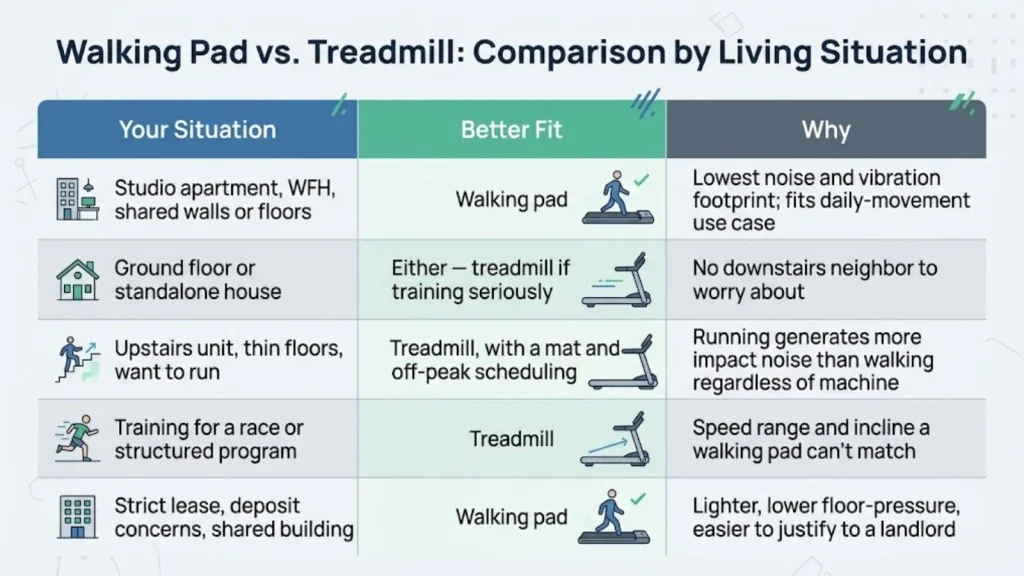
Walking Pad vs Treadmill: Recommendation by Scenario
(Editorial judgment based on the factors above, not a formal scoring system.)
FAQ
Will my downstairs neighbor hear my walking pad?
Maybe, even with a quiet motor — footfall vibration travels through the floor structure separately from airborne noise. A mat under the machine reduces that risk.
Do I need landlord permission for a treadmill in my apartment?
Depends on your lease. Some include weight restrictions or damage clauses that apply here — check before you buy, not after.
Can a walking pad damage my floor?
On softer surfaces like laminate or vinyl, yes, over time, if the machine’s feet create concentrated pressure points. A load-distributing mat lowers that risk.
Is a walking pad loud enough to need headphones during calls?
At normal walking speed, most are quiet enough for calls — though you’ll notice the sound more in a silent room than a noisy one.
What’s the quietest walking pad for apartments?
Look for a stated dB rating at your intended walking speed, not a vague “quiet operation” claim, and check whether reviewers specifically mention footfall noise, not just motor sound. Our comparison of quiet walking pads for apartments narrows it down.
Can I put a treadmill on a second-floor or upper apartment?
Usually, yes — standard residential floors handle typical equipment loads fine. In an older building or one with unusual construction, checking with property management is the safer move. Noise and your lease terms are the bigger practical concerns, not structural safety.
The Bottom Line
The spec sheet tells you which machine is faster or smaller. It won’t tell you whether your downstairs neighbor knocks on your door, or whether your move-out inspection costs you part of your deposit. Answer those two questions first — how noise travels through your building, and what your lease actually says — and the walking pad vs treadmill choice gets easier.
Pingback: Walking Pad Weight Loss: Real Calories Burned Per Hour - Small Space Strength
Pingback: Best Walking Pad Under $300 (2026): 3 Picks - Small Space Strength
Pingback: Walking Pad with Incline: Manual vs. Auto, Explained (2026)