
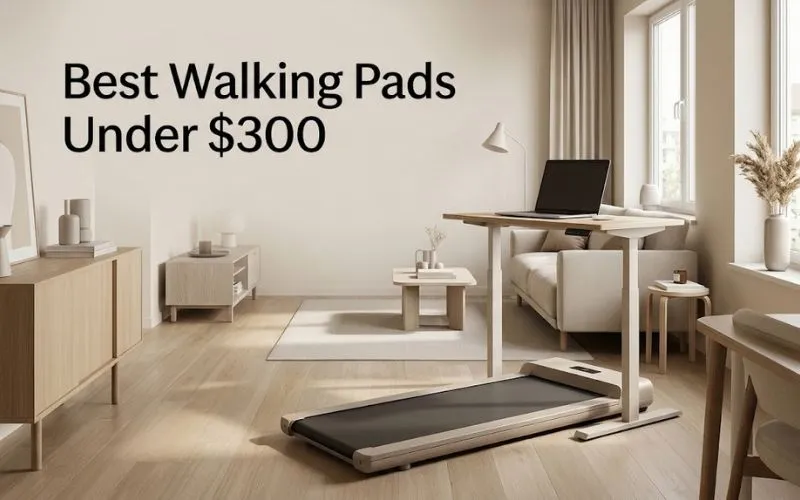
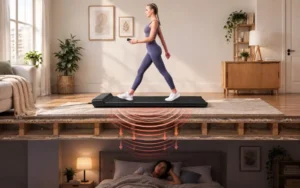
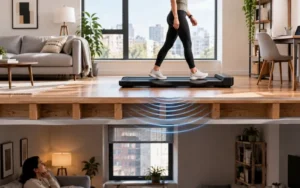
Finding the best walking pads under $300 sounds simple until you actually start comparing listings — prices shift week to week, specs vary between near-identical SKUs, and last year’s budget pick may now cost $500. A walking pad looks harmless, almost like a yoga mat with ambitions, but the motor and belt both touch the floor, and in a rented apartment that matters more than the spec sheet usually lets on.
Three picks below, each verified against current listings. They’re category winners on different criteria, not one ranked list — which one is right for you depends on your weight, your space, and whether you want to walk, jog, or run.
Quick Answer: Best Walking Pads Under $300
- Best overall: WalkingPad Z1 — $299, brushless motor rated below 65 dB, folds to about 5.4″ tall
- Best for higher capacity or incline: DeerRun 4-in-1 — around $199, 300 lb capacity, variable incline, runs up to 7.5 mph
- Best for running versatility: GoPlus 2-in-1 — roughly $119 depending on the exact listing, 265 lb capacity
What Changes Above $300
Above $300, belts get wider, top speeds climb, and warranties tend to get longer. Under $300, the core mechanism — a flat belt moving at walking pace, controlled by a remote — is largely the same technology across the price range. What you give up is usually speed range and belt width, sometimes warranty length. The Z1 below is the exception worth noting: its belt is nearly as wide as some pricier models. If you’re weighing a full-size machine instead, see our breakdown of treadmill vs walking pad on cost.
Evaluating a Walking Pad for Apartment Use
Floor vibration and wall noise. A manufacturer’s dB rating is a starting point, not the full picture — a machine can be quiet at the motor and still transmit vibration through a hard floor. Brushless motors generally run with less mechanical friction than older brushed motors. One caveat: dB testing isn’t standardized across brands (distance, speed, and conditions all vary), so treat published figures as directional, not as an apples-to-apples comparison.
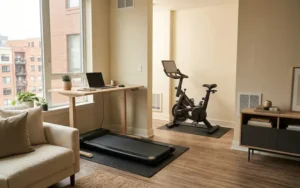
Real folded footprint. “Foldable” doesn’t tell you much on its own. What matters is whether it actually slides under your bed frame or has to stand out in the open because it’s too tall.
What’s a real trade-off at this price, and what isn’t. A narrower belt affects taller users daily. A missing touchscreen usually doesn’t affect anyone.
Weight capacity with headroom. A listed capacity is a ceiling, not a comfortable operating range. Pick a model with room above your actual weight, not one you’d be pushing right up against.
Best Overall: WalkingPad Z1
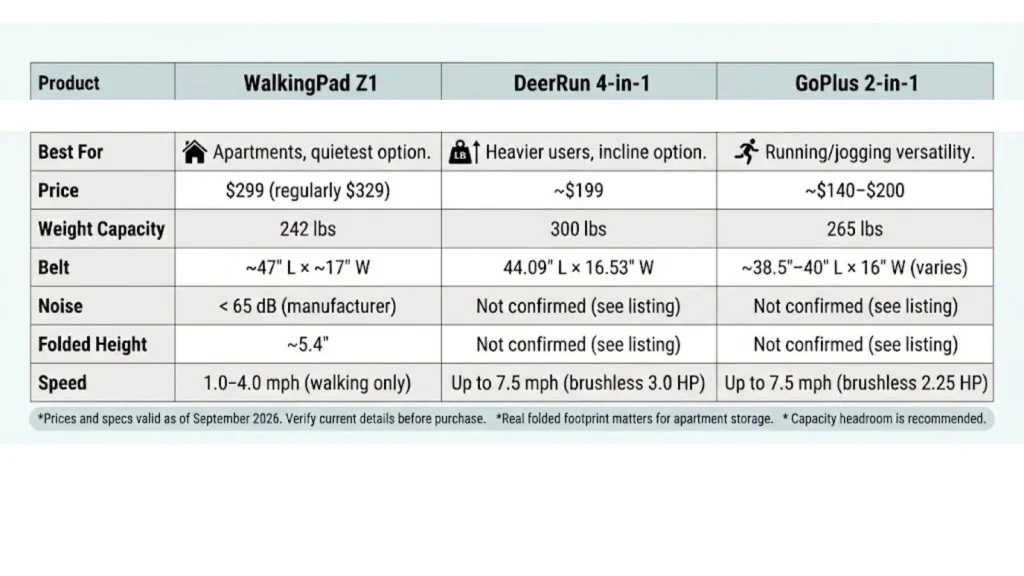
| Price | $299 (regularly $329, per WalkingPad’s official site — right at this article’s ceiling, so reconfirm before buying) |
| Weight capacity | 242 lbs |
| Belt | ~47″ long (sources give 47.2″–47.6″) |
| Noise | Below 65 dB, per manufacturer |
| Folded size | ~31.8″ × 22″ × 5.4″ |
| Speed | 1.0–4.0 mph, walking only |
Among the three picks here, the Z1 has the lowest published noise rating and the widest belt — an unusual combination at this price. It ships fully assembled and folds flat enough to slide under a bed or sofa.
Trade-off: No running mode, and 242 lbs is the lowest capacity of the three. If either rules you out, keep reading.
Best for Higher Capacity or Incline: DeerRun 4-in-1
| Price | ~$199 (per a September 2026 independent review — verify current price) |
| Weight capacity | 300 lbs |
| Belt | 16.53″ × 44.09″ |
| Motor | 3.0 HP, variable incline, up to 7.5 mph with handlebar raised |
If you’re near or above the Z1’s 242 lb ceiling, or you want incline as an option, this is the clearer pick. It’s also one of the few walking pads in this range with real running capability alongside incline.
Trade-off: Belt is narrower and shorter than the Z1’s. DeerRun also sells several similarly-specced models (Q1, Q2, Urban Plus) at different capacities — confirm you’re looking at the 4-in-1, 300 lb version specifically.
Best for Running Versatility: GoPlus 2-in-1
| Price | ~$119, varies significantly by listing |
| Weight capacity | 265 lbs |
| Belt | ~38.5″–40″ × 16″, varies by listing |
| Motor | 2.25 HP; reported speeds range from 0.6–3.8 mph to 0.6–7.5 mph depending on the specific model |
This is the only one of the three that functions as a genuine light jogging treadmill as well as an under-desk walker, generally at the lowest price of the group.
Trade-off: Warranty on this line has been reported as short as 90 days on some listings. Given the SKU confusion above, read the specific listing closely rather than assuming it matches what’s here.
If you can stretch your budget, walking pad models up to $500 add wider belts, higher top speeds, and longer warranties.
Comparison Table
Models That Don’t Actually Qualify
Two names worth flagging specifically because they show up in older “under $300” roundups but don’t currently belong there:
- WalkingPad R3 Hybrid+ — currently around $949. A premium walk-and-run model; any article calling it “under $300” is either outdated or referring to a discontinued predecessor.
- MERACH UltraWalk W60 Plus — regularly $499.99, typically selling for $329.99–$349.99, occasionally $279.99 with a promo code. A capable machine (400 lb capacity, 12% incline), but its normal price sits above this article’s ceiling, and its 53.6 dB noise rating is well above the Z1’s.
If you find either recommended as “under $300” elsewhere, check the publish date.
Who This Tier Isn’t For
Over 300 lbs, none of the three picks here fit — look at higher-capacity machines regardless of price. Want incline as a firm requirement? Only the DeerRun offers it. Want a belt as wide as the R3 Hybrid+’s? That’s a ~$900 purchase, not a budget one.
Will You Actually Use It
Worth asking before you spend $250–300 on anything. The common pattern with home fitness equipment is enthusiasm for a few weeks, then declining use — that’s a general observation, not a specific statistic we’re citing here, and it varies by person.
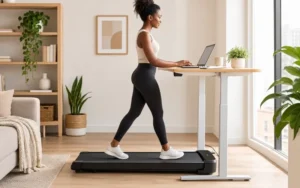
Two things that seem to help regardless of model: keep the pad somewhere visible rather than folded into a closet, and pair it with something you already do daily — answering email, watching a show — instead of treating it as a separate workout you have to schedule.
FAQ
What’s the best walking pad under $300 right now? The WalkingPad Z1 ($299) for most people; the DeerRun 4-in-1 (~$249) if you need higher capacity or incline.
Are walking pads under $300 actually good, or do they break fast? Varies by model. We don’t have long-term reliability data on any of these three specifically — check recent owner reviews on the exact listing you’re considering. For the bigger question of whether a budget model pays off, see our guide on whether walking pads are worth it.
How much weight can a budget walking pad hold? 242 lbs (Z1), 300 lbs (DeerRun 4-in-1), 265 lbs (GoPlus 2-in-1). Capacity varies meaningfully even within this narrow price range, so check the specific model.
Is a walking pad quiet enough for an apartment? The Z1’s below-65-dB rating is the clearest apartment-oriented figure of the three.
Do I need incline, or is flat fine for beginners? Flat is fine for basic walking. Of these three, only the DeerRun offers incline.
Do budget walking pads require assembly? The Z1 ships fully assembled. Confirm assembly requirements for the DeerRun and GoPlus on their specific listings.
What’s the warranty situation on cheaper models? Some GoPlus 2-in-1 listings report warranties as short as 90 days. Confirm current terms before buying, for any model.
Bottom Line
If you just want the best walking pad under $300 today, default to the Z1 unless weight capacity or running matters to you — in which case the trade-offs above already make the call. To compare every pick we’ve tested for apartments, regardless of price, see our full roundup.
Pingback: Best Walking Pads Under $500: Premium Features, No Overpay