
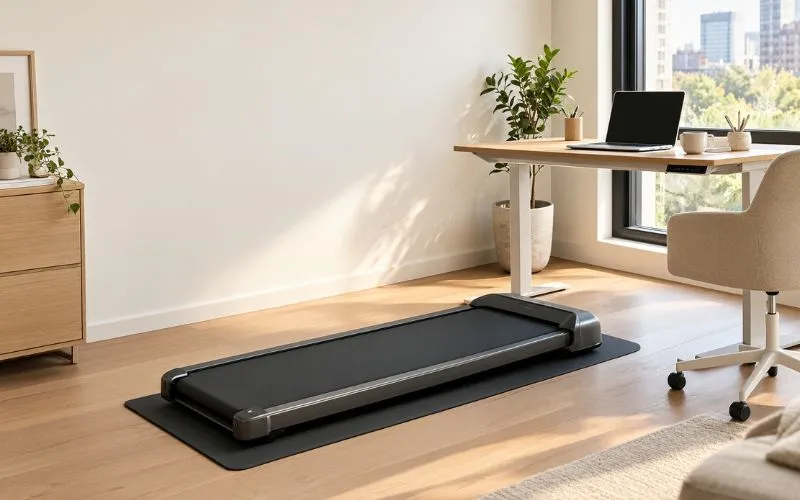
The best walking pads under $500 aren’t necessarily the ones with the longest feature lists. At this price, the bigger differences are motor strength, belt width, noise, vibration control, and how well the machine holds up to regular use.
Quick answer: Prioritize motor power, belt width, and noise/vibration control. Auto-incline and app connectivity are nice-to-haves that don’t correlate with longevity. Get the first three right and a $400 pad will outlast a $700 one with a weaker motor.
What “Premium Under $500” Actually Means
Some listings call anything with a Bluetooth app “premium.” What actually separates price tiers:
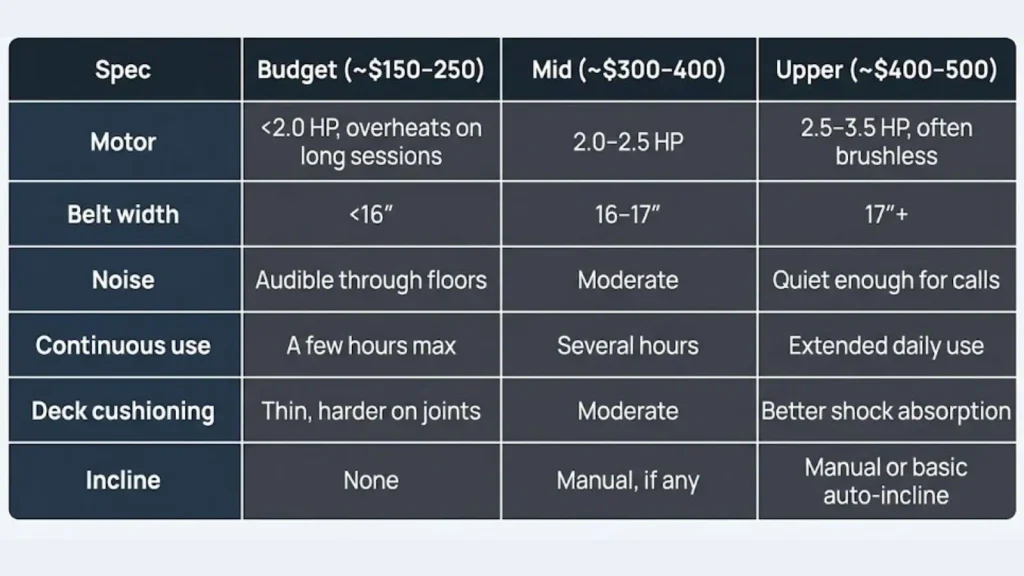
These are general category patterns, not confirmed specs for any single product — verify against the current listing before buying.
For walking (not running), two of these matter more than the rest:
Motor strain and noise beat top speed. A stronger motor isn’t about going faster — it’s about the belt staying steady after 40 minutes instead of straining as it heats up. Belt width matters more than people expect too: a narrow belt feels fine for five minutes and cramped after twenty, especially for taller users or a longer natural stride.
Where the “premium” label is mostly marketing: Auto-incline and detailed app tracking. Auto-incline adds real manufacturing cost, but at typical walking speeds the intensity difference is modest. App connectivity is a convenience, not a durability factor — skip it to protect budget for the motor instead.
Editorial call: If one spec gets the budget, it’s the motor. Everything else is replaceable or skippable; a weak motor is the difference between a machine that lasts and one you’re replacing next year.
How the Best Walking Pads Under $500 Handle Apartment Use
Generic guides talk about “noise and stability” in the abstract. In a shared-wall apartment, the real questions are narrower: will this bother the downstairs neighbor, will it survive the floor, will it fit somewhere you’re not tripping over it.
Noise, in context. For reference: a library runs ~30 dB, normal conversation ~60 dB, a dishwasher ~60–70 dB. Manufacturers often list walking pads in the 40s–50s dB range — but that number varies by model and should be checked against the specific listing, not assumed from the category average.
Noise and vibration are different problems. Decibels measure airborne sound; they say nothing about what travels through the floor to the unit below. A pad can sound quiet in the room and still transmit low-frequency vibration through the subfloor. A dense rubber or foam mat underneath addresses this — budget for it separately, even though it’s not part of the pad’s listed price.
Carpet vs. hardwood. Thick or plush carpet affects belt tracking and stability. If the space has carpet, check the pad’s stated minimum surface requirement and plan on a hard mat rather than relying on the carpet itself.
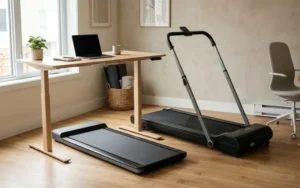
Storage and moving day. A pad that folds flat with built-in wheels stores in a closet or behind a door and moves without help. Measure the folded dimensions before ordering — that’s where buyers in tight spaces get caught out, not the unfolded footprint listed front and center.
Weight Capacity When Choosing a Walking Pad Under $500
A stated capacity tells you the ceiling, not how the motor and belt perform near it. Rule of thumb: look for stated capacity 50–80 lbs above your own body weight. This isn’t just a safety margin — a pad running near its rated max wears faster, so headroom protects the belt and motor, not just the user.
Height matters here too: a longer stride puts more stress on a shorter belt regardless of body weight. If you’re over ~5’10”, check belt length alongside capacity, not instead of it.
Best Walking Pads Under $500 by Use Case
When comparing the best walking pads under $500, matching a pick to what you need—quiet operation, storage, belt length, value, or incline—is more useful than a first-to-fifth ranking. Prices and specs below come from each brand’s and retailer’s current listings and change often; where a number is the manufacturer’s own claim rather than something independently confirmed, that’s noted rather than smoothed over.
Quiet apartment use — WalkingPad Z1
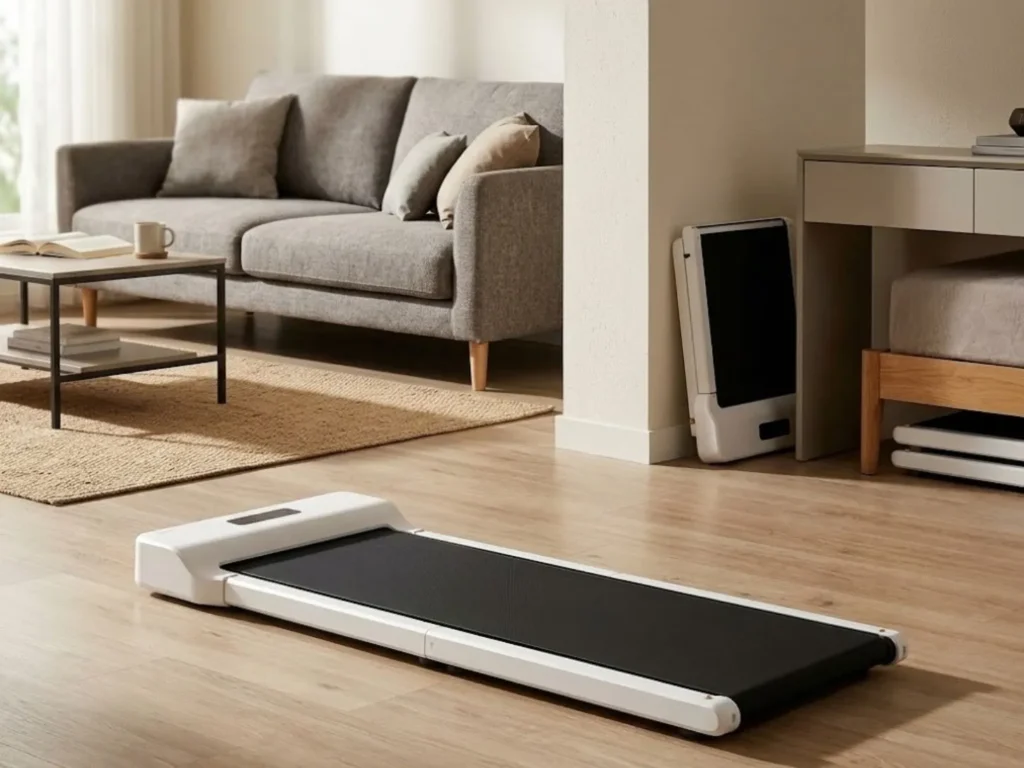
$299 · folds in half (180°) · ~47″ belt · about 243 lb capacity · brushless motor.
WalkingPad rates the Z1 at under 40 dB — that’s the manufacturer’s figure, not an independent lab result, so treat it as “quiet for the category” rather than silent. What sets it apart for shared walls is the combination of a brushless motor and a belt that’s long enough to walk naturally at low speeds, where noise is lowest. Pair it with a dense mat to handle floor vibration, which the dB rating doesn’t cover.
One thing to check before you buy: belt width is listed as 15.8″ on some sources and 17.3″ on others. Confirm it on the live listing, especially if width is your deciding factor.
Taller frames — WalkingPad P1
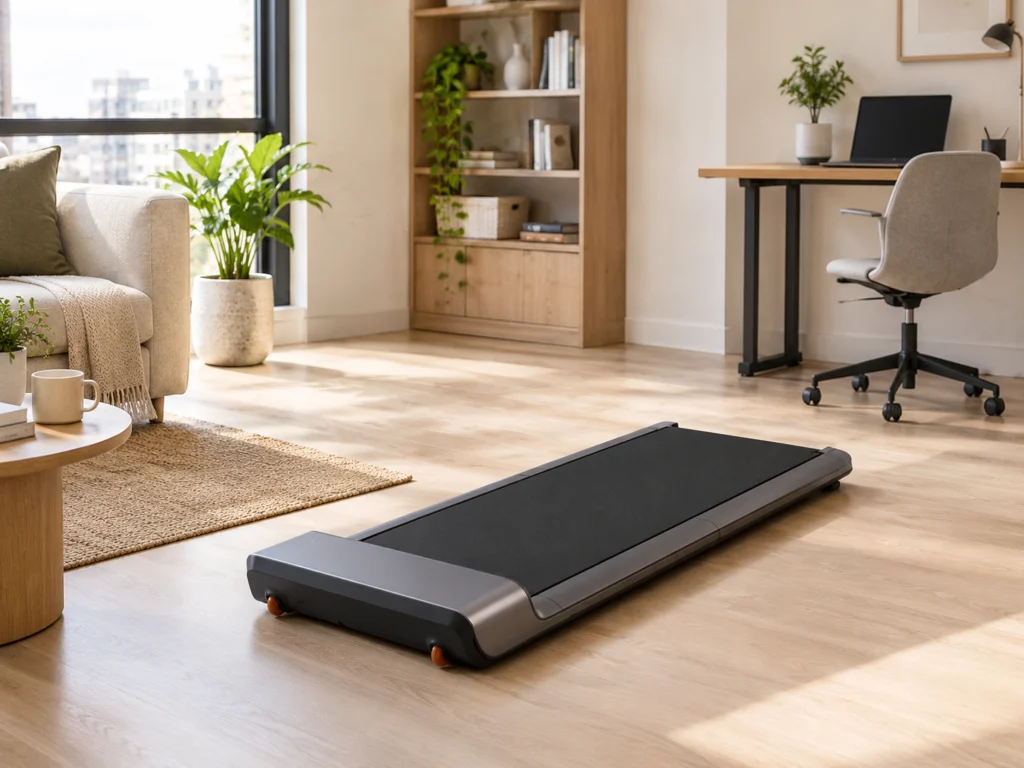
Around $329–$349 depending on retailer · 15.75″W x 47″L belt · 220 lb capacity · 3.7 mph max.
For a longer stride, belt length matters more than almost anything else, and the P1’s 47″ belt is the longest in this lineup. That makes it the pick for anyone over ~5’10”. The trade-offs are worth naming: it’s the one WalkingPad model with a brushed motor rather than brushless, so expect it to be a little louder and less durable over years of heavy use than the Z1. Its 220 lb capacity also leaves less headroom than the other picks here — if you’re both tall and heavier, look at the MERACH W50 below for capacity instead.
Fits under the bed — DeerRun Q2 Urban
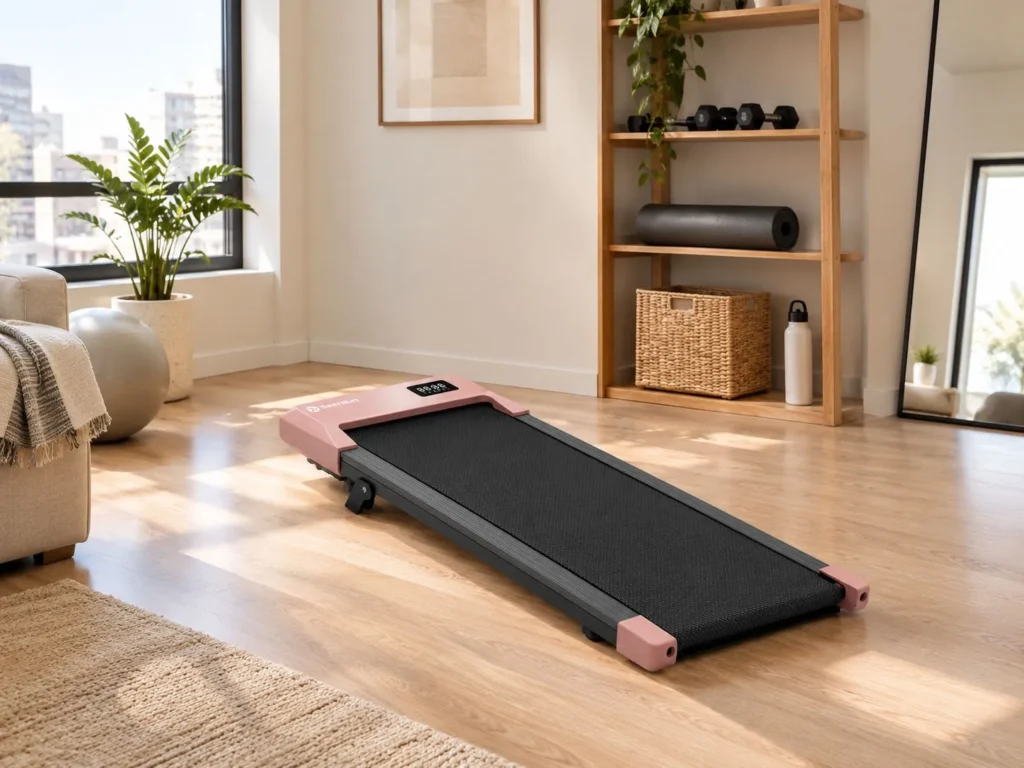
~$239 · 42.9″L x 19.7″W x 3.9″H · 300 lb capacity · 7% manual incline · 3.8 mph max.
At under four inches tall, this is the one that slides under most beds and low sofas — a real advantage in a studio. It’s also the most budget-friendly pick here, which is why the compromises are specific: the belt is on the short, narrow side (roughly 35″ x 15″), so it suits average-height walkers better than taller ones. DeerRun markets the motor as brushless; an independent teardown of this model reported a brushed motor instead, so judge it as a budget pad, not a long-haul workhorse. Measure your clearance before ordering — listed dimensions vary slightly between the brand site and Amazon.
Best value — WELLFIT TM037
~$140 · 36″L x 16″W belt · 320 lb capacity · 0–5% manual incline · up to 6.2 mph · folds flat.
The TM037 is a foldable 2-in-1 with front handrails, which gives you something to hold on to and a walking mode plus a faster running mode — a lot of function for the price. WELLFIT lists the motor at 3.0 HP; that’s a peak figure, and an independent read of the motor label put continuous output closer to 0.75 HP, which is common across this price tier. Keep expectations at daily walking rather than long, heavy sessions. Some buyers also report motor problems after several months and slow returns, so buy through a retailer with an easy return window and use the warranty registration.
Wants incline — MERACH NovaWalk W50
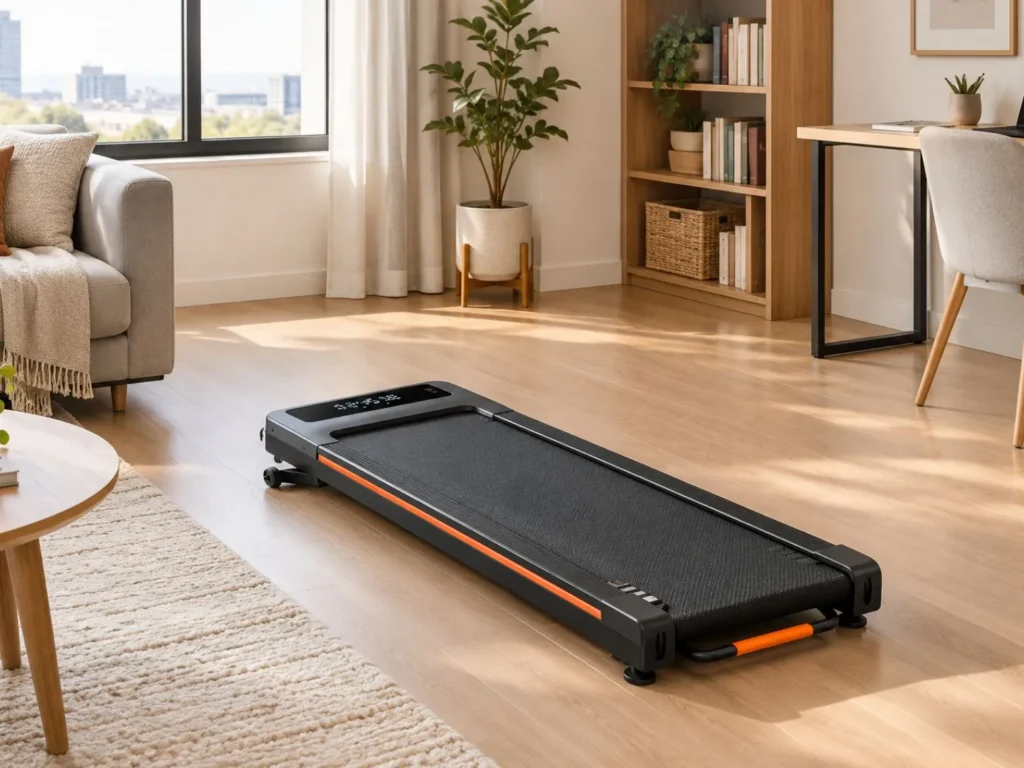
Up to $479.99 on MERACH’s site (often lower on Amazon) · 16.5″W x 41.3″L belt · 400 lb capacity · 12% auto incline · 3.5 HP peak brushless motor.
This is a real automatic incline, not a fixed manual kickstand — up to 12%, controlled from the remote or app. MERACH lists a 3.5 HP peak motor and, unusually, publishes a continuous rating of roughly 1.25 HP alongside it, which is the more useful number for judging real-world strength. The 400 lb capacity and the 15.3 mm reinforced deck make it the sturdiest pick on this list, and MERACH rates it at about 40 dB — again a manufacturer figure. It doesn’t fold, but it rolls on wheels and stores upright, so measure your storage spot first.
Where $500 Is Enough — and Where It Isn’t
Stay under $500 if:
- You’re walking, not running, at a moderate pace
- Auto-incline and detailed app tracking aren’t priorities
- A quiet, durable motor matters more than extra features
- Space and portability matter as much as performance
Spend less? If even $500 is more than you need, there are cheaper options under $300 that still cover the basics.
Spend more if:
- Auto-adjusting incline is a regular part of the workout
- Body weight sits close to the stated capacity even with margin built in
- The pad needs to handle sustained daily use, not intermittent sessions
- Advanced connectivity or granular metrics genuinely factor into training
For apartment-based, walking-focused use, money spent above $500 tends to buy convenience, not durability. For the full lineup across every budget, see our overall top walking pads.
How to Spot a Fake Spec Listicle
Some “best walking pads” roundups name models that don’t correspond to anything actually for sale, attached to suspiciously specific specs. Three checks:
- Search the exact model name — if it doesn’t show up on a retailer or brand site, be skeptical.
- Watch for guides where every “different” brand hits the same round numbers (exactly 2.5 HP, exactly 300 lbs, across five different products).
- Favor sources that link directly to the current retail listing instead of just naming a product.
FAQ
Is $500 enough, or should I spend more?
For walking (not running) at home, $500 is generally enough for a durable motor, a reasonably wide belt, and quiet operation. Spending more tends to buy convenience features like auto-incline, not necessarily longevity.
What HP motor do I need for daily walking?
At least 2.0–2.5 HP. Lower-powered motors are more prone to overheating on longer sessions.
Will a walking pad work on carpet?
It can, but performance is best on firm, flat surfaces. Thick carpet can affect belt tracking — a hard mat underneath is the common fix.
How loud is too loud for a shared wall?
Look for a pad advertised in the 40s–50s dB range, but confirm against the specific listing — that number doesn’t account for floor vibration, which is a separate issue, and manufacturer-stated dB figures aren’t always independently verified.
Are Bluetooth and app features worth paying for?
They’re a convenience, not a performance factor. Reasonable to skip in favor of motor quality if budget is tight.
What breaks first on cheap walking pads?
Underpowered motors and belts run near their weight limit tend to wear out first — a general expectation based on how these machines are built, not lab-tested data.
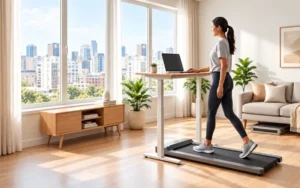
What desk height do I need for use under a desk?
Depends on the specific desk and pad. Measure both — standing desk heights vary enough that assuming fit is a common mistake.
Pingback: Best Walking Pad Under $300 (2026): 3 Picks - Small Space Strength