
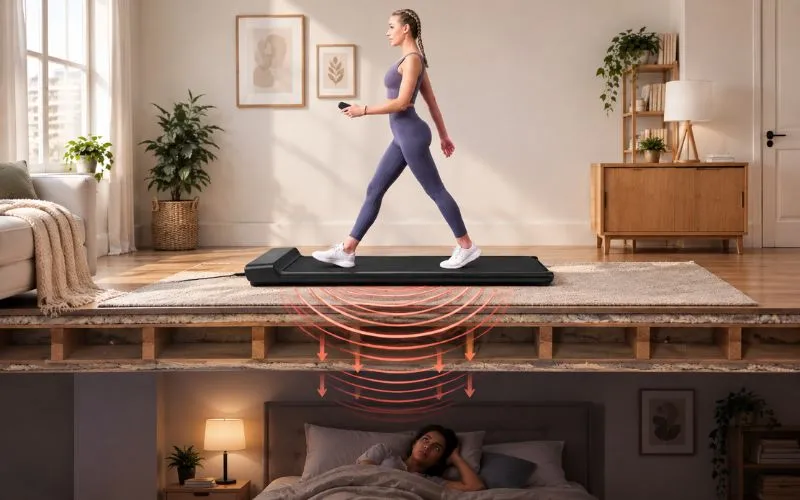
How loud is a walking pad? Usually quieter than you’d expect, sitting in the room with it. But that’s not really the question keeping you up — you’re asking whether the person below you is about to leave a note on your door.
It’s also a different question than the one most product pages answer.
Quick answer: Most walking pads run somewhere between 40 and 65 decibels — in the range of a quiet office or a soft conversation. But that number describes the machine, not your apartment. Footstep impact and floor vibration travel through the building’s structure, not through the air, so a “quiet” walking pad on a bare hardwood floor can still be noticeable downstairs, even when it sounds perfectly reasonable in your own room.
The Real Question: “How Loud” vs. “Will They Hear It”
A decibel rating tells you how loud a walking pad is in the room where it’s sitting. It doesn’t tell you what happens after that sound leaves the room.
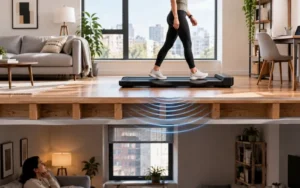
Two separate things are happening when you use a walking pad in a shared building. One is airborne noise — the hum and whir you hear because sound waves are moving through the air toward your ears. The other is structure-borne vibration — the thump of your steps traveling down through the floor, the joists, and into the ceiling of the apartment below you.
A walking pad can be quiet in the first sense and still cause problems in the second. That gap is what most buying guides skip, and it’s usually the part that matters most if you live above someone.
Internal link opportunity: apartment gym setup hub
What Causes Walking Pad Noise?
Walking pad noise isn’t one thing — it’s four different sounds layered together, and each behaves differently.
Motor Hum
The continuous, low background sound the machine makes while running. On a well-functioning unit, it should stay steady — a hum, not a whine or a grind. A rough or uneven motor sound usually points to wear, not normal operation.
Belt Friction
The belt produces a soft whirring sound as it moves. A dry or poorly lubricated belt gets louder over time and can start to squeak — this one is largely within your control through routine maintenance.
Footstep Impact
The part people underestimate. Even a whisper-quiet machine can’t do much about the sound of your body weight landing on the deck with every step. Heavier footfall, hard-soled shoes, and faster paces all increase impact noise — and in most setups, this is louder than the motor.
Floor and Structural Vibration
The one that actually reaches a neighbor. It’s not the same as audible noise — you might barely register it standing in your own living room, while it’s clearly noticeable one floor down, because it’s traveling through the building rather than through open air.
| Noise Source | What It Sounds Like | Who Notices It Most | Fixable? |
|---|---|---|---|
| Motor hum | Steady low hum | You, in the room | Rarely — depends on the machine |
| Belt friction | Whirring or squeaking | You, up close | Yes — lubrication and upkeep |
| Footstep impact | Rhythmic thumping | You and adjacent rooms | Yes — footwear, pace, posture |
| Floor vibration | Dull thud or rumble | Neighbors below | Yes — mats, placement |
How Loud Is a Walking Pad in Decibels?
A number like “50 decibels” doesn’t mean much without something to measure it against.
The decibel scale is logarithmic — it doesn’t behave like a normal number scale. Going from 40 dB to 50 dB isn’t a small step: as a widely used rule of thumb, each 10-decibel increase is roughly perceived as a doubling in loudness to the human ear. So the gap between a 45 dB walking pad and a 60 dB one is bigger than the numbers alone suggest.
Keeping in mind that manufacturers rarely disclose testing distance or speed — so treat these as general comparison points, not precise measurements:
| Sound | Approximate Decibel Level |
|---|---|
| Whisper | ~30 dB |
| Quiet office / most walking pads at a slow pace | ~40–50 dB |
| Normal conversation | ~60 dB |
| A walking pad at a brisker pace | ~60–65 dB |
| Vacuum cleaner | ~70–75 dB |
Ambient noise in a quiet living space is often lower than even a “quiet” walking pad — one reason a machine can feel unremarkable to you and still register as a change in background sound elsewhere in the building. None of this sits in a range associated with hearing risk; the concern here is neighbor courtesy, not hearing safety.
Two walking pads both marketed as “40 to 50 decibels” can still feel different in practice. The spec range hides more than it reveals — which is why flooring and footstep habits end up mattering as much as the machine itself. If noise is your main filter, see these walking pads tested for low noise.
How Flooring Affects How Loud a Walking Pad Sounds
The same walking pad can behave very differently depending on what’s underneath it. This isn’t about one machine being louder than another — it’s about how sound and vibration move through different surfaces.
Carpet absorbs a meaningful amount of impact noise and vibration before it reaches the subfloor. Hardwood and laminate are efficient at carrying vibration outward and downward, which is why a walking pad that feels reasonably quiet on carpet can feel noticeably different on bare hardwood.
A concrete slab on a ground floor or over a garage tends to be the lowest-risk scenario — but not because concrete itself is a poor conductor of vibration. Concrete floors between occupied units can actually transmit impact noise quite efficiently. The real reason ground-floor units are quieter is that there’s typically no living space underneath at all. If your concrete floor has a unit below it, don’t assume it’s automatically quiet.
An anti-vibration mat placed under the machine works by interrupting that transfer — absorbing energy before it reaches the floor, rather than eliminating the sound at its source.
| Flooring Situation | General Noise Behavior | Vibration Risk to Unit Below |
|---|---|---|
| Carpet, no mat | Sound and impact are partly absorbed | Lower |
| Hardwood or laminate, no mat | Sound and vibration transfer efficiently | Higher |
| Hardwood or laminate, with anti-vibration mat | Vibration transfer is reduced | Lower |
| Concrete slab (ground floor, over a garage) | Low risk mainly because there’s usually no unit below — not a general property of concrete | Minimal, when there’s no unit below |
This is general guidance based on how these materials commonly behave acoustically, not a lab measurement of a specific walking pad model. For a number specific to your setup, a basic decibel meter app can give you a rough reading in your own space.
What You’ll Actually Hear, By Living Situation
The honest answer to “how loud is a walking pad” depends less on the machine and more on where you’re standing when you ask it.
Walking on a Walking Pad in a Mid-Floor Apartment
The highest-risk scenario. A mat, a moderate pace, and some awareness of the time of day go a long way here. Here’s what changes when you’re upstairs.
Walking Pad Noise on the Ground Floor or Over a Garage
Lower risk by default — there’s usually no living space directly beneath you for vibration to reach.
Using a Walking Pad Near a Partner or Sleeping Baby
Here, airborne noise matters more than structural vibration. Placement relative to a bedroom or nursery is the bigger factor, though a mat still helps take the edge off.
Walking Pad Noise in a House With Shared Walls
Vibration is less of a concern, but motor and belt sound can still carry through a shared wall during a quiet moment, like a call.
Example: Walking at a brisk 3 mph on bare hardwood in a second-floor unit is a far more likely source of a knock on the door than a slow, desk-pace walk on carpet. Same machine, very different outcome.
How to Make a Walking Pad Quieter
A few habits make more difference than most people expect:
- Use a thick anti-vibration mat underneath the machine. Generally the single most effective fix for structural noise.
- Choose soft-soled shoes, or walk in socks if the deck’s grip allows it. Softer footwear reduces impact noise at the source.
- Avoid heavy heel-striking and keep your pace moderate rather than consistently pushing toward the machine’s top speed.
- Keep the belt clean and lubricated on the schedule the manufacturer recommends.
- Check your lease or building rules for posted quiet hours. These vary by building and city — confirm your own rather than assuming a standard window.
- Position the machine away from shared walls or floors where that’s practical.
The Quietest Walking Pads for Apartments
If you’re shopping with noise specifically in mind, a few models are worth a closer look. Rather than repeat full reviews here, here’s a short pointer to where the deeper detail lives:
- WalkingPad C2
- WalkingPad Z1
- WalkingPad P1
FAQ
How Many Decibels Is a Walking Pad? Manufacturer-reported figures commonly fall between roughly 40 and 65 decibels, depending on the model and your walking speed — comparable to a quiet office at the low end and a normal conversation at the higher end. These are manufacturer claims, not independently standardized measurements, so treat them as a general guide.
Is a walking pad quieter than a regular treadmill? Usually, though not always. Walking pads are typically built for lower speeds and lighter-duty motors, which tends to keep noise and impact lower than a full-size treadmill designed for running. A well-built treadmill can still outperform a cheaper walking pad, so this is a general tendency, not a rule.
Will my downstairs neighbors hear my walking pad? It depends more on your flooring and pace than on the machine itself. Hardwood without a mat, at a faster pace, is the scenario most likely to be noticeable below you. Carpet, a mat, or a ground-floor unit make it far less likely.
Does walking pad noise get worse over time? Belt noise can increase if the belt isn’t kept clean and lubricated. A sudden grinding or rattling sound usually signals something needs attention, not normal wear.
Can I use a walking pad during a work call? Often, at a slow and steady pace — the motor hum tends to sit below what most microphones pick up. This varies by machine and mic sensitivity, so test it on a low-stakes call before relying on it for anything important. Faster paces and heavier footfall make it harder to stay unnoticed.
Will it wake a sleeping baby or partner in the next room? Airborne noise is the relevant factor here, not floor vibration. Distance from the bedroom, a slower pace, and time of day all matter more than the model you choose.
Do treadmill mats actually reduce noise, or just protect the floor? Both. A mat protects flooring from wear, but its main acoustic job is absorbing vibration before it transfers into the subfloor — the part a neighbor below you is most likely to notice.
Conclusion
How loud is a walking pad when you actually live in an apartment? Usually, the machine itself isn’t the biggest concern. Footstep impact, flooring, and vibration often matter more for your neighbor relations than any spec sheet.
Pingback: Can You Use a Walking Pad Upstairs in an Apartment? - Small Space Strength
Pingback: How to Maintain a Walking Pad for Longevity
Pingback: Quiet Walking Pad for Apartment: Best Picks, Compared (2026)
Pingback: Walking Pad vs Treadmill: Best for Small Apartments