
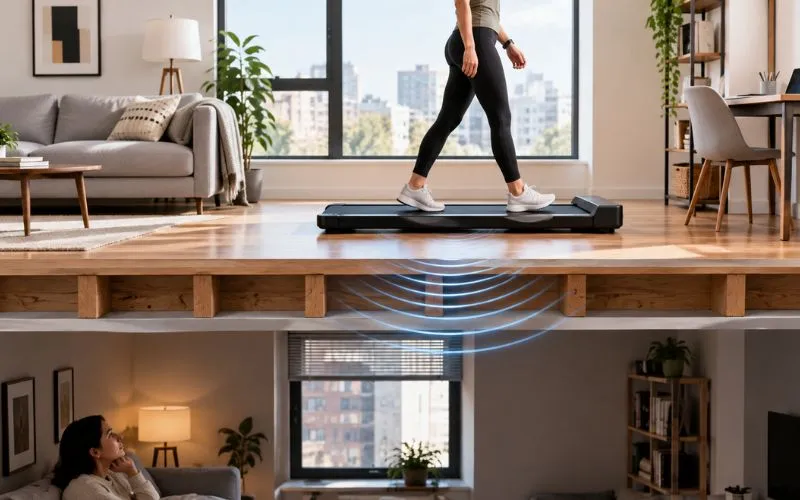
If you’re wondering can you use a walking pad upstairs, the short answer is usually yes. A walking pad can work well in a second- or upper-floor apartment, but the bigger questions are whether your floor can handle the equipment, how much vibration reaches the apartment below, and whether your building has noise or lease restrictions.
If you’ve got a walking pad sitting in your cart and an apartment on the second floor (or the fifth), you’re probably not worried about whether you’ll use it. You’re worried about two other things: whether your floor can handle it, and whether the people below you are about to hate you.
Both are fair questions. Here’s what to know before you set up a walking pad upstairs.
Can You Use a Walking Pad Upstairs? The Short Answer
In most apartments, yes. The bigger concern usually isn’t the walking pad’s weight — it’s vibration and impact noise reaching the apartment below.
Structural load and noise/vibration are two separate questions, and they don’t always track together. A floor can be more than capable of supporting the weight while still transmitting enough impact vibration to bother a downstairs neighbor. The rest of this guide walks through both.
Is a Walking Pad Upstairs Structurally Safe?
This is the part most guides skip past with a reassuring shrug. It’s worth looking at — with the caveat that what follows is general information, not an engineering assessment of your specific apartment.
How Much Does a Walking Pad Weigh?
Compact walking pads are generally lighter than full-size treadmills, which tend to run considerably heavier. Exact weight varies by brand and model, so check the specs of the specific unit you’re considering rather than relying on a category-wide average.
How Much Weight Can an Apartment Floor Handle?
In U.S. residential construction, live-load capacity is commonly referenced around 40 pounds per square foot for many habitable rooms, though the actual figure can differ by room type, local building code, and building age. This is a general orientation point, not a guarantee for any individual apartment — and it isn’t a substitute for a professional assessment if you have specific concerns.
When Should You Double-Check Your Upstairs Floor?
- Older buildings where the floor structure hasn’t been inspected or updated
- Rooms converted from non-living spaces, like an attic or finished garage
- Any floor that already feels soft, springy, or uneven when you walk across it normally
If any of these apply, it’s reasonable to get a professional opinion before placing heavier equipment in that room.
Probably fine vs. worth checking further:
| Probably fine | Worth checking further |
|---|---|
| Floor feels solid underfoot, no noticeable give | Floor has a noticeable bounce or springiness |
| Standard residential construction, no major renovations | Room was converted from a non-living space |
| No cracks, sagging, or sticking doors nearby | Visible sagging, cracked plaster, or doors that stick |
Does Your Building Type Affect Walking Pad Safety Upstairs?
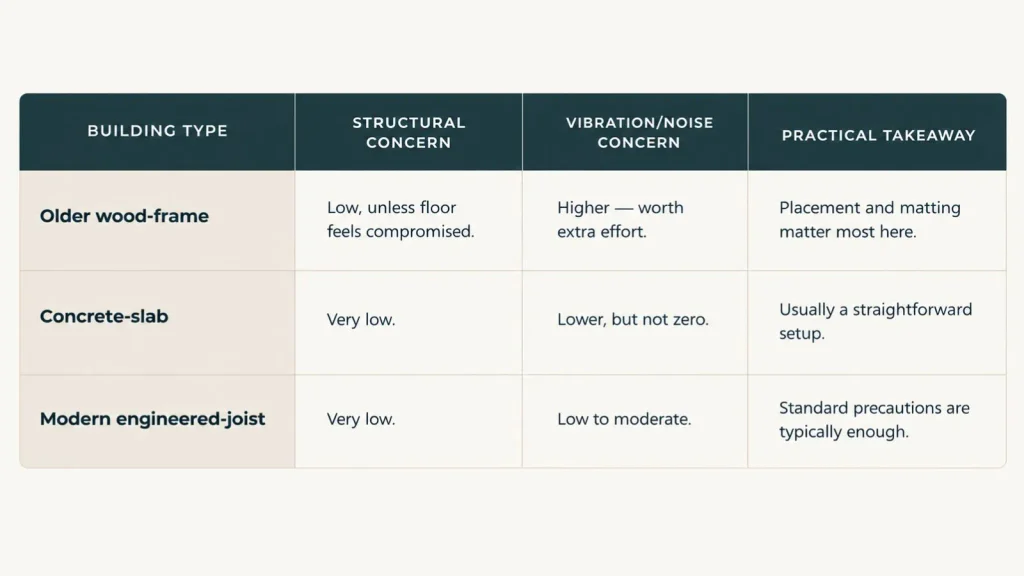
Somewhat — mostly for noise and vibration, less for structural weight.
Walking Pads in Older Wood-Frame Buildings
Wood is generally understood to transmit impact vibration more readily than denser materials, which suggests footstep-style impact may be more noticeable to a neighbor below than in a concrete building.
Concrete-Slab Buildings
Concrete floors are generally considered better at dampening vibration than wood-frame construction. Vibration doesn’t disappear entirely — the building itself is likely doing more of the work of absorbing it.
Modern Engineered-Joist Construction
Often falls somewhere in between, depending on the specific materials and design.
Will a Walking Pad Vibrate the Apartment Below?
Worth separating a few things that get lumped together:
- Motor/airborne noise — the hum of the machine itself, generally minor for most users, especially with a quiet walking pad for apartments
- Footstep/impact noise — the sound of steps landing on the deck
- Structure-borne vibration — impact traveling through the floor into the unit below, generally the more relevant concern of the three
How to Reduce Walking Pad Vibration Upstairs
- Use a dense equipment mat rather than a thin yoga mat
- Walk at a moderate speed rather than a fast one
- Wear supportive shoes rather than going barefoot or in hard soles
- Choose placement strategically (more on this below)
- Avoid hard, direct impact where possible
For more on the acoustic side of this topic, see our companion guide on how loud a walking pad really is and what neighbors actually hear.
Where Should You Put a Walking Pad Upstairs?
Better Placement Options
Near a load-bearing wall, off to the side of a room rather than dead center, on a flat and stable section of flooring.
Places to Avoid
The middle of a room (often the point of greatest flex in a floor span), and directly above a space where a neighbor spends a lot of time — their living room or bedroom, if you know the layout below you.
A dense anti-vibration mat is a natural next step here for anyone finalizing their setup.
What About Lease Rules, Quiet Hours, and Neighbors?
The following is general information, not legal advice — lease terms and local landlord-tenant law vary.
Check Your Lease for Quiet Hours
Some leases include specific quiet-hours language, and separately, most residential leases are also subject to an implied “quiet enjoyment” protection under landlord-tenant law. These are related but distinct concepts, and exact terms vary by lease and jurisdiction — check your own agreement rather than assuming either applies a certain way.
Should You Tell Your Downstairs Neighbor?
A short, friendly heads-up tends to go a long way — letting them know you’ve added a walking pad and asking them to flag it directly if it’s ever an issue. This costs nothing and may help prevent a complaint before it happens.
What Happens If Someone Complains?
Outcomes vary widely depending on your lease, building, and local rules. A conversation or a written reminder from a property manager is a commonly cited starting point in many tenant experiences, but this isn’t a guarantee of how any specific situation will unfold.
Upstairs Walking Pad Pre-Use Checklist
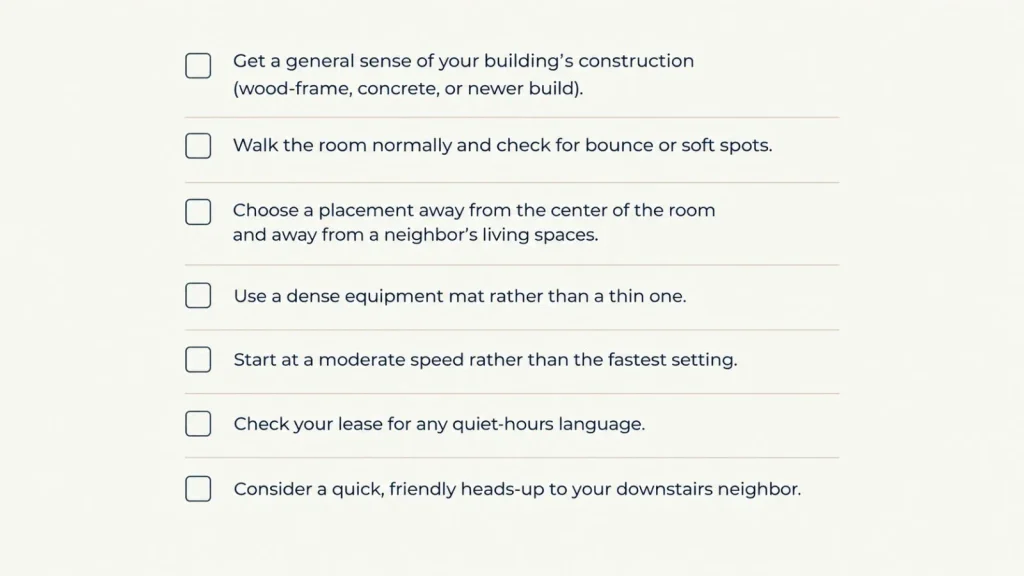
(Pinterest graphic opportunity: vertical checklist asset.)
Best Walking Pads for Upstairs Apartments
If you’re using a walking pad on an upper floor, two things matter more than they do in a typical home gym: how much vibration the machine transfers into the floor and how easily you can store it when you’re finished.
Two models worth considering are the LifeSpan TR1200-GlowUp for its cushioned deck design and the WalkingPad P1 for its compact, folding format.
What We Look For
- Noise and vibration: A cushioned walking surface can help reduce the impact associated with each step, while the machine’s motor and overall construction influence how much sound you hear during use.
- Compact footprint and storage: A low-profile design, transport wheels, or folding mechanism makes it easier to move the walking pad away when you’re finished.
- Walking stability: A stable deck and secure belt can make the machine feel more controlled during everyday walking.
- Apartment-friendly design: Easy setup, manageable weight, and convenient storage are particularly useful when you’re working with limited space or living on an upper floor.
LifeSpan TR1200-GlowUp — Best for Cushioned Walking
The LifeSpan TR1200-GlowUp is worth considering if your priority is a more cushioned walking experience. Its deck cushioning is designed to absorb some of the impact associated with walking, which may make it a useful option when vibration is a concern.
Its larger, more substantial construction also means it isn’t the choice I’d make purely for minimal storage. Instead, it makes more sense for someone who has a dedicated spot for the machine and places greater importance on walking comfort and deck stability.
WalkingPad P1 — Best for Compact Storage
The WalkingPad P1 takes the opposite approach. Its folding design makes it particularly attractive for small apartments where the walking pad needs to disappear between workouts.
Its compact form factor and relatively light weight make it easier to move and store than a bulkier treadmill. If your biggest constraint is floor space rather than floor structure, the P1 is the more space-conscious option.
One important note: Neither walking pad should be treated as a guarantee of zero vibration or noise for the apartment below. Building construction, flooring, walking speed, footwear, and placement can all affect what a downstairs neighbor hears or feels.
For a broader comparison of apartment-friendly models, see our Best Walking Pads for Small Spaces guide.
Frequently Asked Questions About Using a Walking Pad Upstairs
Can you use a walking pad on the second floor of an apartment?
In most cases, yes. Structural weight is generally not the main limiting factor; vibration reaching the unit below tends to be the more relevant consideration.
Will a walking pad damage an apartment floor?
Unlikely under normal conditions, since walking pads are generally lighter than standard treadmills — though very old or already-compromised floors may warrant extra caution.
How do I reduce vibration from a walking pad reaching the floor below?
A dense mat, moderate speed, supportive shoes, and thoughtful placement away from the center of the room may all help. These are general suggestions, not guarantees, since building construction varies.
Is a walking pad quieter than a regular treadmill for apartments?
Generally considered so, since walking pads tend to be lighter with smaller motors — though this varies by individual model.
Can a landlord or neighbor complain about walking pad noise?
It’s possible, as with any household noise. Outright bans on this type of equipment are uncommon in general lease language, which tends to focus more on persistent, unreasonable disturbance — but this varies by lease and jurisdiction. A heads-up conversation with your neighbor may help resolve concerns before they escalate.
What’s the Best Mat for a Walking Pad in an Upstairs Apartment?
A dense, purpose-built equipment mat is generally considered a better choice than a thin yoga or exercise mat for this use.
The Bottom Line: Can You Use a Walking Pad Upstairs?
For most apartment dwellers, using a walking pad upstairs is primarily a question of vibration, placement, and building construction rather than whether the floor can physically support the machine. Use a dense mat, choose your location carefully, start at a moderate speed, and check your lease for noise restrictions.
If you’re still choosing a walking pad, see our Best Walking Pads for Small Spaces guide to compare apartment-friendly options.
Pingback: How Loud Is a Walking Pad? What Neighbors Actually Hear