Search “walking pad weight loss” and the calorie claims scatter everywhere: 90 to 210 an hour on one site, 150 to 200 on another, 400 on a third. None of them show their math, which is exactly why the numbers don’t agree.
They’re not wrong so much as incomplete — each one describes a different person at a different speed, doing a different thing while they walk. The table below uses the same MET-based formula exercise physiologists rely on to estimate calorie burn, broken out by weight and speed, so your walking pad weight loss numbers are based on you specifically instead of a stranger’s average.
Quick Answer
Here’s the realistic range for walking pad weight loss: most people burn 170 to 450 calories per hour, depending on body weight and speed. A 150-pound person at a brisk 3.5 mph burns roughly 305 calories an hour; a 220-pound person at the same pace is closer to 450. If you’re working at a desk while you walk, expect your real number to sit below both — more on why shortly.
Benefits of Using a Walking Pad During Work Hours
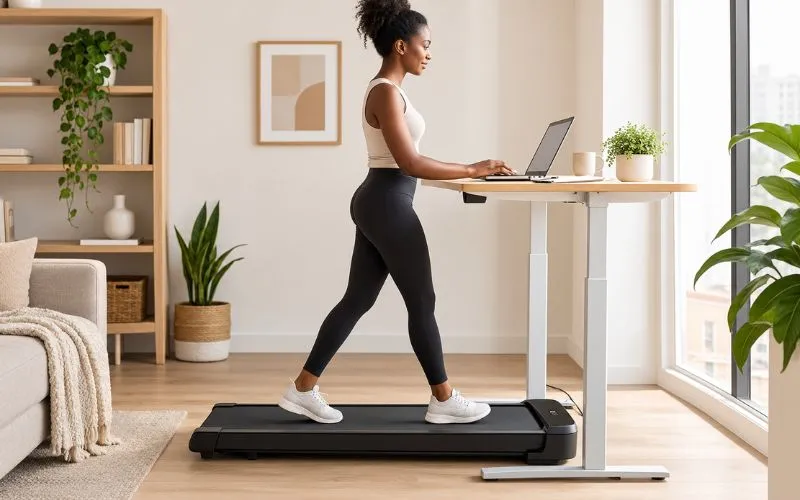
Using a walking pad during work hours makes it easier to add movement to your day without setting aside a separate workout block. A steady, comfortable pace can help you accumulate more daily steps, support calorie expenditure, and reduce the amount of time spent sitting.
The biggest benefit is consistency. Walking during low-focus tasks such as reading emails, joining audio calls, or reviewing documents can turn otherwise sedentary work time into light activity. It is also convenient for people who work from home and may struggle to fit exercise into a busy schedule.
A walking pad may also help you feel more alert during the workday, although the ideal speed depends on the task. Use a slower pace for typing or detailed work, and reserve faster walking for calls or activities that require less concentration. Keep your posture upright, avoid leaning on the desk, and stop if walking affects your balance or work quality.
Remember that desk walking is not identical to a focused workout. Typing and minimal arm movement may reduce your actual calorie burn, so treat the estimates in this article as approximations rather than guarantees.
How Many Calories Does a Walking Pad Burn Per Hour for Weight Loss?
Calorie burn during walking is typically estimated using a MET value — a “metabolic equivalent of task,” or a standard measure of how much energy an activity takes relative to sitting still. A brisk 3.5 mph pace has a higher MET value than an easy 2 mph stroll, and a heavier body burns more calories at any given pace, because moving more mass costs more energy.
The formula:
Calories per minute = MET value × 3.5 × body weight in kg ÷ 200
You don’t need to run this yourself. The table below applies it across five common body weights and four walking speeds.
Estimated calories burned per hour, by weight and speed
| Body weight | 2.0 mph | 2.5 mph | 3.0 mph | 3.5 mph |
|---|---|---|---|---|
| 130 lb | ~170 | ~185 | ~205 | ~265 |
| 150 lb | ~200 | ~215 | ~235 | ~305 |
| 180 lb | ~240 | ~255 | ~285 | ~370 |
| 200 lb | ~265 | ~285 | ~315 | ~410 |
| 220 lb | ~295 | ~315 | ~345 | ~450 |
Estimates assume a dedicated, focused walking session — upright, arms moving, attention on the walk. Stride length, incline, and individual metabolism will shift these up or down.
Speed matters more than most people expect: going from 2.0 to 3.5 mph adds roughly 50–55% more calorie burn at every weight in the table — not a small bump, but the difference between a stroll and an actual workout. Weight matters too, more than most walking pad marketing lets on: at 3.5 mph, a 220-pound walker and a 130-pound walker are separated by more than 180 calories an hour on the identical machine.
Conversion note: if a walking pad's top speed can't hold 3+ mph without wobbling or slowing down, that caps these numbers before you even start. If you're shopping with these numbers in mind, here are the walking pads we'd pick for apartments.
Walking Pad Weight Loss: Why Your Real Calorie Burn May Be Lower
The table assumes you're actually walking — upright, arms swinging, attention on the movement. Most walking pad use doesn't look like that.
Type at a desk, hold a mouse, or lean forward to read a screen, and your stride shortens, your arms go still, and your posture drifts toward stationary. None of that shows up in a MET table, because MET values assume normal, engaged walking form.
No study has measured this specific gap, so treat what follows as an informed estimate rather than a hard number: a desk session at a given speed likely burns noticeably less than a focused walk at that same speed — a modest reduction, not a dramatic one. The point isn't a precise percentage. It's that "3 mph while typing an email" and "3 mph while walking" aren't the same session, even though the display reads identical.
Walking Pad Desk Walking vs. Focused Walking
| Scenario | 150 lb person, 3.0 mph, 60 minutes |
|---|---|
| Focused walk (arms swinging, upright posture) | ~235 calories |
| Desk session (typing, minimal arm movement) | Below that figure — treat the table number as a ceiling, not a guarantee |
To close some of that gap without leaving your desk: straighten up periodically, let your arms move naturally between tasks, and skip leaning on the desk or a railing for support. None of this fully closes the gap, but it narrows it.
How Walking Pad Calories Translate to Weight Loss
Weight loss comes down to a calorie deficit sustained over time. One pound of fat is roughly 3,500 calories — a widely used approximation, not an exact number for every body — which is enough to translate the table above into real, if modest, weekly progress.
Example: A 180-pound person walking 3.0 mph for 45 minutes, five days a week, burns about 1,070 calories a week from walking alone. Over a month, that's a bit more than a pound of fat loss from walking by itself — before diet or any other activity enters the picture.
The walking pad creates the deficit opportunity. Whether it shows up on the scale still depends on what happens at meals.
Walking Pad Weight Loss Plateaus: What Changes Over Time
After some weeks of consistent use, the same pace often starts to feel easier. That's cardiovascular adaptation, and it usually means the identical workout is burning slightly fewer calories than it did in week one. There's no fixed schedule for when this hits — it varies by person.
The fix isn't more time. Bumping speed or incline slightly is a more efficient way to raise calorie burn than adding minutes to a session that's already stopped being a challenge.
Walking Pad vs. Treadmill vs. Outdoor Walking for Weight Loss
All three burn calories the same way — moving body weight over distance — but they differ in what actually keeps someone showing up, which matters more for weight loss than a small gap in calories per hour.
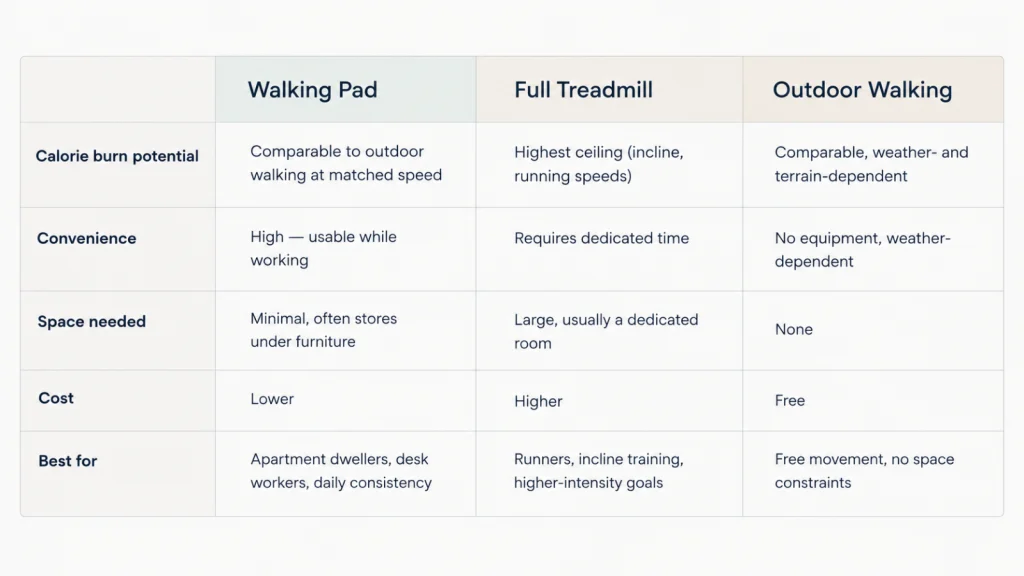
If time and space have been the actual obstacle — not intensity — a walking pad's convenience is likely to matter more for results than a treadmill's higher ceiling. A session done consistently beats one skipped because it required a gym trip. If you're weighing the two for a small space, here's our walking pad vs treadmill comparison for small apartments.
Does Your Walking Pad Affect Weight Loss Results?
To a degree — not because a better walking pad burns more calories on its own, but because it removes the friction that cuts sessions short. A wobbly deck, a motor that struggles past 2.5 mph, or a belt loud enough to bother the next room all push toward shorter, slower sessions than the table assumes.
Worth checking before buying with weight loss in mind:
- Top speed comfortably above 3 mph, so you're not maxed out at your target pace
- A deck wide enough for a natural stride, not a shortened one
- A motor rated for continuous daily use, not occasional light walking
Walking Pad Weight Loss: What to Expect Over Time
Walking pad weight loss doesn't follow a straight line, and knowing roughly what to expect at each stage makes it easier to stay consistent instead of judging progress by the scale alone.
Week 1: Habit-building. The scale usually doesn't move much yet, and it's not supposed to — the goal this week is showing up.
Month 1: At four to five sessions a week, it's common to notice clothing fit loosening or energy leveling out before the scale reflects much. Not universal, but a common early pattern.
Month 3 and beyond: This is typically where consistent use starts showing up as visible change, assuming diet hasn't been working against the deficit. Expect the plateau above to hit somewhere in this window — the response is adjusting pace, not adding time.
These are general patterns for consistent use, not guarantees. If you're still deciding, we break down whether a walking pad is worth the money.
Walking Pad Weight Loss FAQs
How many calories does a walking pad burn in 30 minutes? About half the hourly figure for your weight and speed — a 150-pound person at 3.0 mph burns roughly 115–120 calories in 30 minutes.
Can you lose weight just using a walking pad? Yes, if it sustains a calorie deficit — but the walking pad only creates the opportunity. Diet and overall daily activity decide whether that deficit shows up as weight loss.
Is speed or duration more important for weight loss? Both matter, but once you plateau, increasing speed raises calorie burn more efficiently than adding session length.
Does working while walking reduce calorie burn? Likely yes. Reduced arm movement and a shorter stride while typing or reading a screen mean a desk session probably burns less than a focused walk at the same speed, though nobody has measured exactly how much less.
How many days a week should I use a walking pad to lose weight? Four to five is a common, sustainable target for a meaningful weekly deficit without requiring a drastic daily time commitment.
Is a walking pad as effective as a treadmill for weight loss? At matched speeds, yes — the treadmill's advantage is a higher ceiling for incline and running speed, not a different walking calorie burn.
How long until I see results from a walking pad? No fixed timeline exists, but a common pattern is noticing energy or fit changes within the first month or two, with visible body composition change often taking longer.
Do heavier users burn more calories on a walking pad? Yes — moving more body mass takes more energy, so a heavier person burns more than a lighter person at the same speed and duration.
The Number That Actually Matters
Skip the generic range and use the one in the table that matches your own weight and speed — then adjust it down if you're walking at a desk instead of walking on purpose. That's the real starting point for walking pad weight loss: not a number pulled from someone else's convenience, but one built from your own numbers. When the pace starts feeling easy, that's the plateau, not a sign to quit — nudge the speed, not the clock.