
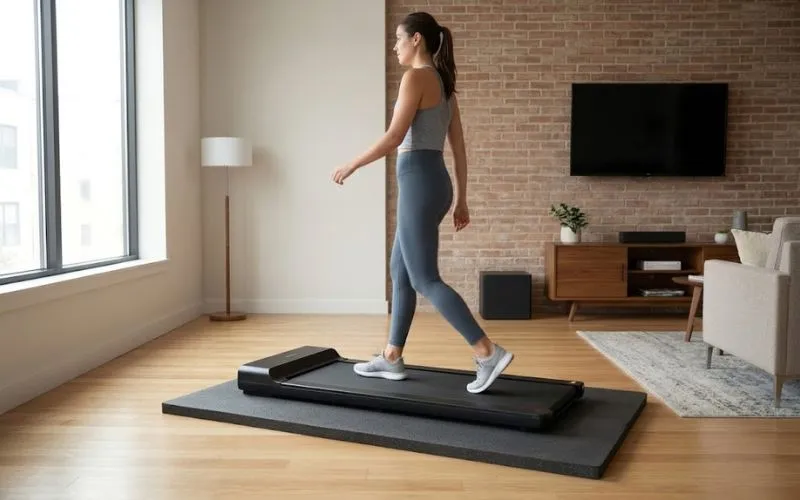
If you’re shopping for a quiet walking pad for an apartment, the real question isn’t “how loud is this machine.” It’s “what does the person below me hear.” Most buying guides answer the first question and ignore the second — which is a problem, because they’re not the same thing.
Walking pad noise comes from two separate sources: the motor, and your feet landing on the belt. A machine can have a quiet motor and still send a dull thump through the floor with every step. Look only at the decibel number on the box, and you’ve solved half the problem — which is exactly why finding a genuinely quiet walking pad for your apartment takes more than checking a spec sheet.
Quick Answer
Your floor matters more than the machine. On hardwood or laminate, a thick shock-absorbing mat does more for your neighbor’s experience than the motor’s dB rating. On a concrete slab, that’s reversed — vibration is less of a concern, so motor noise carries more weight in your decision. A slower, steadier pace helps with both, though how much depends on your specific setup.
If you already know your floor type, skip to the comparison table. Otherwise, the next two sections will tell you which category you’re in.
Quiet Walking Pad for Apartment: Motor Noise vs. Footstep Vibration
These are two different problems with two different fixes, and conflating them is where most buying advice for a quiet walking pad goes wrong.
Motor noise is airborne. It’s the hum you hear standing next to the machine — the number on the spec sheet, the one brands put in bold.
Footstep vibration is structural. Each step sends force down through the frame, into the floor, and potentially into the ceiling below. A microphone doesn’t pick this up the way it picks up motor hum, because it isn’t traveling through the air — it’s traveling through the building. People tend to describe it as a low thump rather than a typical “sound.”
The practical consequence: a walking pad with a genuinely quiet motor can still be a disruptive neighbor if your floor transmits vibration easily. A low dB number tells you about the motor. It tells you nothing about your floor — which is why picking the right quiet walking pad for your apartment starts with the floor, not the spec sheet.
Check Your Floor First
The machine matters less than what’s underneath it.
A rough way to check: have someone stand in the unit below (or a lower floor, if you share a building with family or roommates) while you walk normally across your space. Ask what they notice — nothing, something faint, or something they can actually feel. It’s not a measurement. It’s a gut check before you spend money on the wrong thing.
| Floor Type | Typical Vibration Risk | What to Prioritize |
|---|---|---|
| Hardwood or laminate over wood joists | Higher | Thick mat, slower pace |
| Carpet with padding | Moderate | Mat still helps |
| Concrete slab | Lower | Motor noise matters more |
Building age plays a role too. Older wood-frame construction tends to transmit footstep vibration more readily than newer concrete-and-steel buildings — though this varies enough by individual building that it’s a starting assumption, not a rule. A walk-up with original hardwood throughout is a reasonable candidate to treat as higher-risk by default.
How Loud Is a Quiet Walking Pad, Really?
Decibels are logarithmic, so small differences on paper feel bigger in the room. A 10 dB increase is commonly cited as roughly doubling perceived loudness — the gap between a running refrigerator and a dishwasher is more dramatic than the numbers suggest.
For rough context:
| Sound | Approximate dB (commonly cited) |
|---|---|
| Quiet library | ~30–40 dB |
| Running refrigerator | ~40 dB |
| Normal conversation | ~60 dB |
| Running dishwasher | ~55–60 dB |
A genuinely quiet walking pad for apartment use tends to land somewhere in this range at typical walking speeds — but brand-published dB figures vary widely even for the same product depending on which retailer’s listing you read, and we haven’t independently measured specific models for this piece. Treat any single product’s claimed dB figure as a starting point, not a verified fact. Here’s more on how we read the decibel numbers.
That skepticism is warranted: “whisper-quiet” isn’t a standardized term. It means whatever the brand wants it to mean. A product page with a specific dB number has at least committed to something measurable. A page that only says “whisper-quiet” hasn’t.
Best Quiet Walking Pad for Apartment Use, by Scenario
A flat “top 5” ranking treats every apartment as identical, and they aren’t. What works for a third-floor walk-up with original hardwood is close to irrelevant for someone on a concrete slab who mainly needs the machine to survive six hours a day under a desk.
Note on the figures below: sound levels are brand-claimed unless otherwise noted — we did not independently test these units. Pricing reflects current listings at time of writing and moves often in this category, so verify before you buy.
Best Quiet Walking Pad for Hardwood or Laminate Floors: WalkingPad Z1
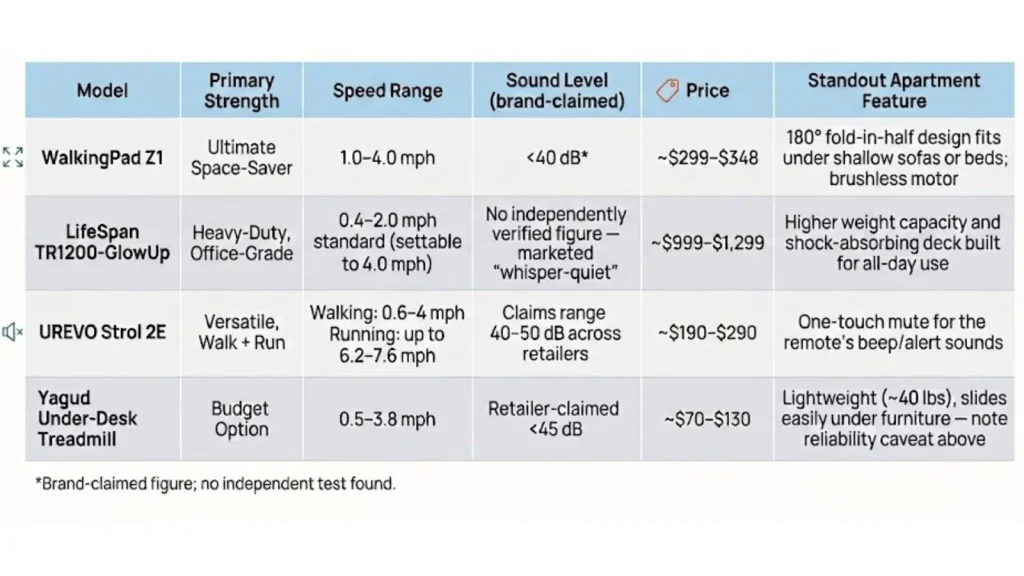
The Z1’s 180° fold-in-half design is the standout feature for apartment use — it collapses to a footprint of about 0.16 square meters, small enough to slide under a bed or a shallow sofa. The brushless motor is marketed at under 40 dB, though that figure comes from the brand rather than an independent test. Speed runs 1.0–4.0 mph, with independent testing measuring the practical top speed closer to 3.7 mph. Runs around $299–$348 depending on retailer.
On this floor type, pair it with a mat regardless — the mat does more for your downstairs neighbor than the motor spec does.
Best for Heavy Daily Office Use: LifeSpan TR1200-GlowUp
This is the outlier in the group: a commercial-grade unit built for up to six hours of continuous daily use, with a higher weight capacity and a more substantial frame than the others. Its official spec sheet lists a standard speed range of 0.4–2.0 mph, settable up to 4.0 mph if configured — worth knowing if you were expecting 4.0 mph as the default. No independently verified dB figure exists for this model; it’s marketed as “whisper-quiet” without a number attached, so we’re not going to invent one. Priced at roughly $999–$1,299, it’s 3–5 times the cost of the other machines here — you’re paying for durability and desk-height design, not a noise advantage over the cheaper options.
Best for Under-Desk Calls: UREVO Strol 2E
A 2-in-1 unit with a genuinely useful feature for apartment/office use: a one-touch mute on the remote that kills the speed-change beep, which matters more than people expect once you’re on a call. Its walking mode runs 0.6–4 mph; a separate running mode extends up to 6.2–7.6 mph, though that upper range is irrelevant to (and worse for) apartment noise, so ignore it for this use case. Retailer-claimed dB figures range from under 40 dB to around 50 dB depending on the listing — inconsistent enough that we’d treat it as “reasonably quiet at walking speed” rather than cite a specific number. Runs about $190–$290.
Best Budget Quiet Walking Pad: Yagud Under-Desk Treadmill
At roughly $70–$130, this is the cheapest of the four, lightweight at around 40 lbs, and easy to slide under furniture. Speed range is 0.5–3.8 mph, in line with the others. Retailers claim “under 45 dB,” though again unverified. One caveat worth flagging: an independent product tracker noted a reliability complaint — a reported motor issue a few months in, with a slow warranty response. That’s a single data point, not a pattern, but at this price point it’s worth going in with reasonable expectations about longevity rather than assuming budget and premium models age the same way.
Comparison Table
Does a Mat Actually Help a Quiet Walking Pad Perform Better?
Yes, and it’s one of the cheaper fixes available — with a caveat worth being specific about.
A mat addresses vibration, not motor noise. It sits between the machine and the floor and absorbs impact energy before it reaches the building structure. It does close to nothing for the airborne hum coming off the motor, because that noise was never traveling through the floor.
What to look for:
- Dense rubber, not thin foam
- Roughly 6mm or thicker — a threshold several buying guides use, not a hard engineering spec
- Sized a bit larger than the machine’s footprint, not an exact match
Placement: where your layout allows it, keep the setup away from shared walls. That reduces how much motor hum reaches the neighboring unit through drywall — a separate fix from the mat, addressing the other noise source.
Five Free Ways to Walk Quieter
Before buying anything:
- Slow down. 2.0–2.5 mph instead of 3.5+. Higher speeds mean more motor noise and harder footstep impact.
- Wear socks or soft-soled shoes. Hard soles strike the belt more sharply than either.
- Aim for a lighter, more even step rather than a heavy stomp — offered here purely as a noise-reduction habit, not a fitness or gait recommendation.
- Move the machine toward the center of the room, away from shared walls, where your layout allows.
- Skip very early morning or late night sessions. The building is quieter then, which means any sound you make is more noticeable, not less.
Already Got a Noise Complaint?
The instinct is to get defensive. Resist it — a short, direct conversation usually resolves this faster than anything else.
Tell the neighbor you’re aware of it, name a specific change you’re making (a mat, a different time, a slower pace), and ask them to flag it again if the problem persists. That’s a more useful message than silence, and it costs you nothing.
On leases: this is general information, not legal advice. Lease terms vary by location, landlord, and individual agreement. Some leases include general “quiet enjoyment” or noise clauses; whether they apply to exercise equipment is case-by-case. If you’re concerned, read your own lease’s noise language or ask your property manager directly — don’t rely on assumptions about what leases “usually” say.
FAQ
How loud is a quiet walking pad in an apartment?
It varies by machine and speed, but a walking pad marketed as quiet for apartment use is often positioned somewhere between a running refrigerator and a normal conversation — a general reference point, not a measurement of any specific product.
Can my downstairs neighbor feel my walking pad even if it sounds quiet to me?
It’s possible. Motor noise and footstep vibration are separate problems, so a machine that sounds quiet in your unit can still transmit noticeable vibration through the floor, depending on your building’s construction. If you’re on an upper floor, our guide to using a walking pad upstairs goes deeper.
Is a walking pad quieter than a regular treadmill?
Generally, yes — walking pads are built for lower speeds and typically use smaller motors than full-size treadmills. Not a guarantee across every model, but a reasonable default assumption.
What speed is quietest for apartment use?
2.0–2.5 mph, generally. Faster speeds mean more motor noise and heavier footstep impact.
Do walking pad mats actually reduce noise?
For vibration, yes — that’s usually the bigger concern for a neighbor below you. For motor hum, not meaningfully.
Will a walking pad violate my lease’s noise clause?
Depends entirely on your specific lease and location — not something to generalize about reliably. Check your own lease or ask your property manager. This isn’t legal advice.
Bottom Line: Choosing a Quiet Walking Pad for Your Apartment
The right quiet walking pad for your apartment isn’t necessarily the one with the lowest number on a spec sheet — it’s the one matched to your floor and how you plan to use it. Add a real mat if you’re on hardwood or laminate. Adjust your pace and placement before you assume you need to spend more money. Those three moves do more for your neighbor relationship than any “whisper-quiet” label on a box. Want to compare more machines? See the full ranking of our top walking pads.
Pingback: How Loud Is a Walking Pad? What Neighbors Actually Hear
Pingback: Can You Use a Walking Pad Upstairs in an Apartment? - Small Space Strength
Pingback: Walking Pad vs Treadmill: Best for Small Apartments