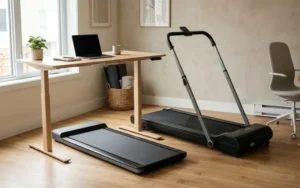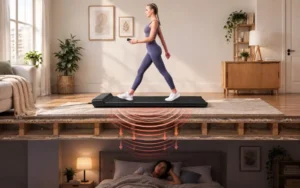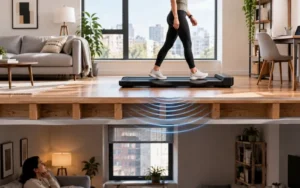
Finding the best walking pads for heavy users takes more than comparing the weight capacity printed on the box. While researching this guide, I found two models from brands I cover whose own pages disagree about how much weight they hold. Neither case means walking pads are unsafe. It means the printed capacity is a starting point, not a guarantee.
This guide covers walking pads from four brands I partner with: WalkingPad, DeerRun, Merach and Wellfit. It’s not a whole-market ranking. If you buy through my links, I earn a commission at no extra cost to you.
Quick answer: If you weigh over 250 lbs, look for a walking pad rated at 300 lbs or higher, with a buffer above your actual weight instead of a rating that sits right at your limit.
Among the brands I cover, the Merach NovaWalk W50 (400 lbs) is the strongest all-round pick on paper. Check the motor’s continuous rating too. A high weight rating on a motor with a low continuous rating is a red flag, not a selling point.
Why Weight Capacity Matters for the Best Walking Pads for Heavy Users
Weight capacity looks like a hard engineering spec. It’s often a marketing number that nobody reconciled with the engineering one.
Take the DeerRun Q1 Classic Pro. DeerRun’s product title says 350 lbs, but the comparison table further down the same page says 300 lbs. A separate DeerRun page for the same pad also lists 300 lbs, while the UK listing says 159 kg, which is about 350 lbs. I haven’t confirmed which figure is current with DeerRun, so treat it as an open discrepancy.
The Wellfit TM032 shows the same pattern. Wellfit’s US product page lists 400 lbs. An older Wellfit blog post says 350 lbs, and the UK page says 160 kg, about 353 lbs. If you weigh 320 lbs, a 50-lb gap between official numbers is worth resolving before you buy, not after.
These are documented cases, not proof that capacity claims are broadly unreliable. But you can’t sanity-check a weight rating from photos or color options. You have to compare what the brand says in more than one place. Search the model name plus “manual” or “spec sheet” and compare it to the retail listing. If they don’t match, plan around the lower number. It takes a few minutes and it’s the most useful thing a heavier buyer can do before checkout.
What to Look for in Walking Pads for Heavy Users
Three things separate a capacity number you can rely on from one that’s mostly marketing:
- Continuous motor power, not just peak. Most brands advertise peak horsepower. The Merach NovaWalk W50 is listed at 3.5 HP peak but 1.25 HP continuous. Peak numbers don’t compare cleanly across brands, so look for the continuous figure when a brand publishes one. If a listing shows only a big peak number next to a high weight rating, ask why.
- Named frame and deck details vs. vague language. “Reinforced deck,” “double-frame construction” and a stated deck thickness give you something to check against reviews and photos. “Durable materials” asks you to take the brand’s word for it.
- Agreement between the brand’s own sources. Retail listing, spec table, manual: when these disagree, the lower number is the safer read.
Best Walking Pads for Heavy Users
These picks come from published manufacturer and retailer specs gathered during research, not hands-on testing. Specs, model naming and pricing change often. Confirm current details before buying.
Best Overall on Paper: Merach NovaWalk W50
The W50 pairs the highest listed capacity in this guide with a real auto incline. Merach describes a reinforced frame and a 15.3 mm reinforced deck, which is more concrete than most brands offer.
- Capacity: 400 lbs
- Motor: 3.5 HP peak, 1.25 HP continuous, brushless
- Belt: 16.5 x 41.3 inches
- Incline: up to 12% auto
- Noise: Merach lists under 40 dB
Tradeoff: At roughly 69 lbs, it’s heavier than most folding pads, so plan for it to live in one spot. The continuous motor rating is modest next to the peak number. One Amazon field also lists 150 kg, so confirm 400 lbs on Merach’s own page before you order.
Best Value: Merach W50 Lite
The Lite keeps the same belt size as the W50 and drops the price. For a 350-lb rating with auto incline, it’s the most affordable option in this guide.
- Capacity: 350 lbs
- Motor: 3.0 HP peak
- Belt: 16.5 x 41.3 inches
- Incline: up to 10% auto
Tradeoff: You give up 50 lbs of capacity and 2% of incline versus the W50. Merach’s page meta description mentions 400 lbs while its spec list says 350, so plan around 350.
Best for a Wider Stride: WalkingPad R3 (330-lb Version)
The R3 has the roomiest belt in this guide, which matters if standard pads leave you feeling cramped. Pick the 330-lb version. WalkingPad also sells a 265-lb variant of the R3 and a hybrid R3 rated lower.
- Capacity: 330 lbs (walking version)
- Motor: 1.0 HP brushless per the spec table
- Belt: 47.2 x 17.3 inches
- Incline: none, flat walking only
Tradeoff: It’s the most expensive pick here, and the spec table lists a modest motor. The marketing copy on the same page quotes a higher horsepower figure, so go by the spec table when you compare.
Best Auto Incline with Handrails: Wellfit TM032
The TM032 is a hybrid: fold the handrails down and it works as a walking pad, raise them for extra stability. If balance on an incline worries you, the handrails are the point.
- Capacity: listed at 400 lbs on Wellfit’s US page, but older Wellfit material says 350 and the UK page says 160 kg. Plan around 350 lbs.
- Motor: 3.5 HP brushless
- Belt: 17 x 44 inches
- Incline: 0-10% auto
Tradeoff: Planning around 350 lbs leaves only about 30 lbs of buffer for someone at 320. If you’re near that weight and use it daily, look at the W50 instead. It’s also bulkier than a flat pad.
Best for Walk-to-Jog: DeerRun A1 Pro Move+
This is the pick if you want to walk at your desk some days and jog on others. DeerRun lists a 350-lb capacity consistently across its store pages.
- Capacity: 350 lbs
- Motor: the page mentions both 3.0 HP and 3.5 HP
- Speed: up to 10 mph
- Incline: 6% manual
Tradeoff: It’s a handrail treadmill at nearly 80 lbs, not a slim under-desk pad. Buyers report the incline is manual, not automatic. DeerRun’s flat walking pads top out at 300 lbs, so this is the only DeerRun pick with a steady 350-lb rating.
Best for Tight Spaces: WalkingPad A1 Pro (300-lb Version)
The A1 Pro folds in half and slides under a desk, bed or sofa, which makes it the easiest pick here to hide in a small apartment. WalkingPad sells it in 230-lb and 300-lb versions, so choose the 300.
- Capacity: 300 lbs (300-lb version)
- Motor: listed anywhere from 1.0 to 2.0 HP depending on the source
- Walking area: 47 x 16.5 inches
- Incline: none listed
Tradeoff: 300 lbs is the floor of this guide, so it leaves little buffer if you weigh near that. It suits people at the lower end of the heavy-user range who value storage over headroom.
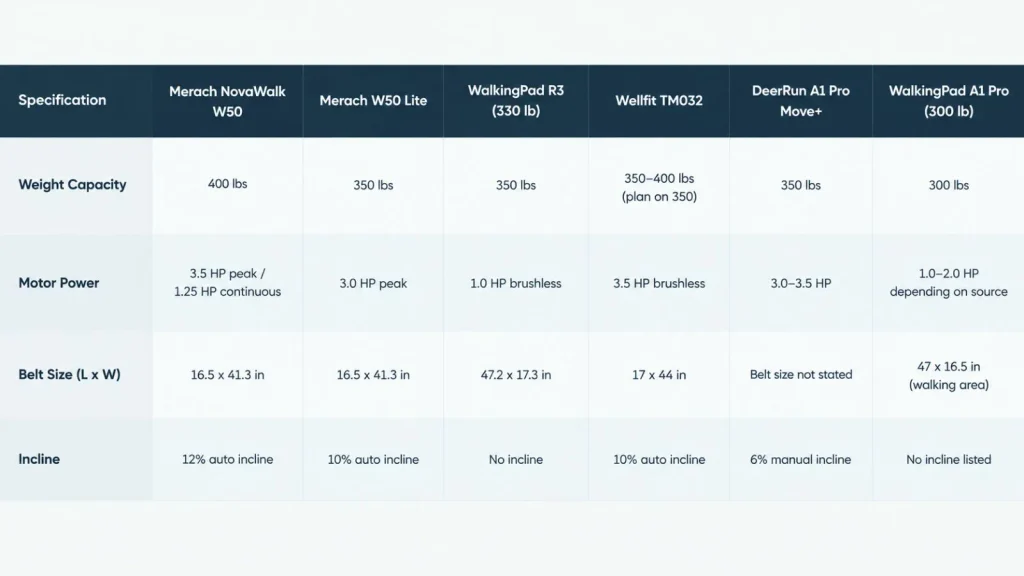
Best Walking Pads for Heavy Users at a Glance
Specs come from retailer and manufacturer listings, not independent testing. Verify with the retailer before you buy.
Choosing a Walking Pad Based on Your Weight and Use
Body weight tells you part of the story. Hours per day tell you the rest.
- Occasional use, under 300 lbs: a 300-350 lb rating is generally enough, because the machine isn’t under sustained daily stress.
- Daily desk use, over 300 lbs, several hours a day: buffer earns its keep here. Aim for a rating 25-50 lbs above your weight, such as the W50 or W50 Lite.
- 300+ lbs with incline or higher-intensity sessions: incline adds load on top of body weight, so look for 50+ lbs of headroom and a motorized incline. The W50 is the best fit in this guide.
How to Maintain a Walking Pad for Heavy Users
- Lubricate on schedule. Heavier daily use generally calls for more frequent belt lubrication. Check your manual for the interval instead of guessing. For the full routine, see my guide to belt care for heavier use.
- Watch for early warning signs. New creaking, belt slippage or visible frame flex deserve attention right away.
- Read the warranty before you buy. Terms vary by brand and model, so know what’s covered before something breaks.
Short on floor space for anything else? My foldable exercise bikes guide covers the next-best option for small apartments.
Best Walking Pads for Heavy Users FAQ
How much weight can a walking pad actually hold?
Among the models in this guide, listed ratings run from 300 to 400 lbs. Cross-check the retail listing against the manufacturer’s manual where you can, because the two occasionally disagree.
What’s a safe weight buffer above my body weight?
No official standard exists. As general guidance, a rating at least 25-50 lbs above your body weight gives the motor and frame margin for daily use.
Do heavier users need a stronger motor, not just a higher weight rating?
As a matter of general mechanical reasoning, yes. But compare continuous horsepower where brands publish it. Peak numbers, like the W50’s 3.5 HP against its 1.25 HP continuous rating, make motors look stronger than they run day to day.
Will a walking pad wear out faster near its max capacity?
Running consistently near the rated limit is generally understood to add more stress than running with buffer. That’s a mechanical principle, not a documented finding about any specific product here.
What’s the difference between “heavy-duty” and standard walking pads?
“Heavy-duty” isn’t a regulated term. A capacity rating with real headroom, a stated frame or deck build and a believable motor rating are the concrete indicators. The label itself isn’t.
Are wider belts necessary, or just marketing?
For larger frames or longer strides, a belt around 17 inches wide or more is generally more comfortable and may reduce the chance of stepping off the edge. I’m not aware of data quantifying that safety benefit. It’s a reasonable preference, not a strict requirement.
Which brands are most transparent about real capacity?
It varied by model, not consistently by brand. Checking a specific model’s manual against its listing beats trusting a brand name across its whole lineup.
Final Takeaway: Choosing the Right Walking Pad for Heavy Users
Skip the instinct to buy whichever number is highest on the page. Weigh capacity, continuous motor power and your actual use pattern together, and check that a brand’s own numbers agree before you commit. For most people over 250 lbs using a pad daily, that points toward a 350-400 lb rating confirmed against the manual, not just the listing. Within the four brands I cover, the Merach W50 is where I’d start. If you weigh under 300 lbs, my general apartment picks cover more options.